
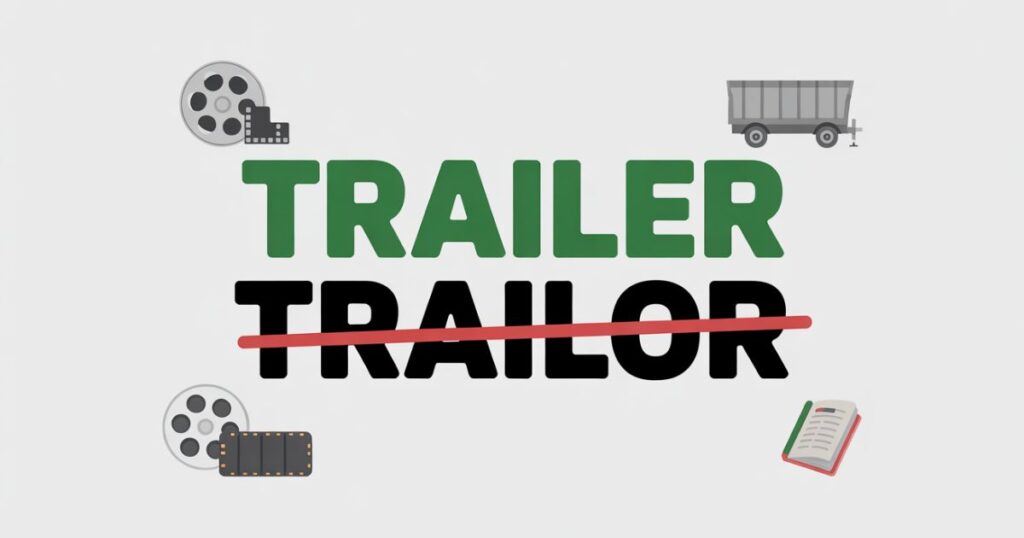
Ever found yourself hesitating mid-sentence, wondering if you’ve been spelling a word wrong your entire life? You’re not alone. The spelling confusion between “trailer” and “trailor” trips up countless Americans daily. This isn’t just about looking silly online incorrect spellings damage your professional credibility and writing accuracy faster than you’d think.
Let’s settle this once and for all. Understanding the correct spelling of trailer matters whether you’re writing formal documents, crafting blogs, or simply texting friends. This comprehensive guide breaks down everything about trailer vs trailor, so you’ll never second-guess yourself again.
The Correct Spelling – “Trailer”
Definition and Usage of “Trailer”
Here’s the straightforward answer: “Trailer” is the only correct spelling. Period. No exceptions exist anywhere in the English language. Merriam-Webster and the Oxford Dictionary both confirm this without ambiguity.
The trailer definition encompasses multiple meanings. It’s a vehicle towed behind another. It’s also a movie preview showcasing upcoming films. Additionally, it describes mobile homes where millions of Americans reside. Each context uses the identical spelling “trailer.”
The word origins and etymology trace back to the early 20th century. The term literally means something that “trails” behind. Simple, right? That’s why remembering becomes easier when you notice “trail” sitting inside “trailer.” This phonetic spelling follows logical English spelling rules perfectly.
Common Usage in Different Contexts
Trailer appears across vastly different situations daily:
Transportation: Semi-trailers dominate American highways. Boat trailers crowd marina parking lots. U-Haul trailers help families move coast-to-coast. The vehicle trailer meaning remains consistent a towed apparatus carrying cargo.
Entertainment: Hollywood revolutionized cinema marketing with movie trailers. Netflix drops trailers generating millions of views. Game developers tease upcoming releases through cinematic trailers. The movie trailer meaning has evolved into essential promotional content.
Housing: Trailer parks provide affordable housing solutions nationwide. FEMA trailers offer temporary shelter during disasters. Luxury RV trailers enable nomadic lifestyles. The vehicle terminology expanded beyond simple transportation decades ago.
Technology: YouTube channels premiere trailers constantly. Sci-fi film franchises build anticipation through carefully crafted previews. Television show networks compete for viewer attention with strategic trailer releases.
| Context | Example Usage | Common Phrase |
|---|---|---|
| Vehicle | Commercial hauling | “Semi-trailer truck” |
| Entertainment | Film promotion | “Movie trailer premiere” |
| Housing | Residential | “Mobile home trailer” |
| Gaming | Marketing | “Game trailer reveal” |
Historical Background of “Trailer”
The 1910s brought the first recorded usage. Early automobile enthusiasts attached simple carts behind vehicles. These contraptions literally “trailed” behind hence the name stuck permanently.
Hollywood co-opted the term brilliantly. Early film promoters showed “trailers” after features concluded. Audiences would trail out while previews played. Eventually, studios moved them before main attractions. The name remained despite the repositioning.
Cinema marketing transformed trailers into art forms. Modern trailers cost millions to produce. They generate massive social media engagement. The movie preview definition now encompasses sophisticated storytelling techniques compressing narratives into two-minute spectacles.
Why “Trailor” Is Incorrect
Common Spelling Mistakes
“Trailor” doesn’t exist. Never has, never will. Yet search engines register thousands typing it monthly. Why does this trailor misspelling persist so stubbornly?
Our brains recognize patterns automatically. Words ending in “-or” seem familiar: sailor, tailor, jailor. That pattern recognition backfires here. We transpose letters unconsciously, creating nonexistent variations. Spelling mistakes in English often follow these predictable pathways.
Autocorrect doesn’t always catch this error either. Many basic spell-checkers miss subtle transpositions. That’s why proofreading remains irreplaceable despite technological advances. Improving writing accuracy requires human vigilance beyond automated tools.
The Role of Homophones
Homophones are words sounding identical but spelled differently. Think “their,” “there,” and “they’re.” Or “affect vs effect examples” that confuse even experienced writers. These English homophones create massive spelling confusion.
“Trailer” and “trailor” represent a different problem though. They’re not true homophones because “trailor” isn’t a word. However, people treat them like homophones mentally. Your ears can’t distinguish what doesn’t exist. That’s why pronunciation of trailer alone won’t guide correct spelling.
Common homophone mistakes plague English constantly:
- “Loose vs lose confusion” trips up writers daily
- “Their vs there vs they’re” remains eternally problematic
- “Your” versus “you’re” still generates errors
- “Accept” versus “except” causes headaches
- “Its” versus “it’s” confuses professionals regularly
Why “Trailor” Doesn’t Exist
Check any reputable dictionary. Search Merriam-Webster exhaustively. Consult Oxford meticulously. You’ll find zero entries for “trailor.” It’s not British spelling. It’s not regional dialect. It’s not archaic usage.
The dictionary spelling of trailer remains unchanged across centuries. No linguistic authority recognizes “trailor” as legitimate. This isn’t debatable or subjective. It’s simply a spelling error nothing more complex.
Common Confusions and Mistakes
Why People Get Confused Between the Two Words
Several factors contribute to this persistent confusion:
Pattern interference: Words like “sailor” and “tailor” end with “-or.” Our memory systems assume “trailor” follows similar rules. This language confusion words phenomenon affects even native speakers.
Speed typing: Fingers move faster than conscious thought. We transpose letters creating accidental variations. These phonetic spelling errors multiply when we rush through writing.
Lack of reading: People reading extensively encounter correct spellings repeatedly. That visual reinforcement prevents future mistakes. Reduced reading habits mean weaker spelling intuition overall.
Other Similar Confusions in the English Language
English spelling frustrates learners and natives alike. Consider these commonly confused words:
“Definitely” not “definately”: Break down the root word “finite” for clarity.
“Accommodate” requires double letters: Two C’s and two M’s always.
“Separate” contains “a rat”: Weird memory trick, but surprisingly effective.
“A lot” is two words: “Alot” never appears correctly written.
These frequently misspelled words share common traits. They violate expected phonetic patterns. They contain silent letters. They resemble other legitimate words closely. Understanding these patterns helps avoid common writing mistakes systematically.
Key Differences in Pronunciation and Spelling
The Correct Pronunciation of “Trailer”
The pronunciation of trailer follows straightforward rules: TRAY-ler. Emphasis lands firmly on the first syllable. The second syllable gets reduced to a quick “ler” sound.
Phonetically, it’s written /ˈtreɪlər/ in IPA notation. Regional accents create minor variations. Southern drawls might extend vowels slightly. Northeastern accents might clip endings shorter. Regardless, the fundamental difference in pronunciation trailer versus imagined “trailor” doesn’t actually exist.
Practice these sentences aloud:
- “We need a trailer to move these boxes.”
- “The movie trailer was full of suspense and excitement.”
- “The truck was hauling a trailer filled with supplies.”
Why “Trailor” Doesn’t Match the Pronunciation
If “trailor” existed, it would suggest a different sound pattern. Words ending in “-or” typically emphasize that final syllable differently. Compare “sailor” (SAY-lor) where both syllables receive nearly equal stress.
Phonetic spelling would favor “trailer” based purely on sound. The “-er” ending matches how Americans actually pronounce it. This demonstrates why word pronunciation vs spelling sometimes conflicts, but here they align perfectly.
Difference Between Trailer and Trailor
What’s the Real Difference Between “Trailer” and “Trailor”?
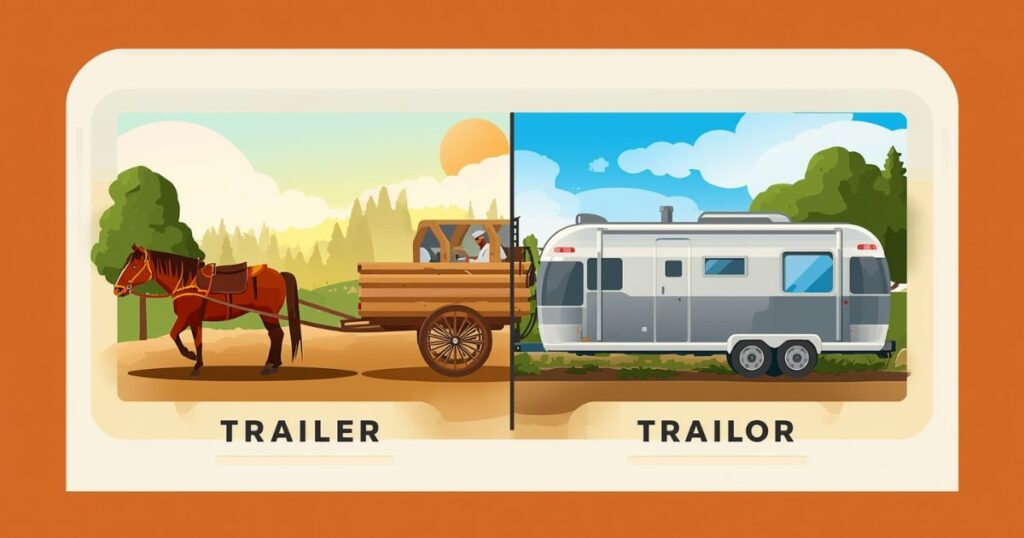
This question contains a trick premise. There’s no actual comparison because “trailor” doesn’t exist. It’s like asking the difference between a unicorn and a horse. One exists; one doesn’t.
| Aspect | Trailer | Trailor |
|---|---|---|
| Dictionary Entry | ✅ Yes | ❌ No |
| Correct Spelling | ✅ Always | ❌ Never |
| Professional Writing | ✅ Required | ❌ Unacceptable |
| Search Results | ✅ Accurate | ❌ Error suggestions |
Read This Article: Too Late or To Late? Grammar Explained With Examples (and Why It Matters)
“Trailer” vs. “Trailor”: Which One Is Correct in AP Style?
AP Style journalism standards recognize “trailer” exclusively. The Associated Press Stylebook contains zero references to “trailor” except possibly as a common error to avoid. AP style spelling trailer follows standard dictionary conventions without deviation.
Professional journalists, bloggers, and content creators must maintain spelling clarity in writing. Media outlets never legitimize “trailor” usage. Your credibility hinges on these seemingly small details. Editors reject submissions containing such spelling errors examples immediately.
Why “Trailor” Is a Common Misspelling You Should Avoid
Professional consequences follow spelling mistakes directly. Hiring managers screen résumés for basic competence. Clients judge your expertise through written communication. Writing credibility improvement starts with eliminating obvious errors.
Reasons for spelling confusion include:
- Insufficient proofreading time allocated
- Over-reliance on imperfect autocorrect
- Pattern interference from similar words
- Speed prioritized over accuracy
- Lack of dictionary verification habits
Examples of “Trailer” Used Correctly in Sentences
Mastering correct word usage requires seeing examples in action. Here are diverse examples of correct trailer usage in sentences across multiple contexts:
Transportation and Vehicle Usage:
- “The semi-trailer jackknifed on Interstate 95 during heavy rain.”
- “We rented a cargo trailer from U-Haul for the weekend move.”
- “His utility trailer carried all our camping equipment effortlessly.”
- “The boat trailer needed new tires before launching season.”
- “Commercial trailers require special licensing and insurance coverage.”
Entertainment and Media: 6. “Netflix released an explosive trailer for their new series yesterday.” 7. “The documentary trailer went viral within hours of posting.” 8. “I’ve watched the movie trailer five times already today.” 9. “The game trailer showcased incredible graphics and innovative gameplay.” 10. “Super Bowl trailers generate millions in immediate social engagement.”
Housing and Residential: 11. “Hurricane victims received temporary FEMA trailers for emergency shelter.” 12. “They purchased a double-wide trailer in a quiet community.” 13. “Luxury RV trailers now feature full kitchens and bathrooms.” 14. “The trailer park provided affordable housing for working families.” 15. “Mobile home trailers offer flexibility for nomadic lifestyles.”
Each example demonstrates proper spelling rules in action. Notice how “trailer” never changes spelling regardless of context. This consistency makes understanding homophones in English spelling easier once you grasp the fundamentals.
Writing credibility improvement happens when you consistently apply correct spelling. These trailer examples in sentences serve as templates for your own writing skills development.
Common Mistakes Writers Make with “Trailer” and “Trailor”
Even experienced writers fall into predictable traps. Understanding these common English mix-ups helps you avoid them entirely:
Muscle Memory Errors: Your fingers type “trailor” automatically because you’ve practiced the wrong pattern. Breaking bad habits requires conscious effort initially. How to avoid spelling mistakes like trailor starts with deliberate practice and awareness.
Homophone Interference: Confusion with words like “tailor” and “sailor” creates mental interference. Your brain categorizes them together incorrectly. This homophone spelling issues problem affects thousands of writers daily.
Speed Over Accuracy: Rushing through drafts prioritizes quantity over quality. You type faster than you think consciously. These phonetic spelling errors multiply when deadlines pressure you.
Inadequate Proofreading: Many writers skip thorough editing entirely. They trust autocorrect blindly. However, spell-checkers miss contextual errors frequently. Spelling improvement tips always emphasize human review over automated tools.
Dictionary Avoidance: Modern writers rarely consult dictionaries anymore. Quick Google searches replace authoritative sources. This laziness perpetuates misspelled words in English across digital platforms.
Pattern Assumptions: You assume spelling follows phonetic rules consistently. English rarely cooperates with logical expectations. The difference in pronunciation between trailer and trailor doesn’t exist because “trailor” isn’t real.
| Common Mistake | Why It Happens | How to Fix It |
|---|---|---|
| Typing “trailor” | Muscle memory from similar words | Practice writing “trailer” repeatedly |
| Trusting autocorrect | Over-reliance on technology | Manual proofreading always |
| Speed typing errors | Rushing without reviewing | Slow down during drafts |
| Not consulting dictionaries | Assuming you know | Verify uncertain spellings |
| Pattern interference | Brain categorizes incorrectly | Use memory tricks like “trail” |
Final Verdict: Always Use “Trailer,” Not “Trailor”
Let’s make this abundantly clear one final time: No exceptions exist. Professional writing, academic papers, casual blogs, business emails, text messages every single situation demands “trailer” exclusively.
AP Style rules for the word trailer apply universally across journalism and professional communication. The Associated Press, New York Times, Wall Street Journal, and every credible publication maintains this standard without deviation.
Consistency matters tremendously for several reasons:
Professional Credibility: Employers judge your competence through written communication. One spelling error can disqualify your résumé immediately. Improving writing accuracy protects your professional reputation consistently.
Reader Trust: Audiences question your expertise when spotting basic mistakes. Spelling clarity in writing establishes authority and reliability. Readers won’t trust complex arguments if simple spelling fails.
SEO Performance: Search engines prioritize correctly spelled content. Misspellings hurt your websites rankings substantially. The correct spelling of trailer improves discoverability and traffic organically.
Communication Clarity: Errors distract from your message entirely. Readers focus on mistakes rather than content. English writing clarity requires eliminating preventable distractions completely.
Make “trailer” your permanent default forever. Bookmark this comprehensive trailer spelling guide for future reference. Share it with colleagues, students, or anyone struggling with spelling confusion examples regularly.
Your commitment to correct vs incorrect spellings demonstrates professionalism and attention to detail. These qualities separate mediocre writers from exceptional communicators consistently.
Grammar and spelling tips work only when you implement them actively. Reading this article accomplishes nothing unless you change your habits immediately. Start today. Use “trailer” correctly in every sentence. Your improved English vocabulary accuracy begins with this single conscious decision.
Remember: Excellence in writing isn’t about perfection it’s about consistent improvement. Eliminating “trailor” from your vocabulary represents meaningful progress toward mastery of English language fundamentals. Every expert writer made countless mistakes initially. The difference? They learned, adapted, and never repeated the same errors unnecessarily.
Quick Grammar Tip: Remembering the Right Spelling Every Time
Here’s your foolproof remember correct spelling tricks method: Notice that “trailer” contains “trail” inside. Trailers trail behind vehicles. This simple mnemonic device works instantly. How to avoid spelling mistakes often requires these creative memory aids.
Another approach: Remember “-ER” endings dominate English compared to “-OR.” When uncertain, default to “-ER.” This grammar and spelling tips strategy succeeds more often statistically.
When to Use “Trailer” in Sentences
Examples of “Trailer” in Context
Entertainment industry: “I watched the trailer for the upcoming sci-fi film and felt genuinely excited.”
Transportation: “The trailer was loaded with camping gear for our summer expedition.”
Housing: “Hurricane survivors received temporary FEMA trailers within days.”
Personal use: “Have you seen the trailer for the new Marvel movie everyone’s discussing?”
How to Use “Trailer” Correctly in Writing
Correct usage of trailer appears in various grammatical positions:
Subject position: “The trailer overturned on Highway 101 yesterday.”
Object position: “She watched the trailer repeatedly before the premiere.”
Possessive form: “The trailer’s hitch broke during our road trip.”
Plural usage: “Multiple trailers lined the production lot waiting.”
Compound terms: “Trailer-mounted equipment,” “trailer hitch installation,” “trailer park regulations.”
Bonus – 10 More Tips on Common Spelling Mistakes to Avoid
These writing tips for beginners and experienced writers alike prevent embarrassing errors:
- “Definitely” contains “finite” remember that root word always
- “Accommodate” needs double C’s and double M’s
- “Separate” has “a rat” hiding inside
- “Lose” has one O; “loose” has two
- “Effect” is usually a noun; “affect” usually verbs
- “Their” shows possession; “there” indicates location; “they’re” contracts “they are”
- “Your” shows possession; “you’re” contracts “you are”
- “Its” is possessive; “it’s” contracts “it is”
- “Then” relates to time; “than” makes comparisons
- “Breathe” is the verb; “breath” is the noun
Conclusion
The verdict stands crystal clear: “Trailer” is correct; “trailor” doesn’t exist anywhere in proper English. This isn’t opinion or preference it’s linguistic fact supported by every reputable dictionary and grammar rules for writers worldwide.
Your writing skills improve dramatically when you eliminate simple errors. Professional credibility depends on attention to these details. Whether drafting formal documents, creating websites content, or writing casual emails, accuracy matters equally.
Bookmark this trailer spelling guide for future reference. Share it with colleagues struggling with similar spelling confusion examples. Most importantly, implement these memory tricks immediately. Your improved English writing clarity starts today with conscious spelling choices.
FAQs
Is “trailor” ever correct in any context?
Absolutely not. “Trailor” remains incorrect always. No situation, region, or context legitimizes this misspelling whatsoever.
Why do I see “trailor” online sometimes?
You’re witnessing spelling errors. Anyone can publish online content without editing. That doesn’t validate “trailor” as correct.
What’s the easiest way to remember the correct spelling?
Notice “trail” inside “trailer.” Trailers trail behind vehicles. This simple connection prevents future confusion.
Does British English spell it differently?
No. Both American and British English use “trailer” exclusively. This isn’t a “color/colour” situation at all.
Will spell-check catch “trailor” as an error?
Most modern spell-checkers flag it. However, don’t rely solely on technology. Learn proper spelling yourself.
What does “trailer” mean exactly?
“Trailer” means a towed vehicle, a movie preview, or a mobile home. Context determines which meaning of trailer applies.
How common is this spelling mistake?
Extremely common. Thousands misspell it monthly according to search data. That’s exactly why understanding matters.
Can I use “trailor” informally or casually?
Never. Incorrect spelling remains incorrect regardless of context. Always use “trailer” in every situation.
What should I do if I’ve been spelling it wrong?
Start using “trailer” immediately. Don’t feel embarrassed everyone makes mistakes. Now you know better definitively.
Where can I find more grammar and spelling tips?
Reputable sources include Merriam-Webster, Oxford Dictionary, and professional writing blogs focused on English vocabulary accuracy and grammar correction tips.

Flairsy is the word expert behind Englishfixerr.com, helping readers find the perfect synonyms and simple word choices. With a love for clarity and creativity, Flairsy makes English easy and stylish. From tricky terms to everyday phrases, he turns confusion into confidence.