Ever hit “send” on an important email only to spot “to late” staring back at you? That sinking feeling is universal. This two-letter difference trips up even native speakers daily.
Let’s eliminate this embarrassing typo from your writing forever.
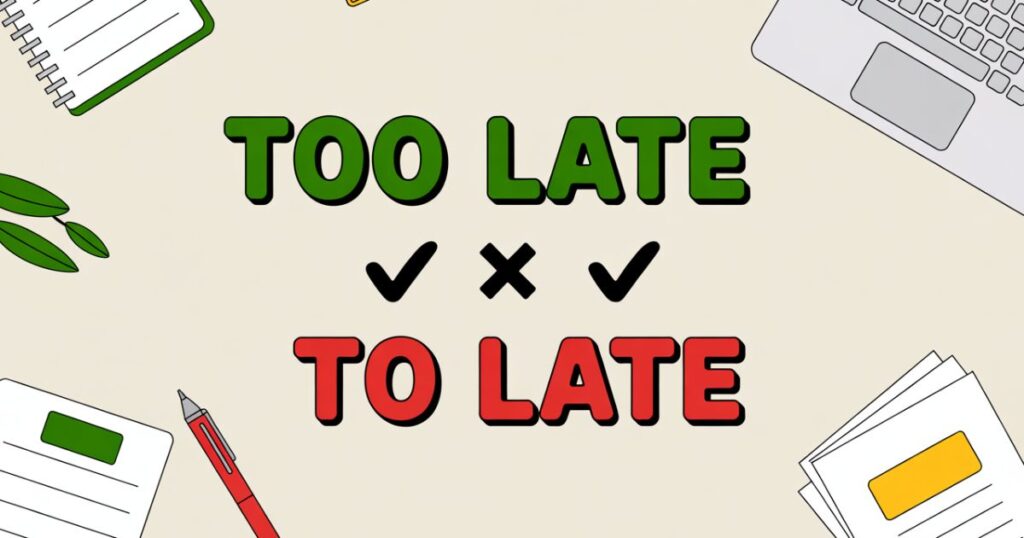
Quick Answer: The Correct Phrase Is “Too Late”
Here’s the truth: “too late” is always correct. “To late” never works grammatically not in texts, emails, or anywhere else.
Think of it this way. “Too” carries an extra “o” for excessive meaning. The phrase signals you’ve missed the window or gone beyond the proper time.
Example: “She arrived too late to catch her flight.”
This matters more than you think. A misplaced preposition can damage your professional credibility instantly. Grammarly reports that homophone errors rank among the most common grammar mistakes in digital communication.
What Does “Too Late” Mean?
Understanding meaning prevents future confusion better than rules alone.
Common Meanings
This phrase adapts across countless situations:
Timing-related: You’ve passed the desired time or deadline. “Applications submitted too late won’t be considered.”
Missed opportunity: Chances have vanished completely. “He wanted to invest, but it was too late.”
Irreversibility: Actions cannot be undone now. “By the time doctors arrived, it was too late.”
Degree of lateness: You’ve crossed acceptable boundaries. “Showing up two hours too late ruins dinner plans.”
Emotional Nuance
The phrase carries heavy emotional weight beyond simple timing. Regret often accompanies these words. You hear finality in someone saying “it’s too late now.”
Cultural interpretations vary slightly. Americans might emphasize missed chances while British speakers focus on propriety violations. Still, the core meaning beyond saving remains universal.
Synonyms
Expand your vocabulary with these alternatives:
- Overdue (formal context)
- Belated (gifts or apologies)
- Tardy (educational settings)
- Past the deadline (business writing)
- After the fact (legal situations)
- Missed the boat (casual idiom)
Why “To Late” Is Incorrect
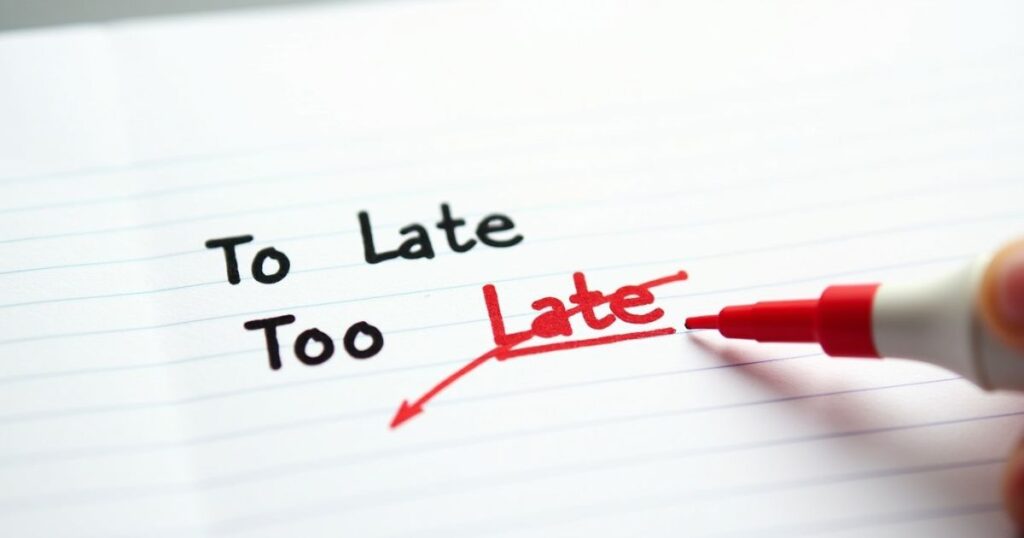
This combination violates fundamental English grammar rules completely.
“To” functions as a preposition showing direction or as an infinitive marker. “I’m going to the store.” “I want to learn.”
“Late” serves as an adjective describing timing or an adverb modifying verbs.
Here’s the problem: Prepositions cannot modify adjectives. These parts of speech simply don’t connect this way in proper grammar.
❌ “I’m to late” (grammatically broken—preposition can’t modify adjective)
✅ “I’m too late” (grammatically sound—adverb modifies adjective)
Quick Grammar Rule
“Too” means excessively or also. “To” indicates direction, purpose, or forms infinitives. Never interchange them.
Memory trick: “Too” has extra letters because it means “extra” stuff. Simple but effective.
Difference Between “To” and “Too” (Grammar Breakdown)
These homophones create confusion despite completely different functions.
“To” Explained
This preposition works three primary ways:
Direction indicator: “Walking to work saves money.” The word points toward a destination.
Infinitive marker: “She loves to dance on weekends.” It introduces verb forms.
Recipient indicator: “Give the report to your manager.” Shows who receives something.
Old English origins trace “to” back over a thousand years. The word’s pronunciation hasn’t changed much since.
“Too” Explained
This degree adverb operates differently:
Meaning “also”: “I’m coming too!” Adds someone to an action.
Meaning “excessively”: “This coffee is too hot.” Shows something beyond acceptable limits.
Emphasis tool: “That’s not too shabby!” Intensifies descriptions.
English learners often struggle here. Unlike “to,” which shows direction or purpose, “too” always modifies adjectives or other adverbs.
Side-by-Side Comparison
Watch both words work together:
- “I went to the party too.” (direction + also)
- “It’s too early to go to bed.” (excessive + infinitive + direction)
- “She’s too tired to drive to work.” (excessive + infinitive + direction)
Notice how each word maintains its distinct grammatical role? That’s fluency in action.
Common Examples Using “Too Late”

Real-world usage demonstrates proper grammar better than abstract rules.
Timing scenarios:
- “You called too late; I’d already left the office.”
- “The apology came too late to repair the damage.”
- “We spotted the mistake too late.”
Opportunity-based:
- “It’s too late to register for spring classes.”
- “By the time backup arrived, it was too late.”
- “She applied too late for scholarship consideration.”
Cause-and-effect:
- “He arrived too late to prevent the accident.”
- “They discovered the data breach too late.”
Famous References
Carole King’s classic “It’s Too Late” (1971) captured relationship finality perfectly. The lyrics “It’s too late, baby” became an anthem for irreversible endings.
George Eliot wrote, “It’s never too late to be what you might have been” one of history’s most powerful motivational quotes about second chances.
“Too Late” in Different Contexts
Context dramatically shifts meaning and emotional weight.
1. Everyday Life
Morning routines demonstrate this perfectly. “I woke up too late to make breakfast” carries mild frustration. Shopping deadlines hit harder: “The sale ended; we’re too late.”
Transportation schedules create anxiety around timing. Missing trains or flights means rescheduling everything downstream.
2. Business
Professional contexts demand precision. “The proposal submission window closed; we’re too late” might cost millions.
Marketing campaigns require perfect timing. Launching too late means competitors capture market share first. Innovation windows close rapidly in technology sectors.
Studies show punctuality affects career advancement significantly. Being “too late” repeatedly damages professional reputation permanently.
3. Relationships
This phrase carries maximum emotional nuance romantically.
“He wanted her back, but it was too late.” That sentence tells an entire story. Apologies delivered after trust shatters rarely succeed.
Relationship research indicates turning points exist where partners emotionally exit. After that point of no return, reconciliation becomes impossible regardless of effort.
4. Education
Academic deadlines create clear consequences. “Your assignment arrived too late for grading” means reduced scores or zeros.
Course registration periods close quickly. Realizing “it’s too late to enroll” forces semester-long delays. The educational context leaves little room for exceptions.
5. Technology
Digital environments move faster than ever. “Update your security patches—don’t wait until it’s too late” isn’t dramatic; it’s necessary.
AI development illustrates rapid innovation cycles. Companies arriving too late to AI integration risk obsolescence. Timing determines survival.
Read This Article: 🌶️ Spicey or Spicy – The Correct Spelling (2026 Update)
Phrases and Idioms Related to “Too Late”
English offers rich expressions about timing:
“Better late than never” contradicts finality partially. Some arrival beats complete absence.
“The ship has sailed” means opportunities vanished completely. Similar to “missed the boat”—both maritime idioms about lateness.
“A day late and a dollar short” emphasizes inadequacy plus poor timing combined.
“Too little, too late” appears constantly in relationship discussions and political commentary.
“Water under the bridge” references past events beyond changing now.
How to Avoid the “To” vs “Too” Mistake
Mastering this distinction elevates your writing immediately.
Grammar Tricks
Try the substitution test: Replace with “excessively” or “also.” If it works naturally, use “too.” If not, you probably need “to.”
Example: “I’m [excessively] late” works! Use “too.”
Example: “I’m going [excessively] work” fails. Use “to.”
The question method helps too. Ask “to where?” or “to what?” If answerable, use “to” as your preposition. If not, likely you need “too.”
Read aloud whenever possible. Your ear catches what eyes miss during proofreading. This language learning tip works across all common English confusion words.
Quick Quiz
Test your mastery:
- “I want ___ go ___ the concert ___.”
- “It’s ___ hot ___ handle.”
- “Are you coming ___ the party ___?”
- “This seems ___ difficult ___ solve.”
Answers: 1) to, to, too 2) too, to 3) to, too 4) too, to
Notice the patterns? Position in sentences often hints at correct usage.
Too Late Meaning

Let’s dive deeper into precise definitions.
Primary meaning: Occurring after the appropriate or required time has passed. The phrase signals that timing has rendered actions ineffective.
Linguistic breakdown: “Too” functions as a degree adverb modifying the adjective “late.” This creates intensifying meaning in grammar you’re not just late, you’re excessively late.
Contextual meanings shift subtly:
Temporal: After a specific deadline passes
Conditional: When circumstances have changed irreversibly
Emotional: When damage is already done
Practical: When action no longer produces desired results
The phrase appears in social media posts, professional emails, and everyday phrases constantly. Understanding its tone prevents miscommunication.
Too Late Meaning in Relationship
Romantic contexts give this phrase devastating power.
Partners say “it’s too late” when emotional trust has evaporated completely. Apologies that come after repeated betrayals rarely restore intimacy. The phrase represents relationship death more than simple timing issues.
Psychology research identifies specific warning signs:
- Communication attempts receive cold responses
- Regret expressions no longer affect the other person
- One partner has emotionally moved on already
- Outcome seems predetermined regardless of actions
“You say you’ve changed, but it’s too late” means the injured party has closed that chapter permanently. Finality in relationships often hinges on timing more than severity.
To or Too Examples
Examples solidify understanding:
“To” Examples (direction/purpose):
- “I’m driving to Chicago tomorrow.”
- “She went to the gym.”
- “We need to finish.”
- “Give it to your sister.”
- “The path to success is challenging.”
“Too” Examples (excessive/also):
- “This coffee is too hot.”
- “I’m coming too.”
- “You’re driving too fast.”
- “She’s too tired.”
- “Can I have some too?”
Mixed sentences (both words):
- “I’m too exhausted to go to work.”
- “It’s too early to go to bed.”
- “We’re too late to catch the train to Boston.”
The patterns become obvious quickly. Practice transforms spelling confusion to vs too into automatic correctness.
Summary Table: “To Late” vs “Too Late”
| Aspect | “To Late” ❌ | “Too Late” ✅ |
|---|---|---|
| Grammatically Correct? | Never | Always |
| Meaning | Makes no sense | Past acceptable time |
| Part of Speech | Preposition + adjective (wrong) | Adverb + adjective (correct) |
| Example | Don’t use | “We arrived too late” |
| Substitution Test | Fails completely | “Excessively late” works |
| Professional Writing | Damages credibility | Proper usage |
This reference table clarifies everything instantly.
Conclusion
You’ve now mastered one of English’s trickiest homophones. Remember: “too late” carries that extra “o” for “extra” meaning. This distinction matters across professional emails, personal texts, and everywhere between.
The phrase appears in business communication, relationship discussions, and everyday usage constantly. Correct English phrases separate competent writers from careless ones.
Apply these grammar tricks immediately. Your writing accuracy just improved dramatically. Share this guide with anyone struggling with common grammar mistakes.
Final thought: It’s never too late to sharpen your grammar skills!
FAQs
Is it “too late” or “to late”?
Always “too late.” The phrase “to late” is grammatically incorrect everywhere. “Too” functions as an adverb meaning excessively.
What does “too late” mean?
It means after the appropriate time has passed. The phrase suggests missed opportunities, irreversible situations, or timing that renders actions ineffective.
How do I remember the difference?
Use this trick: “too” has an extra “o” because it means “extra” or “also.” For direction, use “to.”
What’s “too late” mean in relationships?
It signifies that damage has become irreparable or a partner has emotionally moved on. Changes or apologies no longer matter.
Can “to late” ever be correct?
No, never. These words cannot grammatically connect under any circumstances.

Flairsy is the word expert behind Englishfixerr.com, helping readers find the perfect synonyms and simple word choices. With a love for clarity and creativity, Flairsy makes English easy and stylish. From tricky terms to everyday phrases, he turns confusion into confidence.