
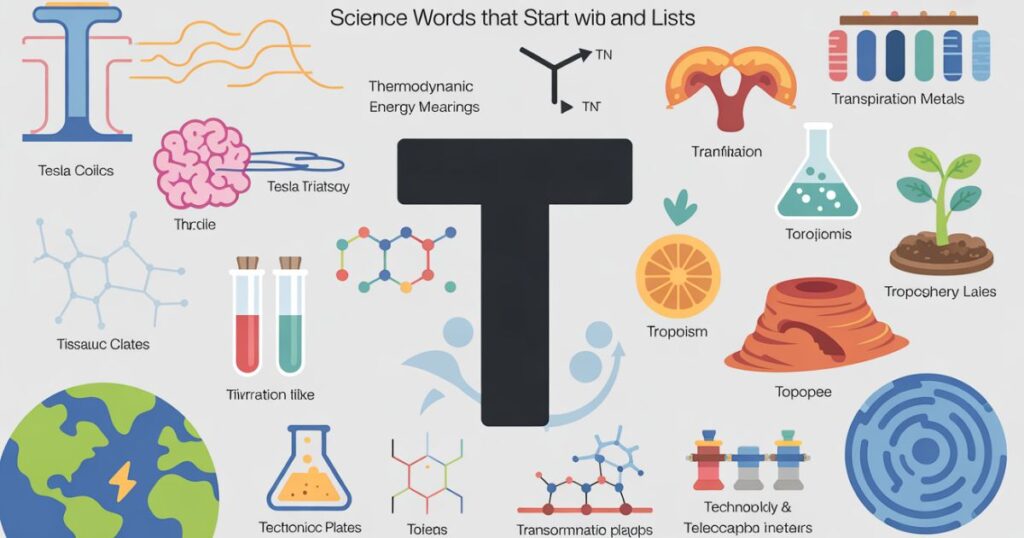
Tesla coils crackling with electricity. Thermodynamics governing your morning coffee. Tectonic plates reshaping continents beneath your feet. The letter T dominates scientific vocabulary in ways you’ve never imagined.
Scientific terminology matters because it unlocks understanding. When you grasp these T-words in science, complex concepts transform into accessible knowledge. This comprehensive guide explores science words starting with T across every major discipline.
Students, educators, and science enthusiasts will discover essential terms that appear in textbooks, laboratories, and standardized tests. Let’s dive into this treasure trove of scientific concepts beginning with T.
Easy Science Words With T for Students
Starting simple builds confidence in learning science vocabulary. These foundational student science terms create stepping stones toward advanced concepts.
Temperature measures heat in degrees Fahrenheit or Celsius. Water boils at 212°F (100°C). Your body maintains roughly 98.6°F through sophisticated biological mechanisms.
Tissue refers to cell groups performing similar functions. Muscle tissue contracts when you move. Connective tissue provides structural support throughout your body.
Test represents the experimental phase in scientific method. Scientists conduct tests to validate hypotheses. Every discovery begins with systematic testing procedures.
Theory differs dramatically from casual “guess” usage. Scientific theories explain natural phenomena through extensive evidence. Gravity qualifies as theory, not mere speculation.
Here’s a quick reference table for beginners:
| Term | Definition | Real-World Example |
|---|---|---|
| Tool | Laboratory equipment | Microscope magnifies specimens |
| Tornado | Rotating air column | Twister strikes plains regions |
| Tube | Cylindrical laboratory container | Test tube holds liquid samples |
| Tail | Biological appendage | Dogs wag tails expressing emotion |
Practice these easy science words through flashcard creation and memory games. Observe your surroundings for real examples.
Physics Science Words That Start With T
Physics vocabulary dominates T-terminology because energy and motion concepts frequently begin with this powerful letter.
Thermodynamics governs heat and energy transfer through fundamental laws. Your refrigerator operates on thermodynamic principles, extracting heat from food storage compartments. Power plants convert thermal energy into electricity using these same scientific foundations.
Trajectory describes the path projectiles follow through space. Basketball players calculate trajectory intuitively when shooting. Baseball pitchers manipulate trajectory through spin and velocity adjustments.
Torque measures rotational force in mechanical systems. Wrench length affects torque applied to bolts. Automotive engineers design engines maximizing torque for acceleration performance.
Tension represents force transmitted through strings, cables, or ropes. Bridge construction relies heavily on tension calculations. Guitar strings produce sound through tension variations.
Additional physics terms starting with T include:
- Tesla: Unit measuring magnetic flux density
- Turbulence: Irregular fluid flow causing airplane bumps
- Thrust: Propulsion force pushing rockets skyward
- Terminal velocity: Maximum falling speed when air resistance balances gravity
- Transformer: Device converting voltage in electrical systems
- Transverse wave: Oscillation perpendicular to energy transmission direction
- Tachyon: Hypothetical particle exceeding light speed
- Torsion: Twisting force on structural elements
- Time dilation: Relativistic effect where time slows at high velocities
These physics concepts interconnect beautifully. Turbines convert fluid motion into rotational energy through careful blade design. Transmission systems deliver power from engines to wheels efficiently.
Chemistry Science Words That Start With T
Chemical terms beginning with T populate laboratories worldwide. Understanding these chemistry vocabulary words unlocks molecular mysteries.
Titration determines solution concentrations through controlled chemical reactions. Chemists use burettes, pipettes, and indicators for precise measurements. Pharmaceutical companies employ titration ensuring medication dosage accuracy.
Transition metals occupy groups 3-12 on the periodic table. These elements display variable oxidation states enabling catalytic applications. Iron, copper, and gold qualify as transition metals with unique properties.
Tungsten (W) possesses the highest melting point among metals at 6,192°F. Light bulb filaments traditionally contained tungsten. This refractory metal serves critical roles in industrial manufacturing.
Tin (Sn) forms protective coatings on steel cans. Solder traditionally combined tin with lead for electrical connections. Modern electronics use lead-free tin alloys.
Here’s a comprehensive chemistry table:
| Compound/Element | Formula | Primary Application |
|---|---|---|
| Toluene | C₇H₈ | Industrial solvent |
| Tartaric acid | C₄H₆O₆ | Food additive, wine stabilizer |
| Teflon | (C₂F₄)ₙ | Non-stick coating |
| Tritium | ³H | Nuclear fusion fuel |
| TNT | C₇H₅N₃O₆ | Explosive compound |
Toxicity describes poisonous substance effects on organisms. LD50 measurements indicate lethal doses for 50% of test populations. Household chemical safety depends on understanding toxic properties.
Thiols contain sulfur-hydrogen bonds producing characteristic odors. Natural gas companies add thiols for leak detection. Your nose detects thiols at remarkably low concentrations.
Tetrachloride compounds contain four chlorine atoms. Carbon tetrachloride once served as cleaning solvent before toxicity concerns emerged. Tetravalent elements form four chemical bonds simultaneously.
Biology Science Words That Start With T
Life sciences vocabulary showcases T-terminology across microscopic to macroscopic scales. These biology terms reveal interconnected biological systems.
Taxonomy classifies organisms into hierarchical categories. Carl Linnaeus developed this classification system grouping species systematically. Modern taxonomy incorporates DNA analysis for accurate evolutionary relationships.
The Linnaean hierarchy follows this structure:
- Kingdom (broadest category)
- Phylum
- Class
- Order
- Family
- Genus
- Species (most specific)
Tissue expands beyond simple definition into four primary animal types. Epithelial tissue forms protective barriers covering body surfaces. Connective tissue provides structural support through collagen and elastin. Muscle tissue generates movement through contraction. Nervous tissue transmits electrical signals coordinating body functions.
Transpiration moves water through plants from roots to leaves. Stomata regulate water vapor release into the atmosphere. Environmental factors like humidity and temperature influence transpiration rates dramatically.
Tropism describes plant growth responses to environmental stimuli. Phototropism causes plants to bend toward light sources. Gravitropism ensures roots grow downward while shoots grow upward. Thigmotropism triggers growth responses to touch, helping vines climb supports.
Thyroid gland produces hormones T3 and T4 regulating metabolism. Located in your neck, this butterfly-shaped organ influences energy expenditure. Hypothyroidism causes fatigue while hyperthyroidism accelerates metabolic processes.
Additional critical biology terms:
- Thorax: Body region between neck and abdomen containing vital organs
- Trachea: Windpipe structure conducting air to lungs
- Translation: RNA-to-protein synthesis in cellular machinery
- Tendon: Fibrous tissue connecting muscles to bones
- Trait: Inherited characteristic passed through generations
- Tumor: Abnormal tissue growth from uncontrolled cell division
- Telomere: Protective chromosome caps shortening with age
- Thymus: Immune system gland training T-cells
- Taproot: Primary root growing vertically downward
- Toxin: Poisonous substance produced by living organisms
Scientific Words Starting With T

Cross-disciplinary scientific concepts demonstrate how T-words transcend individual fields. These universal terms appear throughout research literature.
Technology represents applied science solving practical problems. Innovation creates new technologies while invention discovers novel solutions. Societal impact follows technological advancement inevitably.
Theory provides frameworks explaining natural phenomena through testable predictions. Unlike casual usage suggesting uncertainty, scientific theories rest on substantial evidence. Atomic theory, cell theory, and evolutionary theory qualify as robust explanations.
Technique encompasses standardized research methods ensuring reproducibility. Scientists publish detailed protocols allowing others to replicate experiments. Proper technique separates reliable science from questionable results.
Temporal relates to time-based measurements and changes. Geologists examine temporal patterns across millions of years. Biologists study temporal variations in circadian rhythms.
Terrestrial describes land-based phenomena distinguishing Earth-specific characteristics. Scientists compare terrestrial conditions with extraterrestrial environments seeking life elsewhere.
Transport mechanisms move substances across biological membranes. Active transport requires energy while passive transport follows concentration gradients. Cellular survival depends on efficient transport systems.
Math Science Words That Start With T
Mathematics provides science’s universal language through precise terminology. These math vocabulary terms appear constantly in scientific calculations.
Theorem represents proven mathematical statements requiring rigorous demonstration. Pythagorean theorem calculates right triangle relationships: a² + b² = c². Fermat’s Last Theorem puzzled mathematicians for centuries before Andrew Wiles proved it in 1994.
Tangent functions in trigonometry relate opposite sides to adjacent sides in right triangles. Geometrically, tangent lines touch curves at single points without crossing. Calculus employs tangent lines representing instantaneous rates of change.
Trigonometry studies triangle relationships through sine, cosine, and tangent ratios. Navigation systems use trigonometry calculating positions. Surveyors measure land boundaries through trigonometric principles.
Topology examines shape properties persisting through continuous deformations. Imagine geometry on rubber sheets that stretch without tearing. A coffee cup topologically equals a donut because both contain one hole.
Key mathematical terms include:
- Triangle: Three-sided polygon with angles summing to 180 degrees
- Trapezoid: Quadrilateral featuring one pair of parallel sides
- Tetrahedron: Four-faced polyhedron forming triangular pyramid
- Transversal: Line crossing two or more parallel lines
- Term: Individual component within mathematical expressions
- Tessellation: Repeating patterns covering surfaces without gaps
- Transformation: Function mapping points to new locations
- Translation: Geometric sliding motion preserving shape orientation
- Total: Sum resulting from addition operations
- Times: Multiplication operation combining quantities
Earth Science Words Starting With T
Geological and atmospheric terminology beginning with T explains planetary processes shaping our world.
Tectonic plates represent lithosphere segments floating on the asthenosphere. Plate boundaries include convergent (colliding), divergent (separating), and transform (sliding) types. Earthquakes and volcanoes concentrate along plate boundaries forming the Ring of Fire.
Topography describes land surface elevation features through contour mapping. GPS and satellite technology now create detailed topographic models. Relief and terrain characteristics influence water drainage patterns and ecosystem development.
Troposphere forms Earth’s lowest atmospheric layer where weather occurs. Temperature decreases approximately 6.5°C per kilometer of altitude. The tropopause boundary separates troposphere from stratosphere above.
Tsunami generates from underwater earthquakes displacing massive water volumes. These seismic sea waves travel at 500 mph across open ocean. Coastal impact produces devastating flooding as waves slow and amplify approaching shore.
Tornado creates violently rotating air columns extending from thunderstorms. The Fujita scale classifies tornado intensity from F0 (weak) to F5 (incredible). Tornado Alley stretches across central United States where conditions favor formation.
Additional earth science vocabulary:
- Temperate: Moderate climate zones between tropics and polar regions
- Tide: Ocean level changes from gravitational pull of moon and sun
- Tundra: Cold, treeless biome with permanently frozen subsoil
- Tropics: Region between Tropic of Cancer and Tropic of Capricorn
- Tributary: Smaller river feeding into larger river systems
- Turbidity: Water cloudiness from suspended particles
- Talus: Rock debris accumulating at cliff bases
- Tuff: Volcanic rock from consolidated ash
- Trench: Deep oceanic depression formed at convergent boundaries
- Till: Unsorted glacial sediment deposited by ice sheets
- Thermosphere: Upper atmospheric layer experiencing extreme temperatures
- Tropopause: Boundary between troposphere and stratosphere
- Thermal spring: Groundwater heated by geothermal processes
Technology and Engineering Words That Start With T
Applied science terminology demonstrates how engineering solves real-world problems through innovative technology.
Transistor revolutionized electronics as semiconductor devices controlling current flow. Signal amplification and switching functions enable modern computers. Integrated circuits contain billions of transistors on single chips.
Turbine converts fluid motion into rotational mechanical energy. Wind turbines generate electricity from air movement. Steam turbines power traditional electrical plants. Hydroelectric turbines harness falling water energy.
Telecommunication enables distance communication through signal transmission. Network infrastructure supports global connectivity. 5G technology promises faster data speeds and lower latency.
Torque measurements guide mechanical system design ensuring proper force application. Engineers specify torque values for fastener tightening procedures. Engine torque determines vehicle acceleration capabilities.
Engineering terms include:
- Transformer: Voltage conversion device in power distribution
- Transmission: System delivering engine power to wheels
- Telemetry: Remote measurement and data transmission
- Thermocouple: Temperature sensor using voltage differences
- Touchscreen: Interactive display responding to finger pressure
- Troubleshooting: Systematic problem identification and resolution
- Traffic engineering: Transportation system optimization
- Telematics: Vehicle communication and monitoring systems
- Thread: Helical ridge enabling fastener engagement
- Testing: Quality assurance through systematic evaluation
- Tensile strength: Material resistance to pulling forces
Read This Article: Science Words That Start With N – Physics, Chemistry, Biology & More
Forensic Science Words With T

Criminal investigation relies on scientific analysis using specialized forensic vocabulary.
Toxicology detects poisons and drugs in biological samples. Blood alcohol concentration testing determines impairment levels. Autopsy toxicology reports reveal substance presence at death. Chain of custody protocols ensure evidence integrity throughout analysis.
Trace evidence includes microscopic materials transferring between people, objects, and environments. Locard’s Exchange Principle states contact always leaves traces. Hair, fiber, and glass fragments undergo comparison microscopy analysis linking suspects to crime scenes.
Tool marks create impression evidence from instruments used during crimes. Burglary investigations examine pry bar markings on door frames. Comparison microscopy reveals unique patterns identifying specific tools.
Trajectory analysis reconstructs bullet paths through crime scenes. Ballistics experts use angles and impact patterns determining shooter positions. Tire tracks preserve vehicle movement evidence at outdoor scenes.
Additional forensic terms:
- Tissue analysis: Microscopic examination of biological samples
- Time of death: Postmortem interval estimation using body changes
- Testimony: Witness statements and expert opinions in legal proceedings
- Triage: Evidence prioritization based on investigative value
- Trace DNA: Genetic material from minimal biological sources
- Toxic substances: Poisonous materials analyzed in suspected poisonings
- Thermal imaging: Heat detection technology locating evidence
- Tread analysis: Footwear pattern identification and comparison
- Taphonomy: Study of organism decay and fossilization processes
General Science Words That Start With T
Miscellaneous scientific terminology enhances broader scientific literacy connecting everyday experiences to scientific principles.
Common terms everyone encounters:
- Trial: Experimental attempt testing hypotheses
- Track: Following movement or progress systematically
- Transfer: Movement from one location to another
- Transmit: Send signals, energy, or disease organisms
Intermediate terms for advancing students:
- Therapeutic: Healing treatment promoting recovery
- Thoracic cavity: Chest area containing heart and lungs
- Threshold value: Minimum level triggering responses
- Telescope: Optical instrument magnifying distant objects
Advanced terminology for serious learners:
- Teratogen: Agent causing birth defects during development
- Thermophile: Heat-loving organism thriving at high temperatures
- Transduction: Signal conversion between different forms
- Trophic level: Organism position in food chain hierarchy
Tips for Learning Science Words That Starting With T
Effective study strategies build systematic vocabulary knowledge ensuring long-term retention through practical application.
Context-based learning accelerates comprehension dramatically. Read scientific articles incorporating T-terminology naturally. Watch educational documentaries demonstrating concepts visually. Science podcasts explain terms through engaging narratives.
Mnemonic devices create memorable associations strengthening recall. “Thermodynamics Tells Tales” helps remember heat-related principles. Visual associations link abstract concepts to concrete images. Story-based memory techniques transform boring lists into engaging narratives.
Active recall practice outperforms passive reading consistently. Flashcard apps like Anki and Quizlet facilitate spaced repetition scheduling. Self-testing without notes reveals knowledge gaps requiring attention. Track progress metrics monitoring vocabulary growth over time.
Real-world applications cement understanding through hands-on experience:
- Conduct kitchen chemistry experiments observing reactions
- Maintain nature observation journals documenting phenomena
- Perform home physics demonstrations testing principles
- Build DIY science projects applying theoretical knowledge
Group study sessions leverage peer teaching opportunities. Discussion-based learning clarifies confusing concepts through multiple perspectives. Collaborative concept mapping reveals connections between related terms. Quiz competitions make vocabulary practice enjoyable and competitive.
Multi-sensory approaches engage different learning pathways:
- Draw diagrams illustrating processes visually
- Create physical models demonstrating structures
- Record voice notes explaining concepts personally
- Use interactive online simulations exploring principles
Root word analysis unlocks meaning efficiently. “Therm-” indicates heat-related terms like thermodynamics and thermometer. Greek and Latin origins provide clues about definitions. Building word families around common roots expands vocabulary rapidly.
Regular review schedules prevent forgetting through consistent reinforcement. Daily 15-minute sessions maintain progress steadily. Weekly comprehensive reviews consolidate recent learning. Monthly cumulative testing ensures long-term retention.
FAQs
Why are science words that start with T so common?
Greek and Latin roots generate numerous T-terms. “Therm-” (heat), “tele-” (distant), and “terra-” (earth) create entire word families. Technological advancement continuously introduces new terminology throughout history.
What’s the hardest science word starting with T?
“Thigmotropism” challenges many learners combining complex Greek roots. This biological term describes plant growth responses to touch stimuli.
How many science words begin with T?
Thousands exist across all scientific disciplines. Major dictionaries list 500-1000 distinct T-terms. New technologies add vocabulary continuously.
Do science words starting with T appear frequently in exams?
Absolutely. Temperature, tissue, theory, and tectonic plates appear regularly on standardized tests. Understanding these words proves essential for academic success.
Can I memorize all science T-words quickly?
Quick memorization rarely creates lasting knowledge. Focus on mastering 10-15 terms weekly instead. Deep understanding beats superficial cramming every time.
Which science field uses the most T-words?
Physics and chemistry tie for highest usage. Thermodynamics, temperature, and related concepts appear constantly in both disciplines.
Are there tricks for remembering scientific T-terms?
Connect terms to personal experiences creating memorable associations. Link transpiration to sweating plants. Associate trajectory with throwing basketballs naturally.
Where can students practice science vocabulary effectively?
Quizlet offers pre-made science flashcard sets. Science Bowl competitions provide excellent practice opportunities. Educational apps like Kahoot make learning interactive.
Conclusion
Science words starting with T span every discipline from physics to forensics. Thermodynamics explains energy flow. Tectonic plates reshape our planet. Taxonomy organizes life’s diversity systematically.
This comprehensive guide explored student science terms, physics vocabulary, chemistry concepts, and biology terminology. Mathematical T-words provide calculation foundations. Earth science vocabulary explains planetary processes. Technology terms showcase engineering innovations.
Vocabulary mastery requires consistent effort over time. Start with one category, then expand gradually into others. These T-words unlock deeper scientific understanding transforming complex ideas into accessible knowledge.
Scientific literacy empowers informed decision-making throughout life. Bookmark this resource for future reference. Begin practicing today with five chosen terms from your favorite discipline.
Your journey through scientific terminology transforms abstract concepts into practical wisdom. Every scientist started where you stand now—curious and eager to learn.

Flairsy is the word expert behind Englishfixerr.com, helping readers find the perfect synonyms and simple word choices. With a love for clarity and creativity, Flairsy makes English easy and stylish. From tricky terms to everyday phrases, he turns confusion into confidence.