

You’ve probably paused mid-sentence, fingers hovering over your keyboard, wondering: “Wait is it reinforce or reenforce?” This spelling confusion plagues writers everywhere, from students crafting essays to professionals composing business reports. The good news? One choice is definitively correct.
Let’s eliminate that hesitation forever. Understanding proper word choice matters deeply in written communication. Whether you’re strengthening arguments in academic writing, supporting behavior in psychology, or literally reinforcing structures in construction, knowing the right spelling keeps your message crystal clear. Throughout this guide, you’ll discover not just which spelling dominates modern English, but why precision in language makes all the difference.
By the time you finish reading, spelling mistakes won’t slow you down anymore.
Reinforce vs Reenforce: Correct Spelling
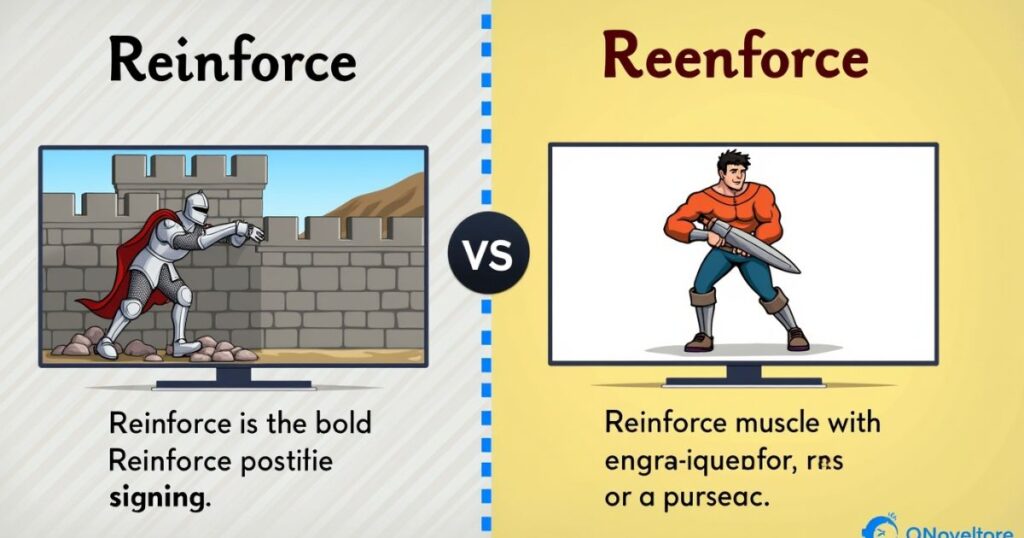
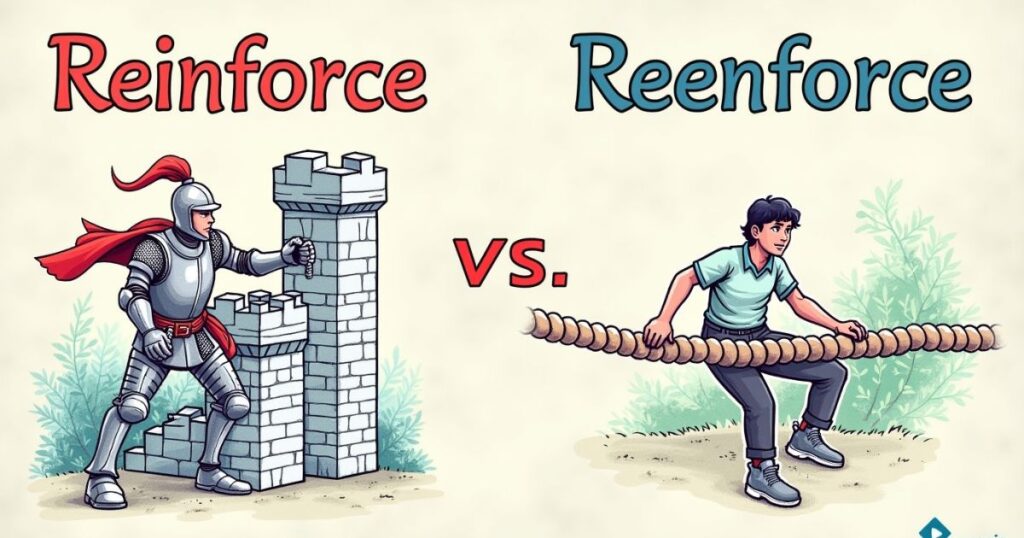
Here’s the straightforward answer: reinforce is the correct, standard spelling in contemporary English.
“Reenforce” exists in historical texts and older dictionaries, but it’s now considered an outdated spelling variation. Major authorities like Merriam-Webster, Oxford English Dictionary, and Cambridge Dictionary all list “reinforce” as the primary often only accepted form. When you run spell-checkers across documents in Microsoft Word or Google Docs, they’ll typically flag “reenforce” with that dreaded red squiggle.
Professional writing standards across the United States, United Kingdom, Canada, and Australia demand “reinforce” exclusively. Academic institutions expect it. Business communications require it. Publishers insist on it.
The semantic understanding remains identical between both spellings. However, choosing “reenforce” in 2025 signals unfamiliarity with commonly accepted spelling conventions. That’s not the impression you want to leave on professors, clients, or employers.
Bottom line? Always use “reinforce” in modern contexts.
Understanding the Spelling Difference

Why does this confusion persist if one spelling reigns supreme?
The answer lies in linguistic development and how English evolved over centuries. The word traces back to Latin origins through Old French “reinforcer” meaning to make stronger or provide additional support. When the term entered English vocabulary around the 14th century, spelling wasn’t standardized like today.
Early writers sometimes added prefixes liberally. The prefix “re-” already meant “again” or “back.” Some scribes thought adding “en” created emphasis: “re-en-force.” This logic seems sound superficially. After all, we say “re-enter” not just “renter,” right?
But English doesn’t follow perfect logic consistently. Language evolution favored the simpler “reinforce” construction. By the 20th century, dictionaries codified this preference. Modern grammar rules now treat “reenforce” as a variant spelling from historical texts nothing more.
Both American and British spelling preferences align here, which rarely happens! No regional spelling difference exists like “color” versus “colour.” Everyone agrees globally.
| Aspect | Reinforce | Reenforce |
|---|---|---|
| Dictionary Status | Standard | Archaic/Obsolete |
| Professional Writing | ✓ Accepted Everywhere | ✗ Avoid Completely |
| Spell-Check Tools | Passes | Usually Flagged |
| Academic Writing | Required | Rejected |
| Modern Usage Frequency | 99%+ | <1% |
Clarity in communication demands we use the spelling readers expect. Choosing the outdated variant creates unnecessary friction.
Reinforce vs Reenforce: The Only Right Choice (Meaning)
Let’s explore what “reinforce” actually means when you use it correctly.
At its core, reinforce meaning centers on strengthening or supporting something that already exists. You’re not creating from scratch you’re making existing structures, ideas, or behaviors more robust. Think of it as adding layers of strength.
In construction and engineering, workers reinforce concrete foundations with steel beams. Buildings need reinforced walls to withstand earthquakes. Bridges require reinforcement techniques using additional support materials throughout their structure. This structural reinforcement prevents collapse under stress.
In psychology and therapy, professionals discuss behavioral reinforcement constantly. Teachers reinforce learning through practice problems and real-life experiments. Parents reinforce behavior patterns with consistent responses. Therapists use cognitive reinforcement to strengthen emotional resilience in clients. Positive reinforcement rewards desired actions, making them more likely to recur.
In education, instructors reinforce lesson concepts through repetition and varied examples. Students reinforce their understanding by teaching others. Study groups reinforce learning outcomes through collaborative discussion.
In business and marketing, companies reinforce brand messages through repeated campaigns. Managers reinforce team performance with recognition programs. Leaders reinforce organizational values through consistent modeling.
Military contexts use “reinforce” when sending additional troops to strengthen defense systems or support positions under pressure.
The reinforcement definition stays consistent: adding support to make something stronger, whether physical or abstract. Both spellings carry this identical meaning when encountered the difference is purely about standard English vocabulary acceptance.
Reinforce vs Reenforce: The Only Right Choice (Synonym)
Sometimes varying your vocabulary strengthens your writing. Here are powerful alternatives to “reinforce”:
Strengthen works universally. “Practice strengthens skills” carries the same weight as “Practice reinforces skills.” This synonym fits nearly every context seamlessly.
Fortify suggests defensive preparation. Military strategists fortify positions. Writers fortify arguments with evidence. The term implies protection against attack or weakness.
Bolster emphasizes support or encouragement. “Her confidence bolstered his resolve” sounds more emotional than purely structural. Use this when discussing morale, confidence, or emotional states.
Support is simpler and more direct. Data supports conclusions. Pillars support roofs. While less forceful than “reinforce,” it works beautifully in straightforward statements.
Buttress brings architectural flavor to your writing. Originally describing structural supports in architecture, it now applies to arguments: “Statistics buttress her claims effectively.”
Consolidate means bringing elements together for combined strength. “The company consolidated resources” differs slightly it’s about combining, not just strengthening what exists.
Augment emphasizes addition and increase. “Training augmented their capabilities” focuses on expanding beyond current levels.
Amplify works when making something stronger and more noticeable. “Media coverage amplified the message” suggests both strengthening and spreading.
Substantiate fits academic and legal writing. “Evidence substantiates the hypothesis” shows proof reinforces validity.
Enhance suggests improvement and quality increase. “Technology enhanced productivity” implies making something better, not just stronger.
Each synonym carries subtle distinctions. Vocabulary accuracy depends on matching the right word to your specific context and tone.
Reinforce vs Reenforce: Definition
Dictionary-recognized spelling provides the clearest definition framework.
Merriam-Webster defines “reinforce” (pronounced /ˌriːɪnˈfɔːrs/) as:
- To strengthen by additional assistance, material, or support
- To strengthen or increase by fresh additions
- To stimulate (a response) with reinforcement
Oxford English Dictionary emphasizes the transitive verb nature: “Strengthen or support (an object or substance), especially with additional material.”
Cambridge Dictionary highlights practical application: “To make something stronger or more effective, usually by adding something to it.”
Breaking down these definitions reveals three core components:
First, adding to what exists. You can’t reinforce nothing. The foundation, behavior, idea, or structure must already be present. This distinguishes “reinforce” from “create” or “establish.”
Second, strengthening through addition. Whether adding steel beams to buildings, evidence to arguments, or encouragement to behavior the addition creates increased strength or effectiveness.
Third, intentional action. Reinforcement doesn’t happen accidentally. Someone deliberately chooses to strengthen something specific for particular reasons.
The part of speech is primarily transitive verb, meaning it requires a direct object. You reinforce something the wall, the concept, the behavior, the message.
Linguistic accuracy demands proper spelling. While “reenforce meaning” matches “reinforce meaning” semantically, only one spelling receives dictionary endorsement for contemporary use.
Reenforce vs Reinforce Meaning
Let’s address this directly: no semantic difference exists between these spellings.
If you encounter “reenforce” in a 19th-century text or older publication, it means exactly what “reinforce” means today. The concept of strengthening or supporting remains unchanged. Historical spelling variations don’t alter language semantics they simply reflect different eras’ conventions.
Why do people assume there’s a meaning difference? Common spelling confusion leads writers to think variant spellings must signify variant meanings. After all, “affect” and “effect” mean different things despite similar appearance. “Accept” and “except” couldn’t be more different.
But “reinforce” and “reenforce” aren’t like those pairs. They’re simply alternative spellings of identical words like “doughnut” and “donut,” or “grey” and “gray.”
The misspelling reenforce persists because the double prefix seems logical. Our brains appreciate patterns. “Re-enter” has that structure. “Re-enact” follows it. “Re-enforce” feels consistent with that pattern.
English doesn’t cooperate with our pattern-seeking instincts consistently, though. Standardization happened, and “reinforce” won. Using “reenforce” today doesn’t communicate different meaning it communicates unfamiliarity with correct English usage.
Professional communication standards require the modern spelling. That’s the only meaningful difference: credibility versus confusion.
Reinforce and Reenforce: Verb Forms
Understanding verb forms helps you use “reinforce” correctly across tenses and contexts.
| Tense | Form | Example |
|---|---|---|
| Present Simple | reinforce/reinforces | “Teachers reinforce concepts through repetition.” |
| Present Continuous | am/is/are reinforcing | “The team is reinforcing safety protocols.” |
| Past Simple | reinforced | “Engineers reinforced the foundation last month.” |
| Past Continuous | was/were reinforcing | “They were reinforcing the structure when inspectors arrived.” |
| Present Perfect | have/has reinforced | “Evidence has reinforced this theory consistently.” |
| Past Perfect | had reinforced | “By then, they had reinforced every weak point.” |
| Future Simple | will reinforce | “Training will reinforce these essential skills.” |
| Future Continuous | will be reinforcing | “Next quarter, we’ll be reinforcing brand messaging.” |
Present participle (gerund): reinforcing Past participle: reinforced
These forms appear throughout professional and academic contexts:
“Reinforcing positive behavior requires patience and consistency.” (gerund as subject)
“The reinforced concrete withstood the earthquake.” (past participle as adjective)
“By reinforcing your argument with data, you’ll persuade skeptics.” (present participle)
Common mistakes include irregular conjugation attempts. Never write “reinforcen” or “reinfarced.” The verb follows standard regular conjugation patterns throughout.
Grammar mistakes often occur when writers confuse “reinforce” with “enforce.” These are distinct words! “Enforce” means to compel compliance with rules. “Reinforce” means to strengthen something existing. You enforce laws but reinforce structures or ideas.
Reinforce and Reenforce: Noun Forms
The primary noun form is “reinforcement.”
Singular: reinforcement Plural: reinforcements
“The wall needs reinforcement before winter storms arrive.” (singular, referring to the process or material)
“Military reinforcements arrived at dawn.” (plural, referring to additional troops or resources)
In construction, “reinforcement” describes materials added for strength steel reinforcement, fiber reinforcement, or mesh reinforcement within concrete. Builders discuss building reinforcement techniques constantly, referencing specific materials and methods.
In psychology, “reinforcement” is a fundamental concept in behavioral development and therapy. Behavioral reinforcement shapes actions through consequences. Cognitive reinforcement strengthens thought patterns. Therapists distinguish between positive reinforcement (adding pleasant consequences) and negative reinforcement (removing unpleasant consequences).
In education, teachers use “reinforcement” to describe techniques strengthening student learning. Practice problems provide reinforcement. Feedback offers reinforcement. Varied examples reinforce understanding through different approaches.
Related nouns include “reinforcer” the person or thing providing reinforcement. In psychological terms, a reinforcer is any stimulus increasing behavior frequency. Praise can be a reinforcer. Food serves as a reinforcer in animal training.
The adjective form “reinforced” modifies nouns: reinforced concrete, reinforced glass, reinforced opinion, reinforced behavior.
Proper noun forms appear in titles: Reinforcement Learning (computer science), Reinforcement Theory (psychology), Structural Reinforcement Engineering (construction).
Examples of “Reinforce”
Real-world usage clarifies how proper term usage functions across contexts.
Construction and Engineering: “Steel beams reinforce the parking garage’s upper levels.” Workers reinforce foundations before building upward. Architects design reinforced structures to withstand stress.
Education: “Daily practice reinforces mathematical concepts effectively.” Teachers reinforce lessons through varied activities. Study groups reinforce learning through peer explanation.
Psychology and Therapy: “Consistent praise reinforces children’s positive behavior.” Therapists reinforce healthy coping mechanisms. Rewards reinforce desired actions in behavioral programs.
Business and Marketing: “Customer testimonials reinforce our brand’s reputation powerfully.” Companies reinforce messages through repeated campaigns. Managers reinforce company values through recognition programs.
Sports and Training: “Repetitive drills reinforce muscle memory permanently.” Coaches reinforce proper techniques through demonstration. Athletes reinforce skills through deliberate practice.
Communication: “Visual aids reinforce the presentation’s key points.” Speakers reinforce arguments with supporting evidence. Writers reinforce themes through recurring motifs.
Military: “Command sent reinforcements to strengthen defensive positions.” Generals reinforce vulnerable areas strategically. Additional troops reinforce overwhelmed units.
Technology: “Encryption protocols reinforce data security measures.” Developers reinforce systems against potential vulnerabilities. Multiple authentication layers reinforce protection.
Parenting: “Consistent rules reinforce healthy boundaries clearly.” Parents reinforce values through modeling behavior. Routines reinforce children’s sense of security.
Social Contexts: “Community programs reinforce neighborhood connections.” Traditions reinforce cultural identity. Shared experiences reinforce group cohesion.
Notice how reinforce usage examples span physical reinforcement (buildings, structures) and abstract reinforcement (ideas, behaviors, concepts). The semantic meaning of strengthening applies universally.
Reinforce vs Reenforce: Grammar
Let’s examine grammatical precision when using “reinforce.”
Part of speech: Primarily a transitive verb, meaning it requires a direct object. You must reinforce something specific.
Correct: “Data reinforces the hypothesis.” Incorrect: “Data reinforces.” (What does it reinforce? The object is missing.)
Preposition patterns:
“Reinforce with” indicates the strengthening material or method: “Reinforce the argument with statistics.”
“Reinforce by” shows how the reinforcement occurs: “She reinforced her point by citing experts.”
“Reinforce through” emphasizes the process: “Teachers reinforce learning through practice.”
Active versus passive voice:
Active: “The company reinforced safety protocols.” (Direct, clear, engaging) Passive: “Safety protocols were reinforced by the company.” (Acceptable but less dynamic)
Following earlier writing instructions, prefer active voice. Passive constructions can sound stiff and bureaucratic. “Engineers reinforced the bridge” reads better than “The bridge was reinforced by engineers.”
Common collocations (words frequently appearing together):
- Reinforce the message
- Reinforce positive behavior
- Reinforce the foundation
- Reinforce an argument
- Reinforce learning outcomes
- Reinforce team performance
- Reinforce the structure
- Reinforce existing beliefs
Error correction tools in modern word processors recognize these standard patterns. They’ll flag unusual constructions or the outdated “reenforce” spelling.
Grammar tips for writers: Always check that your subject performs clear action on a specific object when using “reinforce.” The sentence structure should be transparent and direct.
Reinforce and Reenforce: Usage
How frequently does each spelling appear in published writing?
Overwhelmingly, “reinforce” dominates. Academic journals, professional publications, business documents, educational materials, and media outlets use “reinforce” almost exclusively. The professional writing standards across industries align consistently.
Text detection tools and language models trained on contemporary writing recognize “reinforce” as standard. When AI systems encounter “reenforce,” they often flag it as potential error unless processing historical documents.
Major style guides provide explicit guidance:
AP Stylebook: Lists “reinforce” without mentioning “reenforce”
Chicago Manual of Style: Recognizes only “reinforce” as standard
MLA Handbook: Uses “reinforce” in all editorial guidance
APA Style: References “reinforcement” in psychological contexts, always spelled with “rei-“
Academic writing terminology demands precision. Scholarly writing guidelines emphasize using contemporary, standardized spellings. Professors and peer reviewers expect “reinforce” in research papers, dissertations, and published articles.
Business communications similarly require the modern spelling. Professional emails, reports, presentations, and proposals should always use “reinforce.” Using “reenforce” might raise questions about attention to detail.
International English shows rare unanimity. United States, United Kingdom, Canada, and Australia all prefer “reinforce” identically. No regional English spelling variation exists here, unlike “color/colour” or “realize/realise” differences.
The commonly used English terms databases and corpus linguistics research confirm this dominance. Google Ngram Viewer shows “reinforce” usage climbing steadily while “reenforce” essentially flatlines near zero in texts published after 1950.
Read This Article: Girlie or Girly: Which One Is Correct to Use?
Usage of Reinforce and Reenforce in Modern English
Current trends reveal fascinating patterns about language evolution and standardization.
Digital communication accelerated spelling standardization. Spell-checkers, autocorrect functions, and writing assistance tools all default to “reinforce.” This technological influence pushes writers toward the accepted form automatically.
Educational reinforcement begins early. Elementary schools teach “reinforce” as the proper spelling. Grammar workbooks include it in vocabulary lists. Students learn this spelling becomes permanent through repeated exposure.
Social media platforms, despite their informal nature, still predominantly feature “reinforce.” Hashtags, posts, and articles use the standard spelling. Communication clarity matters even in casual digital spaces.
Contemporary publications show virtually unanimous preference:
- The New York Times: “reinforce” exclusively
- The Wall Street Journal: “reinforce” in all articles
- The Guardian: “reinforce” throughout
- Academic journals across disciplines: “reinforce” universally
- Technical manuals and guides: “reinforce” consistently
“Reenforce” appears primarily in three contexts:
- Historical texts from 18th-19th centuries
- Quotations from older sources
- Errors in informal writing
Language model systems trained on current text recognize “reinforce” as the overwhelmingly dominant form. Statistical analysis shows usage ratios exceeding 99:1 in favor of “reinforce” in modern publications.
This standardization benefits everyone. Understanding word usage becomes easier when one spelling dominates. Writers avoid confusion. Readers encounter consistency. Language precision in writing improves across the board.
How “Reinforce” is Used in Everyday Language
Beyond technical writing, “reinforce” permeates conversational English naturally.
Common phrases people use daily include:
“Let me reinforce that point.” (Emphasizing importance) “We need to reinforce good habits at home.” (Parenting context) “This example reinforces the message perfectly.” (Communication) “Training will reinforce these skills.” (Professional development)
Workplace conversations feature “reinforce” constantly. Managers discuss reinforcing company values. Teams talk about reinforcing project timelines. HR departments reinforce policies during orientation.
Parenting and education rely heavily on reinforcement language. Parents say they’re reinforcing bedtime routines. Teachers explain they’re reinforcing multiplication facts. School counselors describe reinforcing positive peer relationships.
Sports commentary uses “reinforce” when discussing training: “The coach reinforced defensive techniques during practice.” Athletes describe how competition reinforces competitive instincts.
Self-improvement contexts embrace reinforcement terminology. Personal development books discuss reinforcing positive mindsets. Fitness programs reinforce healthy habits through consistency. Meditation apps reinforce mindfulness through daily practice.
Political discourse employs “reinforce” when discussing values or policies: “This legislation reinforces our commitment to environmental protection.”
Media and journalism use “reinforce” to describe messaging effects: “The campaign reinforces existing stereotypes” or “Evidence reinforces previous reporting.”
The reinforce in everyday language appears so frequently we barely notice. From casual conversations to formal presentations, this verb communicates the essential concept of strengthening through support.
Meaning of reinforce stays consistent across contexts: adding strength to what exists.
Reinforce Synonym
Earlier we covered major synonyms, but let’s explore nuanced alternatives more deeply.
Strengthen remains the closest equivalent. “Strengthen arguments” works exactly like “reinforce arguments.” The terms are nearly interchangeable in most contexts. Use “strengthen” when you want slightly simpler vocabulary or when “reinforce” has appeared repeatedly nearby.
Fortify carries defensive or protective connotations. “Fortify defenses” sounds more militaristic than “reinforce defenses.” In nutrition, we discuss “fortified foods” (vitamins added) rather than “reinforced foods.” Choose this synonym when emphasizing protection against threats or weakness.
Bolster works beautifully for emotional or abstract support. “Bolster confidence” sounds more natural than “reinforce confidence.” “Bolster an argument” feels appropriate for persuasive writing. This synonym adds emotional warmth.
Support offers directness and simplicity. “Evidence supports the claim” is clearer and more straightforward than “Evidence reinforces the claim.” Use “support” when writing for general audiences or when clarity trumps sophistication.
Buttress brings architectural elegance to your prose. Historically, buttresses were external support structures for cathedral walls. “Buttress your position with facts” sounds scholarly and thoughtful.
Consolidate implies bringing scattered elements together for combined strength. “Consolidate resources” differs from “reinforce resources” the first suggests gathering, the second suggests strengthening what’s already gathered.
Augment emphasizes expansion and addition. “Augment capabilities” suggests adding new skills, while “reinforce capabilities” suggests strengthening existing ones. The distinction matters in precise technical writing.
Amplify combines strengthening with increasing visibility or volume. “Amplify the message” means both making it stronger and spreading it wider more comprehensive than simple reinforcement.
Enhance focuses on quality improvement. “Enhanced security features” suggests refinements and upgrades beyond simple strengthening.
Solidify works when discussing abstract concepts becoming more concrete: “Solidify understanding” or “Solidify commitments.”
Choosing among these synonyms demonstrates vocabulary accuracy and writing precision. Context determines which alternative fits best.
Is Reenforce a Word?
This question deserves direct, comprehensive answer.
Yes, technically “reenforce” is a word but it’s an obsolete variant.
Older dictionaries from the 19th and early 20th centuries list “reenforce” as an acceptable alternative spelling. Historical texts regularly employed it. Writers in previous centuries used both spellings somewhat interchangeably.
However, modern dictionaries treat “reenforce” very differently:
Merriam-Webster: Lists “reenforce” but immediately marks it “variant of REINFORCE” Oxford English Dictionary: Notes it as “archaic or obsolete” Cambridge Dictionary: Doesn’t list “reenforce” at all Dictionary.com: Shows “reenforce” as “obsolete variant spelling”
The label “obsolete variant spelling” means the word existed historically but no longer serves active use in contemporary language. It’s not wrong in the sense that “floobergibit” is wrong (made-up nonsense). Rather, it’s outdated like using “connexion” instead of “connection.”
Should modern writers use “reenforce”? Absolutely not.
Using obsolete spellings in professional or academic writing damages credibility. Readers might assume:
- You’re unfamiliar with standard conventions
- Your education or training is outdated
- You haven’t checked modern references
- You’re careless about details
Exceptions exist in specific contexts:
Historical fiction set in periods when “reenforce” appeared regularly might appropriately use it for authenticity. A character in an 1880s novel could write letters spelling it that way.
Quotations from historical sources should preserve original spelling: “President Lincoln wrote that troops would ‘reenforce the garrison.'” [Note: actual historical quote would need verification]
Academic analysis of historical spelling variations might discuss both forms when examining linguistic evolution.
Outside these narrow exceptions, stick with “reinforce” exclusively.
Historical Development of Reinforce and Reenforce
Understanding language evolution explains how we arrived at today’s standard.
Latin origins provide the foundation. The Latin verb “fortificare” meant “to strengthen.” This evolved in French to “reinforcer” combining “re-” (again, anew) with “enforcer” (to strengthen, make strong).
14th century English borrowed this French construction. Early English spelling remained wildly inconsistent across all words, not just this one. Standardized spelling didn’t exist. Writers spelled words phonetically based on regional pronunciation.
Both “reinforce” and “reenforce” appeared in texts from the 1500s onward. The double-prefix version (“re-en-force”) appealed to writers who thought emphasizing the repetitive nature (“again” + “make strong”) clarified meaning.
17th-19th century usage showed both spellings coexisting. Neither dominated conclusively. Regional preferences existed, though not cleanly divided geographically. Individual writers, publishing houses, and printers each maintained their preferences.
Samuel Johnson’s 1755 Dictionary included multiple spelling variants for many words, reflecting this diversity. Early American dictionaries by Noah Webster attempted standardization but couldn’t eliminate all variation instantly.
20th century standardization accelerated dramatically. Several factors converged:
- Mass education required consistent textbooks with standardized spelling
- Professional publishing industries developed style guides
- Dictionaries gained authority as definitive references
- Typewriters and printing made consistent spelling mechanically easier
By mid-20th century, “reinforce” had won.
Modern corpus linguistics (analyzing massive text collections) shows the transition clearly. “Reenforce” usage declined steadily from 1900 onward, essentially disappearing by 1970 in published texts.
Similar evolutionary patterns affected many English words. “Connexion” became “connection.” “Gaol” became “jail” (in American English). “Shew” became “show.” Language naturally standardizes as communication systems modernize.
Today, “reenforce” survives only in historical documents and as a teaching example of obsolete spellings.
Reinforce and Reenforce: Regional Difference

Here’s excellent news for confused writers: no regional spelling difference exists.
American English: “Reinforce” exclusively British English: “Reinforce” exclusively
Canadian English: “Reinforce” exclusively Australian English: “Reinforce” exclusively
This uniformity is remarkable! English famously splits between American and British conventions:
- Color (US) vs Colour (UK)
- Realize (US) vs Realise (UK)
- Center (US) vs Centre (UK)
- Gray (US) vs Grey (UK)
But “reinforce” unites English speakers globally. The spelling remains consistent across all major English-speaking regions.
Historical regional patterns might have existed centuries ago when spelling standardization was incomplete. However, modern US vs UK spelling preferences align perfectly here.
Some writers mistakenly believe “reenforce” represents British spelling while “reinforce” is American similar to “-our” vs “-or” endings. This belief is completely false. British publications use “reinforce” as consistently as American ones.
Global English standardization on this word benefits international communication tremendously. Scientists, engineers, educators, and business professionals can write “reinforce” confidently, knowing readers worldwide will recognize it immediately.
No dialect variations affect this spelling either. Regional English varieties maintain “reinforce” uniformly.
Why did global consensus emerge here? The standardization occurred relatively recently (20th century) when international communication had already expanded. Once major publishing centers in London and New York adopted “reinforce,” the standard spread quickly through international trade, academia, and media.
Practical implication: You never need to adjust “reinforce” spelling for different audiences. Write it the same way whether addressing American, British, Canadian, Australian, or international readers.
Positive Reinforcement
This concept deserves special attention given its profound impact across psychology, education, and everyday life.
Positive reinforcement means adding pleasant consequences after desired behaviors to increase their future frequency. It’s one of behavioral psychology’s most powerful tools, extensively researched and widely applied.
B.F. Skinner, the legendary Harvard psychologist, revolutionized understanding of behavioral reinforcement through extensive research beginning in the 1930s. His experiments demonstrated how consequences shape behavior systematically. Skinner’s operant conditioning theory distinguished between:
- Positive reinforcement: Adding pleasant stimulus after behavior
- Negative reinforcement: Removing unpleasant stimulus after behavior
- Positive punishment: Adding unpleasant stimulus after behavior
- Negative punishment: Removing pleasant stimulus after behavior
Only positive and negative reinforcement increase behavior. Punishment decreases behavior. The “positive” and “negative” refer to adding or removing stimuli, not to good or bad.
Common positive reinforcement examples:
In education: Teachers praise students for correct answers (verbal reinforcement). Gold stars reward completed homework (tangible reinforcement). Extra recess time follows good classroom behavior (activity reinforcement).
In parenting: Parents smile and hug when children share toys (social reinforcement). Allowance rewards completed chores (monetary reinforcement). Choosing the dinner menu follows doing homework (preferred activity reinforcement).
In workplace settings: Bonuses reward exceeding sales targets (financial reinforcement). Public recognition follows exceptional performance (social reinforcement). Promotion opportunities reinforce consistent excellence (career advancement reinforcement).
In therapy: Therapists use positive reinforcement to strengthen healthy coping mechanisms. Cognitive-behavioral therapy incorporates reinforcement to build new thought and behavior patterns. Reinforcement in therapy helps clients develop emotional resilience and break destructive cycles.
In sports training: Coaches praise proper technique execution (verbal reinforcement). Playing time rewards practice effort (activity reinforcement). Trophy systems reinforce achievement (tangible reinforcement). Reinforcement in sports develops both skills and motivation.
In animal training: Treats reward desired behaviors (food reinforcement). Praise and petting reinforce obedience (social reinforcement). Access to toys rewards following commands (activity reinforcement).
Scientific research consistently demonstrates positive reinforcement’s effectiveness:
- More effective than punishment for lasting behavior change
- Builds positive relationships between reinforcer and learner
- Increases motivation and willingness to try
- Creates emotional associations between behavior and pleasant outcomes
- Generalizes across contexts more reliably
Implementation strategies for maximum effectiveness:
Timing: Immediate reinforcement works best. The shorter the delay between behavior and consequence, the stronger the learning.
Consistency: Especially when establishing new behaviors, reinforce every occurrence initially.
Schedules: Continuous reinforcement (every time) establishes behaviors. Intermittent reinforcement (sometimes) maintains them long-term.
Appropriate reinforcers: Match reinforcement to individual preferences. What motivates one person may not motivate another.
Gradual reduction: As behaviors strengthen, gradually reduce reinforcement frequency to maintain without creating dependency.
Common mistakes to avoid:
- Delayed reinforcement: Waiting too long between behavior and reward weakens connection
- Inconsistent application: Randomly reinforcing undermines learning
- Inappropriate reinforcers: Using rewards the individual doesn’t value
- Over-reliance: Never allowing intrinsic motivation to develop
- Reinforcing wrong behaviors: Accidentally strengthening undesired actions
Positive reinforcement vs rewards: While related, these aren’t identical. Rewards are things given. Reinforcement is the process of increasing behavior through consequences. A reward only becomes reinforcement if it actually increases behavior frequency.
Beyond psychology, positive reinforcement principles apply broadly. Reinforcement in business involves recognition programs, performance bonuses, and career development. Reinforcement techniques in education include formative feedback, achievement systems, and collaborative learning rewards.
Understanding positive reinforcement empowers better communication, teaching, parenting, and leadership. It’s not manipulation it’s thoughtful shaping of environment and consequences to encourage growth and positive development.
Conclusion
You’ll never hesitate between “reinforce” and “reenforce” again.
Reinforce is correct. Always. This isn’t debatable or context-dependent. Modern English standardized around “reinforce” decades ago. Professional writing, academic papers, business communications, and everyday language all demand this spelling exclusively.
“Reenforce” exists only as an outdated variant from historical texts. Using it today signals unfamiliarity with current conventions. Your credibility suffers unnecessarily.
Beyond spelling, understanding “reinforce” enriches your communication. The concept of strengthening through support applies everywhere from reinforced concrete in construction to reinforced learning in education to positive reinforcement in psychology. This single verb captures essential human activities across countless domains.
Language precision matters. Choosing correct spelling demonstrates attention to detail. Using “reinforce” properly shows professionalism. Understanding its meaning deeply enhances your ability to strengthen arguments, support concepts, and communicate clarity.
Apply this knowledge immediately. Update your vocabulary. Correct documents using “reenforce.” Share this information with others who struggle with the same spelling confusion.
Clear communication requires proper word choice. You now possess definitive understanding of “reinforce vs reenforce” use it confidently.
FAQs
Which is correct: reinforce or reenforce?
“Reinforce” is the only correct spelling in modern English. “Reenforce” is an obsolete variant from historical texts that’s no longer acceptable in professional, academic, or everyday writing. All major dictionaries, style guides, and spell-checkers recognize only “reinforce” as standard. Using “reinforce” ensures your writing meets professional communication standards and maintains credibility with readers who expect contemporary spelling conventions.
Is reenforce accepted in professional writing?
No, professional writing standards universally reject “reenforce” as outdated. Business communications, academic papers, technical documentation, and published articles all require “reinforce.” Using “reenforce” may cause readers to question your familiarity with current conventions, potentially damaging your credibility. Major style guides (AP, Chicago, MLA, APA) list only “reinforce” as acceptable.

Flairsy is the word expert behind Englishfixerr.com, helping readers find the perfect synonyms and simple word choices. With a love for clarity and creativity, Flairsy makes English easy and stylish. From tricky terms to everyday phrases, he turns confusion into confidence.