
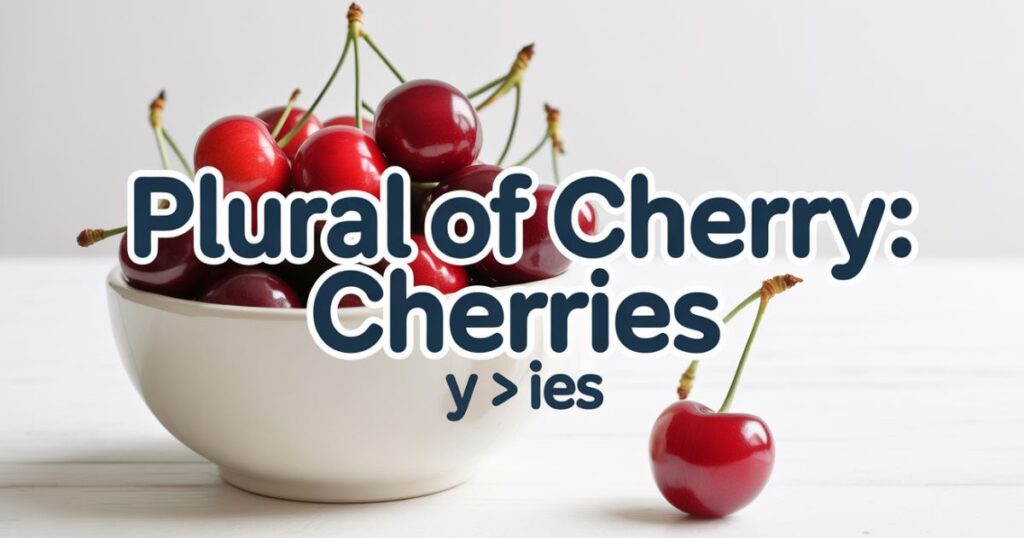
Ever stood in the grocery store, texting a friend about those gorgeous red fruits, and suddenly froze? Should you write “I’m buying cherrys” or “I’m buying cherries”? You’re not alone in this fruity grammar dilemma.
The answer is simple: cherries. That’s it. No debate, no exceptions, no confusion.
But why does cherry become cherries? What’s the rule behind this transformation? And how does this compare to similar fruits like berry to berries or strawberry to strawberries? Let’s dive deep into the world of English pluralization and settle this once and for all.
What is the Plural of Cherry in English?
The Simple Answer: Cherries
The correct spelling of cherries is C-H-E-R-R-I-E-S. When you see a single cherry fruit and want to describe multiple ones, you drop the Y and add IES. This isn’t some random quirk it’s a fundamental English grammar rule.
Think of it like this:
- Single cherry sitting on your counter
- Bowl full of cherries ready for baking
- One piece of fruit vs. many fruits
The cherry plural form follows a predictable pattern that applies to hundreds of English words. Once you understand why cherry becomes cherries, you’ll never second-guess this spelling again.
Why Do We Change Y to IES?
Here’s where grammar gets interesting. English has specific pluralization rules for nouns ending in Y. The key factor? What letter comes before that Y.
The consonant before Y rule works like this:
When a consonant (any letter except A, E, I, O, U) sits directly before the Y, you change Y to IES to form the plural.
| Singular | Letter Before Y | Plural | Rule Applied |
|---|---|---|---|
| Cherry | R (consonant) | Cherries | Y → IES |
| Berry | R (consonant) | Berries | Y → IES |
| Spy | P (consonant) | Spies | Y → IES |
| Baby | B (consonant) | Babies | Y → IES |
But here’s the twist: when a vowel comes before Y, you simply add S.
The vowel before Y plural pattern:
| Singular | Letter Before Y | Plural | Rule Applied |
|---|---|---|---|
| Key | E (vowel) | Keys | Just add S |
| Day | A (vowel) | Days | Just add S |
| Boy | O (vowel) | Boys | Just add S |
This explains the key to keys example perfectly. Notice how the rule changes based on that crucial letter right before the Y?
Common Mistakes People Make
The most frequent error? Writing “cherrys” with just an S added. This happens because many nouns in English follow standard pluralization patterns where you simply toss an S at the end. Think: apple becomes apples, orange becomes oranges.
Your brain wants to apply this simple rule everywhere. But nouns ending in Y after a consonant demand special attention.
Other spelling mistakes include:
- Cherry’s (that’s possessive, not plural)
- Cherrie’s (double error wrong ending plus unnecessary apostrophe)
- Cherris (missing the E entirely)
Autocorrect sometimes catches these errors. Sometimes it doesn’t. That’s why understanding how to form plurals ending in Y matters more than relying on technology.
What is the Plural of Cherry in English (Deep Dive)
Historical Etymology of the Word Cherry
The word cherry traveled through multiple languages before landing in English. It started as the Greek word “kerasos,” transformed into Latin “cerasus,” then journeyed through Old French as “cerise.”
Here’s something fascinating: the English word cherry is actually a back-formation. English speakers heard the French word “cerise” and thought it was already plural, so they created the singular “cherry.” Then we applied our own English plural rules to create “cherries.”
This linguistic journey explains why cherry grammar rules follow English patterns rather than maintaining French pluralization conventions.
Singular vs. Plural Usage in Context
Knowing the difference between cherry and cherries affects how you communicate. Let’s look at real-world applications:
When to use the singular cherry:
- Describing flavor: “I love cherry pie”
- As an adjective: “She wore cherry-red lipstick”
- Discussing one fruit: “A cherry fell from the tree”
- In compound words: “Cherry blossom season arrived early”
When to use the plural cherries:
- Counting multiple fruits: “I ate twelve fresh cherries”
- In recipes: “Add two cups of frozen cherries”
- Shopping contexts: “Cherries cost five dollars per pound”
- Describing groups: “Tart cherries work best for preserves”
Notice how examples of cherries in sentences show the fruit itself, while cherry often functions as a descriptor?
What is the Plural of Cherry in French
The French Word for Cherry
In French, a single cherry is “cerise” (pronounced sehr-EEZE). Multiple cherries become “cerises” (sehr-EEZ-uh). The pronunciation barely changes you add a slight plural sound at the end.
This demonstrates how different languages handle pluralization. French simply adds S to most nouns. English, with our change Y to IES rule, creates more dramatic spelling transformations.
French Pluralization Rules vs. English
French grammar follows simpler patterns than English for most plural nouns. They add S or X depending on the word ending. English pluralization examples show much more variety: we change Y to IES, add ES to words ending in S or X, keep some words identical (like sheep), and have irregular forms (mouse to mice).
| Language | Singular | Plural | Method |
|---|---|---|---|
| French | Cerise | Cerises | Add S |
| English | Cherry | Cherries | Y → IES |
| Spanish | Cereza | Cerezas | Add S |
| German | Kirsche | Kirschen | Add N |
English speakers learning French often find fruit plural forms easier. French learners tackling English struggle with our complex rules for nouns ending in Y.
Cultural Context: Cherries in French Cuisine
The French use cerises in magnificent desserts. Clafoutis, a traditional French dish, features cherries baked in thick batter. Cherry brandy, known as “kirsch,” plays a starring role in fondue and sauces.
Understanding how languages pluralize cherry helps when reading international recipes or traveling. When you see “cerises” on a French menu, you know you’re getting multiple cherries in your dessert, not some mysterious ingredient.
What is the Plural of Cherry Fruit
Botanical vs. Culinary Classification
Botanically speaking, a cherry is a drupe a fruit with a single seed surrounded by flesh. The cherry plural rule applies whether you’re discussing sweet cherries (Prunus avium) or sour cherries (Prunus cerasus).
Scientists refer to multiple specimens as cherries when conducting research. In culinary contexts, chefs also use cherries when preparing meals or writing menus. Both fields follow identical grammar tips for plural nouns.
Different Types of Cherries and Their Plurals
Every cherry variety uses cherries as its plural:
Sweet Cherry Varieties:
- Bing cherries (dark, almost black when ripe)
- Rainier cherries (yellow with red blush)
- Lambert cherries (heart-shaped, deep red)
Sour Cherry Varieties:
- Montmorency cherries (most common tart variety)
- Morello cherries (darker, used in preserves)
- Amarelle cherries (lighter color, clear juice)
Notice how we say “Bing cherries,” not “Bings cherry”? The variety name stays singular while cherries takes the plural form. This pattern holds for all fruit names plural spelling.
Using “Cherry” as an Adjective
When cherry describes another noun, it remains singular even if that noun is plural:
- ✓ Cherry trees (not cherries trees)
- ✓ Cherry blossoms (not cherries blossoms)
- ✓ Cherry pies (not cherries pies)
However, when cherries is the main noun, grammar rules change:
- ✓ “These cherries came from local cherry orchards”
- ✓ “I’m baking cherry tarts with fresh cherries”
Understanding this distinction prevents awkward phrasing in writing.
Read This Article: What is the Abbreviation for County? Understanding Its Meaning and Usage
Examples of Using the Plural of Cherry in A Sentence

Everyday Conversational Examples
Here are natural examples using cherries in daily life:
- “I bought two pounds of cherries yesterday.”
- “Fresh cherries taste better than frozen ones.”
- “Can you pit these cherries for me?”
- “The farmer’s market had beautiful dark cherries.”
- “She tossed cherries into her morning oatmeal.”
- “Cherries grow best in temperate climates.”
- “I’m preserving cherries for winter desserts.”
- “Those cherries look perfectly ripe for eating.”
- “Blend frozen cherries into your smoothie today.”
- “Dark chocolate covered cherries disappeared quickly from plates.”
Formal and Written Context Examples
In culinary writing: “The chef prepared duck with cherries, creating a succulent sauce that balanced savory and sweet profiles perfectly.”
In agricultural reports: “Cherry production increased seventeen percent this season. Farmers attribute abundant cherries to ideal weather patterns throughout spring.”
In nutritional content: “Tart cherries contain higher antioxidant levels than sweet varieties. Consuming fresh cherries daily may reduce inflammation markers.”
Common Phrases and Idioms
The phrase “life is just a bowl of cherries” uses the plural form because it suggests abundance and multiple opportunities. Cherry-picking, meaning to select the best items, can transform into its plural form when discussing multiple selections: “Stop cherry-picking examples” or “Their cherries were picked carefully.”
Incorrect vs. Correct Usage
| ❌ Incorrect | ✓ Correct | Why? |
|---|---|---|
| I ate five cherrys | I ate five cherries | Must apply Y → IES rule |
| The cherry’s are ripe | The cherries are ripe | No apostrophe in plurals |
| Cherry was everywhere | Cherries were everywhere | Plural subject needs plural noun |
| Blend some cherry | Blend some cherries | Countable nouns need proper plural |
Frequently Asked Questions
Is it Cherries or Cherrys?
Cherries is the only correct spelling. The word cherrys doesn’t exist in standard English. Any spell-checker worth its salt will flag “cherrys” as incorrect immediately.
Memory trick: Think “Very Hairy Berries” – when you see consonant + Y, imagine those letters getting hairy and needing IES instead.
What About Cherry’s with an Apostrophe?
Cherry’s indicates possession, not quantity. Use it only when something belongs to the cherry:
- ✓ “The cherry’s pit was enormous” (the pit belonging to one cherry)
- ✓ “The cherries’ stems were still attached” (stems belonging to multiple cherries)
- ❌ “I love cherry’s in my lemonade” (wrong no possession here)
This remains one of the most common apostrophe errors in English writing.
How Do You Spell the Plural of Cherry?
C-H-E-R-R-I-E-S. Seven letters total. Drop the Y from cherry, add IES.
Step-by-step breakdown:
- Start with CHERRY
- Remove the Y: CHERR
- Add IES: CHERRIES
Can Cherry Ever Be Used as a Plural?
Never. Cherry is exclusively singular when referring to the fruit itself. The only time cherry appears with plural nouns is when it functions as an adjective modifying those nouns (cherry trees, cherry recipes, cherry pies).
What About Other Berry Plurals?
All follow the same consonant before Y plural pattern:
- Berry → Berries (R before Y)
- Strawberry → Strawberries (R before Y)
- Blueberry → Blueberries (R before Y)
- Raspberry → Raspberries (P before Y)
- Cranberry → Cranberries (R before Y)
The plural of berry demonstrates this rule perfectly. Notice how consistent English grammar plural nouns become once you understand the underlying pattern?
Do Other Languages Pluralize Cherry Differently?
Absolutely. Each language has unique pluralization rules:
- Spanish: Cereza becomes cerezas (add S)
- Italian: Ciliegia becomes ciliegie (change A to E)
- German: Kirsche becomes Kirschen (add N)
- Portuguese: Cereja becomes cerejas (add S)
English stands out with our change Y to IES rule. Most Romance languages simply add S or minor vowel modifications.
Is There Ever a Time to Write “Cherry” for Multiple Fruits?
No. When counting or describing multiple cherry fruits, you must write cherries. The only exception involves using cherry as an adjective or flavor descriptor:
- ✓ “Cherry flavor” (describing the flavor type)
- ✓ “Cherry-flavored candies” (adjective modifying candies)
- ❌ “A basket of cherry” (incorrect needs cherries)
Your Cherry Grammar Takeaway
The plural of cherry is cherries always. This follows the reliable rule that nouns ending in Y after a consonant transform to IES in their plural forms. Understanding this pattern helps you confidently spell berries, babies, spies, and hundreds of other English words correctly.
Next time you’re writing about these delicious fruits whether discussing fresh cherries in salads, frozen cherries for smoothies, or tart cherries in desserts you’ll nail the spelling every single time. Grammar doesn’t need to be confusing. Sometimes it just needs one clear explanation to stick permanently in your mind.
Now go enjoy some cherries without worrying about spelling! 🍒

Flairsy is the word expert behind Englishfixerr.com, helping readers find the perfect synonyms and simple word choices. With a love for clarity and creativity, Flairsy makes English easy and stylish. From tricky terms to everyday phrases, he turns confusion into confidence.