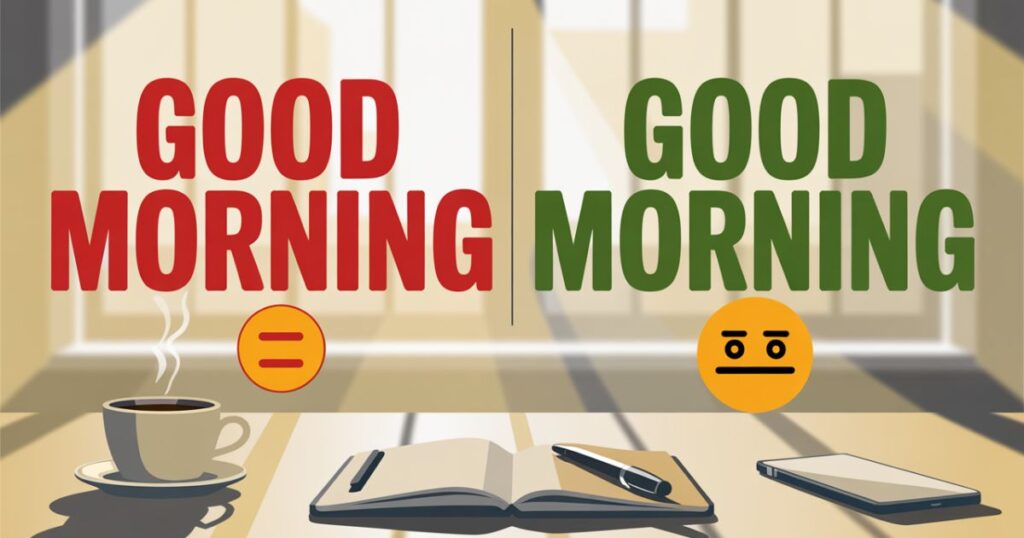
You wake up. You grab your phone. You type a quick message to your colleague. “Goodmorning! Ready for today’s meeting?” You hit send without thinking twice. But here’s the thing you just made one of English’s most common spelling mistakes.
This seemingly tiny error appears in countless emails, text messages, and social media posts every single day. The confusion between “goodmorning” and “good morning” trips up native speakers and English learners alike. But don’t worry. By the end of this guide, you’ll never second-guess yourself again.
Let’s dive into the correct English usage that’ll boost your communication skills instantly.
Understanding “Goodmorning” and “Good Morning”
Here’s the straightforward answer: “good morning” is always two separate words. Always. No exceptions in standard English.
The single-word version “goodmorning” doesn’t exist in any reputable dictionary. It’s not a compound word. It’s simply an incorrect spelling that’s become surprisingly widespread thanks to fast typing and autocorrect failures.
Think of it this way. “Good” functions as an adjective describing the noun “morning.” This grammatical structure requires word spacing between these two distinct parts of speech. You wouldn’t write “beautifulday” or “happybirthday,” right? The same logic applies here.
Why It’s Important to Get It Right
Getting morning greetings correct matters more than you might think.
Professional credibility takes a hit when your emails contain basic spelling errors. Hiring managers notice. Clients notice. Your boss definitely notices. A simple “goodmorning” typo in your cover letter could cost you that dream job interview.
Research shows that grammatical accuracy directly impacts how others perceive your intelligence and attention to detail. Fair or not, people make snap judgments based on written communication. One study found that 77% of recruiters eliminate candidates based on spelling and grammar mistakes.
Beyond professional settings, correct English usage demonstrates respect for your reader. It shows you care enough to communicate clearly. In our digital communication age, these small details build or damage your personal brand with every message sent.
Is “Good Morning” One Word? and Is “Goodmorning” One Word?
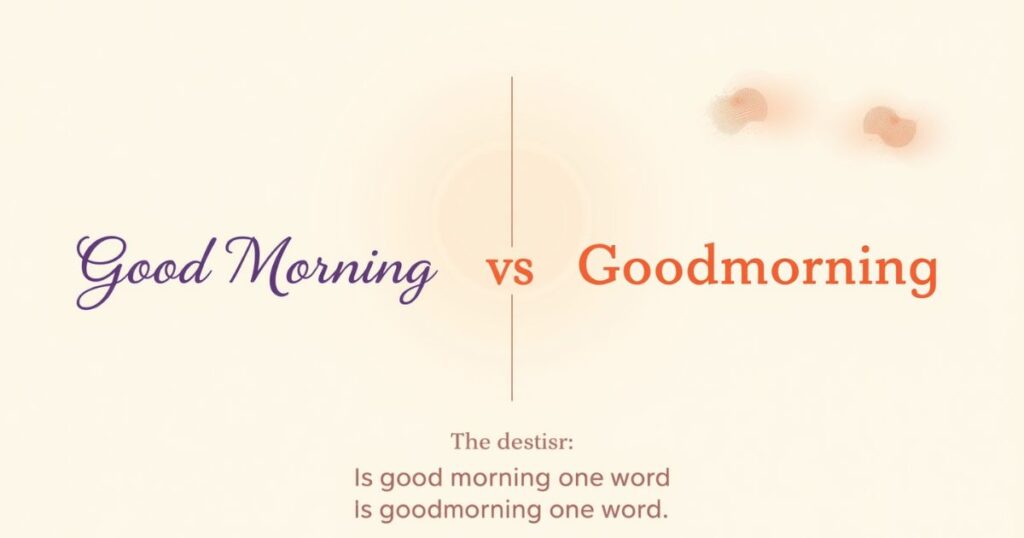
Let’s answer both questions definitively.
Is “good morning” one word? No. It’s two separate words that must maintain proper word spacing.
Is “goodmorning” one word? Absolutely not. This version represents an incorrect spelling that violates English grammar rules.
The confusion likely stems from compound words like “goodbye.” That greeting actually evolved from the phrase “God be with you,” which eventually merged into a single word through centuries of linguistic evolution. But “good morning” never underwent this transformation.
The Oxford English Dictionary and all major style guides including AP Stylebook and Chicago Manual of Style unanimously confirm the two-word format. Webster’s, Merriam-Webster, and Cambridge dictionaries all list it identically.
Breaking Down Each Phrase
Good Morning: Definition and Proper Usage
“Good morning” serves as a standard English greeting used from dawn until roughly noon. The phrase structure combines:
- Good (adjective): expressing wishes for something pleasant or beneficial
- Morning (noun): the period between midnight and noon, especially dawn to midday
Together, they create a polite morning expression meaning “I wish you a pleasant morning” or “I hope your morning goes well.”
Proper usage examples:
- “Good morning, everyone! Let’s make today count.”
- “She walked into the office with a cheerful good morning.”
- “Good morning, Mr. Thompson. Your meeting starts soon.”
The phrase works as both a standalone greeting and within longer sentences. Its versatility makes it essential for formal and informal communication alike.
History of “Good Morning”
The morning greeting history stretches back centuries. English speakers began using “good morning” regularly around the 1400s. Before this, people used variations like “good morrow” (from Middle English “morwen”).
The evolution of morning greeting phrases reflects broader linguistic shifts. As English modernized, “morrow” transformed into “morning,” but the two-word structure persisted. This historical consistency matters if language naturally wanted these words combined, centuries would’ve accomplished it.
Interestingly, most languages maintain separation in their morning greetings too:
- Spanish: “Buenos días” (good days)
- French: “Bonjour” (good day)
- German: “Guten Morgen” (good morning)
This cross-cultural pattern reinforces the logical word spacing rule.
Goodmorning: Why It’s Incorrect
“Goodmorning” fails every grammatical test. Here’s why it’ll never appear in standard dictionaries:
Adjective-noun combinations don’t merge in English. We don’t write “bighouse,” “fastcar,” or “coldwater.” The same principle applies to time-of-day greetings. You’d never write “goodafternoon” or “goodevening,” right?
Your spell-check flags “goodmorning” as an error because it violates fundamental spelling conventions. The red squiggly line isn’t being picky it’s protecting you from a genuine mistake.
No respected grammar authority recognizes this spelling. Not in academic writing. Not in professional settings. Not in creative contexts. The unanimity here is remarkable.
Common Causes of the Error
Why does this common spelling mistake persist? Several factors contribute:
Fast typing creates the perfect storm. Your fingers fly across the keyboard, and that space key gets skipped. Before you know it, “goodmorning” appears on screen.
Autocorrect inconsistency confuses matters. Some systems catch the error; others don’t. Mobile keyboards particularly struggle with this detection.
The “goodbye” effect misleads people. Since one farewell greeting exists as a compound word, learners assume morning greetings work identically. They don’t.
Social media culture prioritizes speed over accuracy. Informal platforms create environments where quick typing trumps correct spelling. These habits then bleed into professional communication.
English learners face extra challenges. When studying proper English usage, these spacing rules aren’t always explicitly taught. Pattern recognition leads to incorrect assumptions.
Side-by-Side Comparison of “Good Morning” and “Goodmorning”
| Aspect | Good Morning ✓ | Goodmorning ✗ |
|---|---|---|
| Dictionary Recognition | Yes—all major dictionaries | No—appears nowhere |
| Grammatical Status | Correct adjective + noun | Incorrect formation |
| Professional Acceptability | Always appropriate | Never acceptable |
| Spell-Check Response | No errors flagged | Marked as incorrect |
| Usage Frequency | Standard everywhere | Only in errors |
| Formal Communication | Required format | Rejected format |
| Style Guide Approval | Universal approval | Universal rejection |
This quick comparison makes the distinction crystal clear. Save this table for future reference.
Rise and Shine: Inspiring Quotes to Start Your Morning Right!

Nothing beats starting your day with motivational morning messages. Here are powerful quotes that properly demonstrate “good morning” usage:
- “Every morning is a beautiful morning.” — Anonymous
- “With the new day comes new strength and new thoughts.” — Eleanor Roosevelt
- “The morning was full of sunlight and hope.” — Kate Chopin
- “Each morning we are born again. What we do today matters most.” — Buddha
- “A day without laughter is a day wasted.” — Charlie Chaplin
- “Write it on your heart that every day is the best day in the year.” — Ralph Waldo Emerson
- “Rise up, start fresh, and see the bright opportunity in each day.” — Anonymous
- “Morning is wonderful. Its only drawback is that it comes at such an inconvenient time of day.” — Glen Cook
These sunrise quotes remind us why correct morning greetings matter they set the tone for positive morning messages that inspire productive days.
Using “Good Morning” in Everyday Language
Formal Situations
Professional settings demand impeccable language accuracy. Here’s where correct spelling becomes non-negotiable.
Business email greetings should always open with “Good morning” when sent before noon. Example: “Good morning, Ms. Davis. Thank you for yesterday’s productive discussion.” This demonstrates professionalism and attention to linguistic detail.
Workplace communication relies heavily on proper greetings. Whether addressing your team or company executives, the two-word format shows respect. “Good morning, everyone” starts meetings on the right foot.
Job interviews begin with first impressions. A correctly written follow-up email “Good morning, Sarah. Thank you for considering my application” reinforces your communication skills.
Academic contexts require formal language usage. Emailing professors? “Good morning, Dr. Thompson” beats casual alternatives every time.
Informal Situations
Casual settings allow relaxed tones, but correct English greetings still apply.
Text messaging etiquette might embrace abbreviations like “GM” (good morning abbreviation), but when spelling out the full phrase, maintain proper spacing. “Good morning! Coffee soon?” works perfectly.
Social media posts benefit from accuracy too. Even in informal communication platforms, demonstrating linguistic accuracy builds credibility. Your followers notice these details.
Friends and family messages create space for warmth without sacrificing correctness. “Good morning, sunshine! Hope your day rocks!” feels personal and grammatically sound.
Additional Contexts
International business communication requires extra care. Non-native speakers appreciate clear, correct English usage that follows established conventions.
Creative writing dialogue should reflect natural speech. Characters say “good morning” in novels, scripts, and stories maintaining realistic everyday communication phrases.
Greeting cards and personal notes blend sentiment with proper grammar. “Good morning to someone special” works beautifully on handwritten messages.
Read This Article: 📏 Gauging Interest vs Gaging Interest
Common Mistakes and How to Avoid Them
Beyond the goodmorning/good morning confusion, several related grammar mistakes plague morning greetings.
Capitalization errors run rampant. Remember: capitalize “Good” only at sentence starts or in titles. Mid-sentence, use lowercase: “I wished him good morning.”
“Good afternoon” confusion creates similar spacing issues. Some write “goodafternoon” equally wrong. Apply identical rules: always two words.
Time-based greeting mix-ups happen when you’re unclear about dawn to noon greeting rules. Generally, switch from “good morning” to “good afternoon” after 12:00 PM.
Punctuation problems emerge too. “Good morning!” with an exclamation point adds enthusiasm. “Good morning,” followed by a name requires a comma. “Good morning.” stands alone with a period.
Tips for Avoiding Errors
Master these English language learning tips for flawless greetings:
Remember the structure: Adjective plus noun equals two words always. This simple rule prevents countless mistakes.
Visualize other time greetings: If “good afternoon” and “good evening” stay separate, “good morning” must too.
Use grammar-check tools: Install Grammarly or similar applications. These catch spacing errors before they reach recipients.
Practice deliberately: Write the correct version repeatedly. Muscle memory develops through conscious repetition.
Proofread everything: Before hitting send, scan for this common typo. Five seconds of review prevents professional embarrassment.
Quick Tips for Accurate Morning Communication
- Always maintain two separate words
- Capitalize only at sentence beginnings
- Remember: adjective describes noun separately
- Compare to “good afternoon” pattern
- Use browser extensions for real-time checking
- Learn from mistakes without harsh self-judgment
- Keep digital style guides bookmarked
- Practice in low-pressure situations first
- Understand underlying grammar, not just rules
- Make learning enjoyable through daily application
FAQ: Addressing Common Questions About “Good Morning” vs. “Goodmorning”
Is it goodmorning or good morning?
It’s always “good morning” two separate words. This represents the only correct spelling in standard English. The single-word version “goodmorning” never appears in reputable dictionaries and violates basic word formation rules.
Is Good morning capitalized?
Capitalization depends on position. Capitalize “Good” at sentence beginnings: “Good morning, team!” Use lowercase mid-sentence: “I said good morning to everyone.” In email subject lines, follow title case for formal messages: “Good Morning and Welcome Aboard.”
Is it good morning or good afternoon?
Choose based on timing conventions. Use “good morning” from dawn until roughly noon. After 12:00 PM, switch to “good afternoon.” Some flexibility exists around the transition hour context and personal judgment matter. When uncertain, “good afternoon” from 12:00 PM onward stays safe.
Is Good morning one word in email?
No. “Good morning” remains two words in emails and all written formats. Digital communication doesn’t change grammatical standards. Whether texting, emailing, or posting on social media, proper word spacing applies consistently.
Why is “Goodmorning” wrong?
“Goodmorning” violates English phrase structure rules. Adjectives and nouns don’t merge in this language pattern. The grammatical relationship between these word types requires separation. Every authoritative source confirms this spelling convention without exception.
Can “Goodmorning” ever be correct in any context?
In standard English communication, never. However, creative contexts offer rare exceptions. Brand names might intentionally use “Goodmorning” for stylistic effect. Artistic license in poetry or experimental writing might break rules deliberately. But in everyday usage professional, academic, or casual stick with the correct two-word format.
Advanced Tips for Proper Greeting Etiquette
Tone and Timing
Professional tone requires matching your greeting to the relationship. “Good morning, Dr. Anderson” sounds appropriate for formal settings. “Good morning, buddy!” fits casual contexts perfectly.
Cultural sensitivity matters internationally. While “good morning” translates well across English-speaking regions, good morning cultural variations exist. Japanese culture, for instance, distinguishes between “ohayou” (casual) and “ohayou gozaimasu” (formal) teaching us that context shapes greetings everywhere.
Enthusiasm levels communicate through punctuation and word choice. “Good morning!” conveys energy. “Good morning.” reads neutral. Adjust based on your message’s purpose.
Digital Communication Tips
Email best practices suggest starting with “Good morning” when sending before noon. This creates a polite greeting foundation before diving into business matters.
Professional networking platforms like LinkedIn benefit from proper greetings. Message templates might read: “Good morning, John. I noticed your expertise in…”
Video conferencing etiquette recommends verbal “good morning” greetings when joining meetings. This acknowledges participants and establishes communication clarity.
Text message conventions allow the abbreviation “GM” among friends, but spelling out “good morning” maintains warmth and personal connection.
Bonus Tip: Improving Your English Language Skills
Tools for Better Grammar
Grammarly catches spelling mistakes and suggests improvements in real-time. The free version handles basic errors; premium offers advanced feedback.
Hemingway Editor improves readability by highlighting complex sentences. Better sentence structure naturally reduces errors.
Oxford English Dictionary online provides authoritative definitions. When questioning any proper English usage, check here first.
These grammar-check tool suggestions transform good writers into great ones through consistent feedback.
Practice Exercises
Strengthen your communication skills through deliberate practice:
Daily writing prompts: Start each morning journal entry with “Good morning” and a reflection. Repetition builds automatic correctness.
Email drafting practice: Compose practice messages using morning greetings. Review for spacing errors before moving to real correspondence.
Peer review exchanges: Share writing with friends who catch mistakes you’ve missed. Fresh eyes spot patterns you’ve overlooked.
Grammar quizzes: Online platforms offer interactive exercises targeting common mistakes. Regular practice shows measurable improvement.
Fun Fact
Here’s something fascinating: English contains approximately 171,476 words currently in use, yet “goodmorning” isn’t among them! Despite millions of people accidentally writing it this way, language authorities have never recognized the merged spelling in over 600 years of “good morning” usage.
Another interesting tidbit: “goodbye” took 300 years to evolve from “God be with you” into its current compound form. Language changes slowly through common usage and “good morning” has resisted this change entirely. That’s linguistic stability at work!
Conclusion
You’ve now mastered the difference between phrases that confuses so many English users. Remember this core truth: “good morning” is always two words. Never one. Not in emails. Not in texts. Not on social media. Not anywhere.
This small detail carries big implications. Correct spelling demonstrates professionalism, respects your reader, and builds credibility. Whether crafting business email greetings or sending quick texts to friends, proper grammar matters.
Start tomorrow by consciously typing “good morning” with that crucial space. Within weeks, correct usage becomes automatic. Your professional image improves. Your communication clarity sharpens. Your confidence grows.
Language serves as your personal brand. Make every word count. Use proper word spacing. Follow grammatical standards. These fundamentals separate memorable communicators from forgettable ones.
Now go forth and greet the world correctly. Good morning, and good luck with your improved English skills!

Flairsy is the word expert behind Englishfixerr.com, helping readers find the perfect synonyms and simple word choices. With a love for clarity and creativity, Flairsy makes English easy and stylish. From tricky terms to everyday phrases, he turns confusion into confidence.