
Ever typed “beaf” and watched that red squiggly line appear underneath? You’re not alone. This common spelling mistake trips up countless writers daily. Here’s the truth: only beef is correct. “Beaf” doesn’t exist in English dictionaries anywhere.
Whether you’re ordering a hamburger, discussing hip-hop rivalry, or writing a professional email, getting this spelling right matters tremendously. Let’s dive into why this confusion happens. You’ll discover memory tricks that stick permanently. By the end, you’ll never second-guess yourself again.
Beef vs Beaf: The Correct Spelling
The correct spelling of beef uses double “e” always. No exceptions exist in American or British English. Check any dictionary: Merriam-Webster, Oxford, Cambridge. You’ll find only “beef” listed as legitimate. The beaf misspelling appears nowhere in official sources.
Why this matters: Professional credibility crumbles with spelling errors. Microsoft Word flags “beaf” immediately with red underlines. Google Docs does the same without hesitation. These tools recognize incorrect patterns instantly because standard English follows specific rules.
Beef follows consistent English spelling rules perfectly. The double “e” creates that elongated sound. Think about similar words: feet, meet, sheet. They all share identical spelling patterns in English. Your brain recognizes these connections naturally with exposure.
Historical records show “beef” remained unchanged for centuries. From Old French “boef” to modern usage, consistency prevailed. No regional variations emerged across English-speaking countries globally. This uniformity makes learning easier than alternatives.
Why Do People Spell It as “Beaf”?

Spelling errors reveal fascinating insights about phonetic confusion. The beaf typo isn’t random carelessness alone. Several factors create this persistent mistake naturally.
Common reasons for the “beaf” mistake:
Phonetic spelling misleads inexperienced writers frequently. English pronunciation doesn’t always match spelling logically. The long “ee” sound confuses learners initially. They hear correctly but guess wrong subsequently.
Autocorrect failures allow typos to slip through occasionally. Quick typing produces transposed letters naturally sometimes. Your fingers move faster than consciousness tracks. Mobile keyboards increase this error rate significantly.
Non-native learners face unique challenges with English irregular spelling. Their native languages might follow different patterns. What works elsewhere doesn’t apply here unfortunately. English learners spelling issues multiply when phonetic rules conflict.
Pattern misapplication happens when students overgeneralize rules incorrectly. They notice “leaf,” “deaf,” and “sheaf” use “ea.” Logic suggests applying this pattern everywhere consistently. Unfortunately, English doesn’t cooperate with such expectations.
Lack of exposure to written English prevents visual memory formation. Reading builds unconscious spelling knowledge gradually over time. Less reading means fewer correct pattern encounters naturally. This explains why misspelled food words appear frequently online.
Digital communication encourages speed over precision constantly nowadays. Abbreviations become normalized in texting culture quickly. People stop checking casual writing habits carefully. This carelessness bleeds into formal contexts eventually.
The Meaning of “Beef” in English
Beef definition includes multiple meanings across various contexts. Understanding these variations solidifies correct usage permanently.
Literal meaning:
Beef refers to cattle meat consumed as food. This protein dominates diets across numerous cultures globally. Steaks, hamburgers, roasts all qualify as beef products.
Different cuts serve distinct purposes:
- Ribeye delivers marbled, tender eating experiences
- Brisket requires slow cooking for optimal results
- Ground beef appears in countless recipe variations
The global beef market represents massive economic importance. According to Statista, the global beef industry valued at $418 billion in 2023. Countries like the United States, Brazil, and China dominate production significantly.
Nutritional discussions center on beef consumption regularly. It provides protein, iron, and essential vitamins. Health debates continue about red meat’s impacts.
Figurative/slang meanings:
“Having beef” means maintaining an ongoing dispute or argument. Two rappers might have beef over territorial disagreements. Friends can develop beef over betrayed trust issues.
Example: “They’ve had beef since high school.”
Beef slang meaning extends to complaints generally. “What’s your beef?” asks about someone’s problem directly. This casual expression requests explanation for dissatisfaction naturally. Beef in hip-hop culture popularized this usage massively.
“Adding beef” means increasing strength or substance. Athletes add beef (muscle mass) through training. Writers add beef (depth) to weak arguments.
Idiomatic expressions:
“Where’s the beef?” originated from a 1984 Wendy’s commercial. It questions substance behind flashy presentations everywhere. Politicians and critics still reference this phrase.
“Beef up” means strengthen something significantly. “Beef up your resume” suggests adding skills. The beefed up meaning implies enhancement or improvement.
Corned beef, roast beef sandwiches, and beef stew represent specific culinary terms. These never vary in spelling ever.
Spelling Rules That Apply to “Beef”
English follows patterns despite seeming chaotic initially. Beef demonstrates several long e spelling rules clearly.
The “EE” vowel team creates predictable sounds consistently. Two vowels together make the first say its name. Examples proving this: cheese, freeze, steel, wheel.
The pattern appears in thousands of words:
- Reef, brief, grief, relief
- All follow identical “ee + f” structure
- Your brain recognizes patterns automatically
No silent “e” needed: The double vowel already creates length required. Adding another vowel would confuse pronunciation completely.
Compare confusing ea and ee words carefully. “Leaf” uses “ea” but sounds different. “Deaf” also uses “ea” with altered pronunciation. These variations prove complexity exists, but patterns help.
The history of “beef”
Etymology of beef traces back to Anglo-Norman French. The origin of beef word stems from “boef” originally. Norman Conquest of 1066 brought French culinary vocabulary to England.
Fascinating class distinction emerged historically. Peasants raised “cows” in fields daily. Norman nobles ate “beef” at fancy tables. This division created our cow/beef split. Pork/pig and mutton/sheep follow identical patterns.
Beef history in English shows spelling evolution. Middle English used various spellings initially: bef, befe. By the 1300s, standardization occurred naturally. Printing press technology cemented “beef” permanently.
Real-World Usage of “Beef”
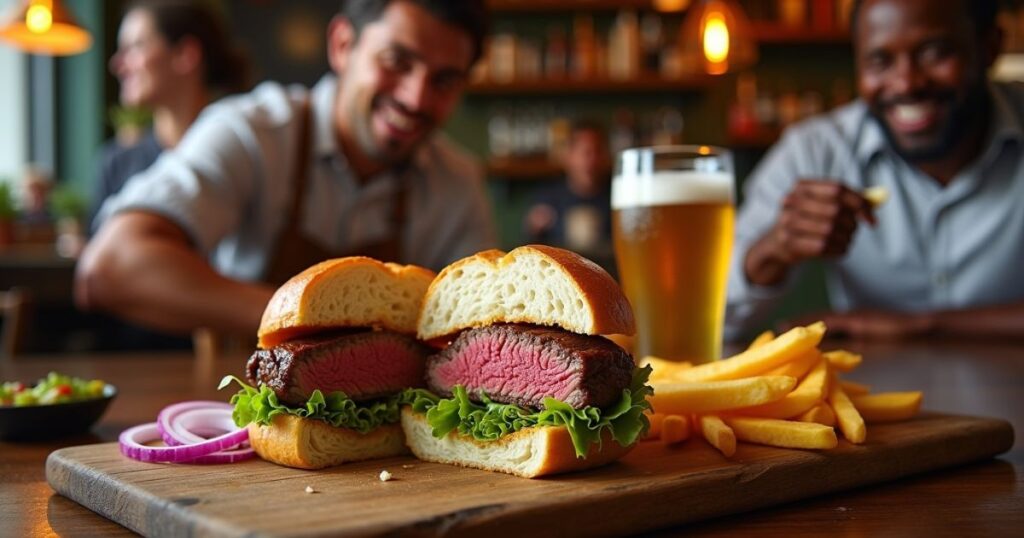
Usage of beef in sentences appears across countless contexts beyond dictionaries.
In food:
Restaurant menus feature beef burger and beef steak prominently. Fast food chains advertise their beef products heavily. Grocery stores label packages clearly and consistently.
Beef dishes vary globally:
- Wagyu beef represents premium Japanese quality
- Beef curry dominates Indian cuisine
- Roast beef defines classic American meals
Beef recipes flood food blogs constantly. Television cooking shows discuss preparation techniques extensively. Cultural dishes showcase regional beef preferences.
In culture and slang:
Beef in hip-hop created legendary rivalries throughout history. Rap feuds became cultural phenomena with lasting impact. Modern artists reference having beef in lyrics.
Social media drama uses “beef” terminology universally. Twitter users declare beef with brands regularly. Instagram comments ask “what’s the beef?” constantly.
Beef cultural references permeate movies and television naturally. Scripts use slang in dialogue authentically. This terminology transcends generational and cultural boundaries.
In business and economics:
Beef industry facts dominate agricultural reports extensively. Economic forecasts predict prices for coming quarters. Trade publications cover export markets thoroughly.
Market analysts track commodity prices on exchanges. Supply chain experts study distribution logistics carefully. Retailers plan inventory based on demand.
| Beef Statistics | 2023 Data |
|---|---|
| Global market value | $418 billion |
| Top producer | United States |
| Per capita consumption (U.S.) | 58.9 pounds/year |
| Major importers | Japan, China |
Incorrect Variations of “Beef”
Common beef misspellings reveal interesting learning patterns consistently.
Common misspellings include:
“Beaf” remains the most frequent error overall. It switches vowel order incorrectly but maintains sound. Why beaf is incorrect: English phonetic patterns don’t support this.
“Beefe” attempts using silent “e” unnecessarily. This removes the necessary double vowel completely. Mistaken spelling examples like this change pronunciation entirely.
“Bif” swaps vowels in another illogical way. Spelling error patterns like this confuse completely different sounds.
“Beeff” doubles the final consonant without reason. No English word ends “eeff” logically ever.
Why correct spelling matters:
Professional credibility depends on accuracy completely. Clients notice common English spelling errors in communications immediately. Job applications with mistakes often face rejection.
SEO spelling importance affects online visibility significantly. Search engines prioritize correctly spelled content higher. Beef vs beaf SEO shows massive search volume differences.
Clarity in writing ensures messages transmit accurately. Readers shouldn’t decode intended meanings constantly. Academic standards demand perfection always consistently.
Read This Article: What is the Abbreviation for County? Understanding Its Meaning and Usage
How to Remember the Correct Spelling
Spelling memory tricks transform frustration into ease permanently.
Easy tricks to lock in “beef”:
Visual association: Picture a bee flying near food. “Bee” + “f” = “beef” forms perfectly.
Rhyme pattern recognition:
- Think of reef, brief, grief, relief
- All share identical spelling structure
- Recognition becomes automatic through exposure
Mnemonic for beef: “Bees Eat Everything Fresh” uses first letters. Create personal connections that resonate deeply. Silly mnemonics stick better than serious ones.
Muscle memory development: Type “beef” correctly fifty times consecutively. Your fingers learn proper patterns physically. This outlasts conscious recall surprisingly often.
Say while writing: Pronounce each letter as you type slowly. Multi-sensory approaches engage more brain regions. Sound plus motion plus sight equals powerful learning.
Related Words and Phrases
Understanding beef synonyms and related vocabulary enriches language mastery significantly.
Meat-related terms:
- Cattle meat
- Red meat
- Ground beef
- Roast beef
- Veal (young cattle)
Slang alternatives:
- Dispute (formal equivalent)
- Quarrel (similar conflict)
- Grievance (complaint)
- Beef argument meaning (conflict)
Action verbs:
- Beef up (strengthen)
- Complain (register grievance)
- Argue (engage in dispute)
Derivatives:
- Beefy meaning (substantial, muscular)
- Beefiness (substantial quality)
- Beefsteak (thick meat cut)
Quick Reference Table: Beef vs Beaf
| Aspect | Beef | Beaf |
|---|---|---|
| Correct Spelling | ✅ Always | ❌ Never |
| Dictionary Entry | ✅ Exists | ❌ None |
| Beef vs beaf meaning | Meat; conflict | ❌ No meaning |
| Professional Writing | ✅ Required | ❌ Avoid completely |
| Autocorrect | ✅ Recognized | ❌ Flagged immediately |
| Etymology | Old French origin | ❌ Not applicable |
FAQs About Beef vs Beaf
Is “beaf” ever acceptable in English? No, beaf is incorrect everywhere always. Standard dictionaries don’t recognize this variation. Academic and professional writing require “beef” exclusively.
Why does autocorrect sometimes miss “beaf”? Your device might have learned incorrect spelling through repetition. Delete “beaf” from personal dictionary immediately. Modern systems flag this error automatically.
What’s the difference between beef and veal? Beef comes from adult cows raised normally. Veal comes from young calves specifically. Color, texture, and flavor differ significantly.
Can “beef” function as a verb? Absolutely beef means strengthening something actively. “Beef up security” uses it verbally. Professional contexts employ this form regularly.
Where did slang “beef” originate? Early 1900s criminal slang used “beef” meaning complaint. Hip-hop culture popularized it massively during 1980s-90s. Now it’s mainstream across demographics.
Conclusion
Only beef qualifies as correct English spelling period. Why beaf is incorrect comes down to established patterns. You’ve learned etymology, meanings, and usage of beef in sentences. Memory tricks will keep you spelling correctly forever.
Key takeaways: Remember the double “e” pattern consistently. Visual associations make spelling stick permanently. Practice reinforces through consistent repetition naturally. Avoid spelling mistakes in professional contexts always.
Use beef confidently across all writing situations. Professional documents, casual texts, social media consistency matters tremendously. Your writing clarity improves when spelling remains accurate. Clear communication starts with confident, correct spelling throughout.

Flairsy is the word expert behind Englishfixerr.com, helping readers find the perfect synonyms and simple word choices. With a love for clarity and creativity, Flairsy makes English easy and stylish. From tricky terms to everyday phrases, he turns confusion into confidence.