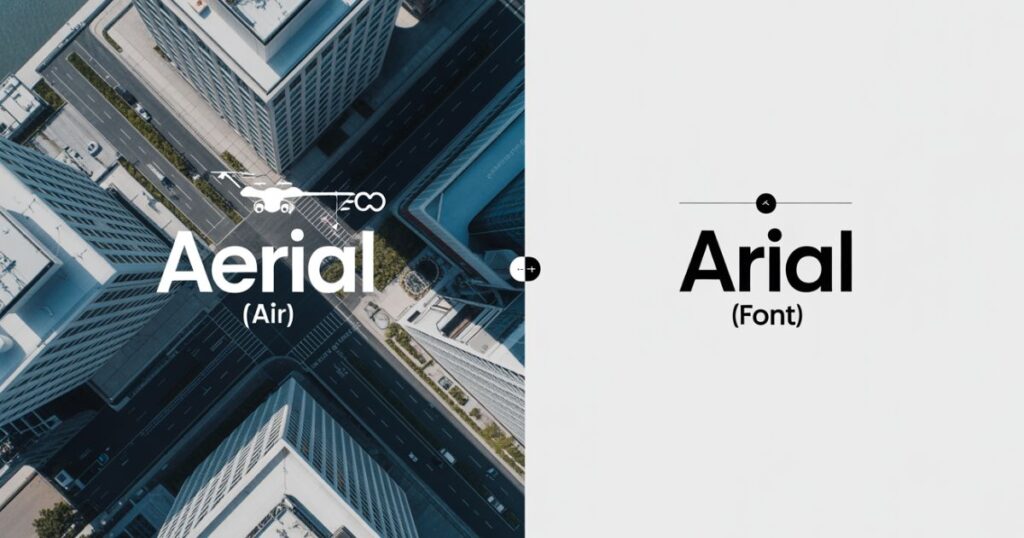
Ever typed “Arial font” and autocorrect changed it to “aerial view”? You’re absolutely not alone. These sound-alike words trip up even the most experienced writers daily. But here’s the reality getting them wrong can make your professional documents and reports look careless.
In 2025, this confusion has only gotten worse. Digital typography tools and autocorrect create more mix-ups than ever before. One moment you’re discussing aerial photography, and the next you’re accidentally talking about fonts. It’s frustrating, honestly.
This guide breaks down everything you need. You’ll learn the difference between Aerial and Arial, see real examples, and get memory tricks that actually stick. Let’s eliminate this confusion forever.
Quick Summary (Aerial vs Arial in a Nutshell)
Aerial relates to air, height, and overhead perspectives. It’s an adjective describing anything airborne or elevated. Think drone footage and aviation terminology.
Arial, on the other hand, is a sans-serif font created by Monotype in 1982. It’s the typeface you see in Microsoft Office and countless web design and branding projects.
| Word | Type | Meaning | Example |
|---|---|---|---|
| Aerial | Adjective/Noun | Related to air | The aerial view was stunning |
| Arial | Proper Noun | Font name | Use Arial for email templates |
The biggest clue? Capitalization. Arial always takes capitals because it’s a proper noun. Aerial typically doesn’t unless it starts a sentence.
Understanding Aerial vs Arial in Grammar
These words sound identical they’re homophones. Your brain processes sound faster than spelling. That’s why spelling confusion happens automatically.
Aerial comes from the Latin root aerius, meaning “of the air.” It’s been in English for centuries. Writers use it for air-related words and descriptions.
Arial was invented by Robin Nicholas and Patricia Saunders at Monotype. They designed it as an alternative to Helvetica. Microsoft chose it as their default font for years before switching to Calibri.
These are completely different parts of speech. Aerial functions as both adjective and noun. Arial only works as a proper noun always capitalized.
Aerial — Meaning, Definition, and Correct Usage
Complete Definition
The aerial meaning encompasses several related concepts. Primarily, it describes anything existing in the air or relating to aircraft. It also refers to overhead meaning or elevated perspectives.
In British English, “aerial” means a television or radio antenna. Americans typically say “antenna” instead. Both uses appear in standard dictionaries worldwide.
Grammatical Function
As an adjective, aerial modifies nouns: “The aerial acrobatics amazed everyone.” As a noun, it stands alone: “She installed a new aerial yesterday.”
Etymology Deep Dive
Greek “aēr” (air) evolved into Latin “aerius.” English adopted it centuries ago. The meaning expanded from simple “of the air” to include aviation terminology and photography contexts.
Common Contexts Where “Aerial” Is Used

The aerial definition applies across multiple industries:
- Aerial photography and videography (drone footage)
- Aviation and aerospace (flight-related descriptions)
- Sports commentary (aerial perspective maneuvers)
- Geography and mapping (topographical studies)
- Telecommunications (British usage primarily)
- Military operations (reconnaissance missions)
- Botany (aerial roots in tropical plants)
Professional photographers now specialize in aerial view work. Drones revolutionized this field completely.
5 Synonyms for Aerial
- Overhead — direct positional substitute for elevated perspectives
- Airborne — emphasizes flying or floating state perfectly
- Elevated — focuses on height and position above ground
- Sky-high — informal variant for casual writing clarity
- Lofty — literary substitute with poetic connotations
These aerial synonyms work in most contexts. Choose based on formality level and specific meaning needed.
Arial — Meaning, Definition, and Correct Usage
Complete Definition
The Arial meaning is straightforward it’s a sans-serif typeface created for digital content clarity. Monotype developed it specifically for IBM printers initially.
Arial font definition: A humanist sans-serif typeface designed in 1982. It features clean lines and excellent screen readability. It became standard in Microsoft Office and Google Docs.
Grammatical Function
Arial functions only as a proper noun. It requires capitalization always. You write “Arial font” or “the Arial typeface,” never “arial.”
Historical Background
Robin Nicholas and Patricia Saunders created Arial at Monotype in 1982. Microsoft licensed it for Windows, making it ubiquitous. The Arial vs Helvetica debate continues among designers today.
Common Contexts Where “Arial” Is Used
Arial font usage appears in:
- Professional business correspondence
- Email templates and signatures
- Resume and CV formatting
- Web design and branding materials
- Advertising layouts and print media
- Presentation slides and reports
- Digital interfaces and applications
Font types and styles matter for readability. Arial provides clean, professional appearance across platforms.
5 Synonyms for Arial
- Helvetica — closest design relative (subtle differences exist)
- Calibri — modern Microsoft replacement since 2007
- Verdana — similar sans-serif with wider spacing
- Tahoma — compact alternative for tight spaces
- Sans-serif — generic category term for technical discussions
These Arial synonyms help in font selection in documents. Each has unique characteristics worth exploring.
Aerial vs Arial — Key Differences Explained
Pronunciation Similarities
Both sound identical: “AIR-ee-ul.” Regional accents barely affect pronunciation. Your ear can’t distinguish them at all.
Meaning Contrast
Aerial describes physical world phenomena air, height, flight. Arial exists only in digital typography and typography in design contexts.
Visual Recognition
Context clues save you. Photography discussions? Probably aerial. Font comparison conversations? Definitely Arial.
| Aspect | Aerial | Arial |
|---|---|---|
| Part of Speech | Adjective/Noun | Proper Noun |
| Capitalization | Lowercase (usually) | Always capitalized |
| Relates to | Air, height, sky | Typography, fonts |
| Origin | Latin/Greek | Modern invention |
| Usage Era | Centuries old | Since 1982 |
Grammar Rules & Usage Tips
Aerial vs Arial grammar follows simple principles. Capitalization indicates the difference immediately. Lowercase “aerial” means air-related. Uppercase “Arial” means font-related.
Context determines everything. Reading about drones? That’s aerial. Formatting documents? That’s Arial.
Spellcheck fails here because both words exist. Manual proofreading remains essential for writing mistakes prevention.
Common Mistakes People Make
Common mix-ups include:
- “Arial view” — wrong! Should be “aerial view”
- “Aerial font” — incorrect! Should be “Arial font”
- “arial photography” — missing capitalization error
Autocorrect creates disasters. Technology can’t distinguish context reliably. Speed typing compounds errors significantly.
For students and for writers, proofreading prevents embarrassment. Read carefully before sending anything professional.
Read This Article: Infront or In Front: The Clear Answer You Need
When to Use Each Word
Choose “Aerial” When:
- Discussing height or elevated positions
- Describing overhead perspectives or views
- Talking about aircraft or airborne objects
- Referencing photography from above
- Explaining aerial acrobatics in sports
Aerial examples: “Photographers captured stunning aerial footage yesterday.”
Choose “Arial” When:
- Discussing font selection in documents
- Formatting professional correspondence
- Giving typography guide specifications
- Comparing typeface comparison options
- Creating content creation tips materials
Arial examples: “Please format your resume in Arial.”
Real-Life Examples
Aerial Examples
- Drones revolutionized aerial photography completely.
- The gymnast’s aerial skills impressed judges.
- Military conducted aerial reconnaissance missions yesterday.
- Birds perform remarkable aerial displays naturally.
- The aerial perspective revealed hidden patterns.
Arial Examples
- Microsoft Office defaults included Arial originally.
- The company’s brand guidelines specify Arial.
- Email signatures typically use Arial font.
- Web designers debate Arial vs Helvetica endlessly.
- Professional documents often require Arial formatting.
Aerial vs Arial vs Ariel — Common Mix-Ups Explained
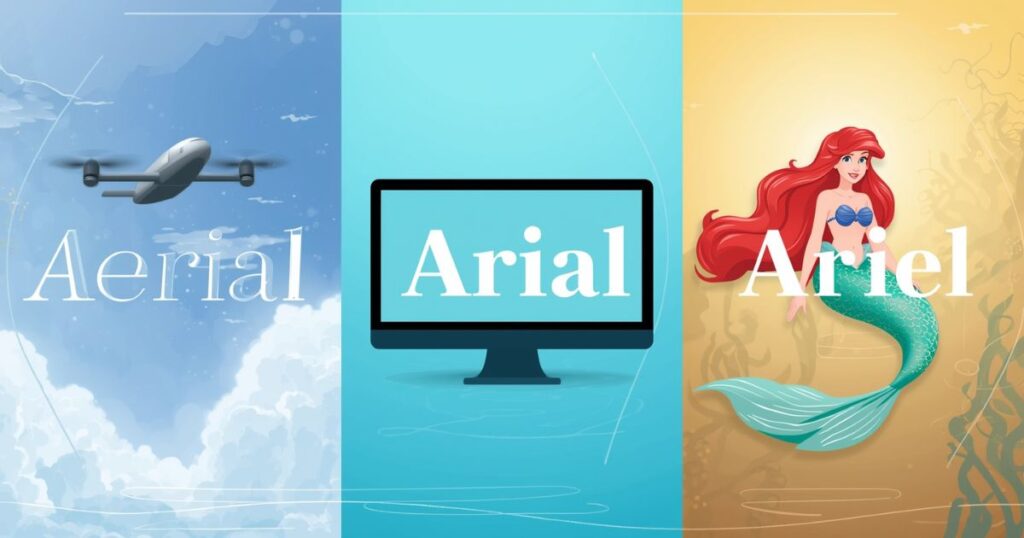
Wait there’s a third word? Yes. Ariel appears in Disney’s “The Little Mermaid” and as a Hebrew name. It’s also a character in Shakespeare’s “The Tempest.”
Arial vs Ariel: Arial has one ‘i’ (font). Ariel has two vowels together (name).
Aerial vs Ariel differences: Aerial relates to air. Ariel refers to people or characters exclusively.
| Word | Pronunciation | Meaning | Usage |
|---|---|---|---|
| Aerial | AIR-ee-ul | Air-related | Descriptive contexts |
| Ariel | AIR-ee-el | Name | People/characters |
| Arial | AIR-ee-ul | Font | Typography |
Quick Quiz: Can You Spot the Correct Word?
Test your knowledge:
- The drone captured stunning _____ footage. (Answer: Aerial)
- Please change the font to _____. (Answer: Arial)
- The Little Mermaid’s name is _____. (Answer: Ariel)
- We need better _____ surveillance equipment. (Answer: Aerial)
- _____ provides excellent readability on screens. (Answer: Arial)
How’d you do? 5/5? You’re a grammar guide expert now!
FAQs
Is it Arial view or aerial view?
It’s “aerial view” always. Correct word usage matters here.
Why do people confuse them?
They’re homophones. Sound identical but mean different things.
Is Arial still used in 2025?
Absolutely. Many organizations specify it in formal writing guide standards.
Can aerial be a noun?
Yes. British English uses “aerial” for antennas.
How do I remember the difference?
Aerial = Air (both start with ‘A’). Arial = fAnt (font).
Conclusion: The Simple Way to Remember Aerial vs Arial
Aerial flies in the air. Arial appears in applications. That’s it your easy way to remember Arial and Aerial forever.
For designers and writers alike, this distinction matters. Professional communication demands accuracy. Nobody wants common word mix-ups embarrassing them.
Keep this 2025 grammar guide bookmarked. Reference it whenever doubt creeps in. Share it with colleagues who need help with grammar tips and avoid grammar mistakes.
Grammar mastery comes from understanding, not memorization. You’ve got this knowledge now. Use it confidently in every document you create.

Flairsy is the word expert behind Englishfixerr.com, helping readers find the perfect synonyms and simple word choices. With a love for clarity and creativity, Flairsy makes English easy and stylish. From tricky terms to everyday phrases, he turns confusion into confidence.