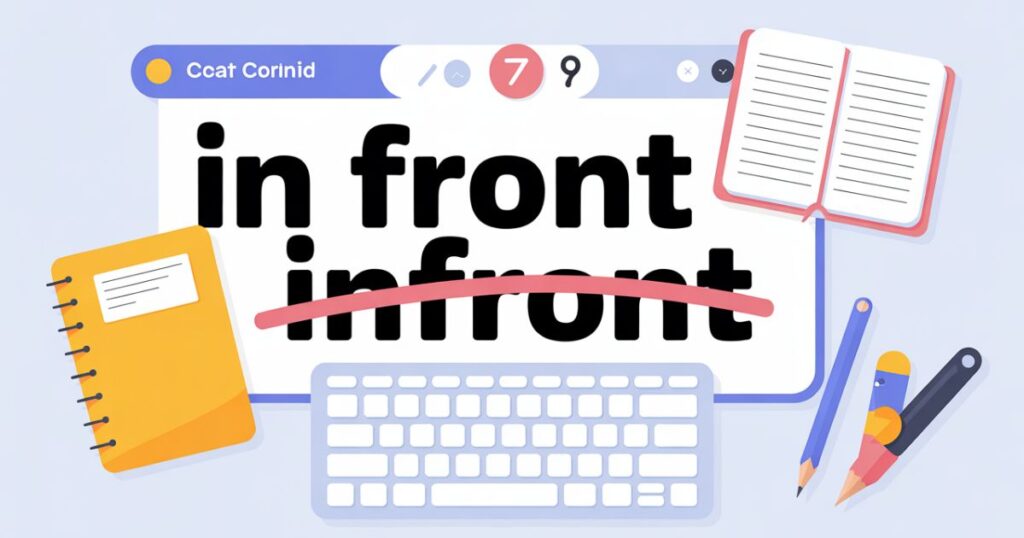
Ever caught yourself typing “infront” and wondered if you’ve been spelling it wrong your whole life? You’re not alone. This common spelling mistake trips up even experienced writers, students, and professionals daily. The confusion stems from how English handles similar words like “inside” or “into” words that evolved from two separate terms into single units. But here’s the thing: “in front” never made that leap.
The answer is crystal clear. “In front” must always be written as two separate words. “Infront” isn’t recognized in any standard English dictionary. Period. This grammar rule holds true whether you’re writing a quick text message, crafting a professional email, or submitting an academic paper. Understanding this distinction improves your writing professionalism immediately and prevents embarrassing errors that undermine your credibility.
Throughout this guide, you’ll discover exactly why “in front” stays separated, explore dozens of practical examples, and learn foolproof strategies to avoid this mistake forever. We’ll dive deep into the correct spelling of in front, examine common spelling mistakes that plague writers everywhere, and provide actionable tips for achieving language accuracy. By the end, you’ll never second-guess this phrase again.
Infront or In Front: Quick Summary
Let’s cut straight to the chase. “In front” is always correct as two separate words. “Infront” simply doesn’t exist in proper English. This isn’t a matter of regional preference or stylistic choice it’s an absolute grammar rule that applies universally across all English-speaking countries.
Why does this confusion exist? Our brains naturally want to streamline language. We’ve watched words like “into” (originally “in to”) and “onto” (originally “on to”) merge over centuries. These linguistic patterns make us expect “infront” to follow suit. But English doesn’t always cooperate with our logical expectations. Some prepositional phrases remain stubbornly separated, and “in front” is one of them.
Think of it like this: “in” functions as a preposition indicating position. “Front” serves as the noun object of that preposition. Together, they create a prepositional phrase describing spatial relationships. Separating them maintains grammatical clarity in ways that matter for communication clarity and writing quality.
Major style guides including AP, Chicago, and MLA unanimously agree on two-word spacing. British vs American spelling rules occasionally diverge, but both variants demand separation here. No exceptions exist. Zero. Understanding this correct usage elevates your language learning journey and prevents future spelling errors.
What Does “In Front” Mean?
Understanding the In Front Definition
The phrase “in front” describes spatial position specifically, something positioned ahead of or before another object or person. It establishes relative position between two elements, indicating one occupies space preceding the other. This spatial awareness vocabulary helps us communicate position and direction with precision.
From an etymology standpoint, “front” derives from the Latin word “frons,” meaning forehead or the foremost part. The preposition “in” specifies location within a particular space. Combined, they paint a picture of positional description that’s both literal and metaphorical.
Consider these core meanings:
- Physical location: Something directly before your viewing angle
- Spatial hierarchy: First position in sequence or arrangement
- Visibility prominence: Positioned where others can see clearly
- Blocking relationship: One object obscuring another from view
The in front meaning extends beyond mere physical placement. In narrative context, characters position themselves “in front” to demonstrate courage or leadership role. In competitive context, athletes strive to stay “in front” of rivals. In social context, people stand “in front of everyone” when facing public scrutiny.
Why “Infront” Feels Correct (But Isn’t)
Your instinct toward “infront” isn’t random. English contains numerous compound words that merged over time. “Inside” replaced “in side.” “Into” supplanted “in to.” “Onto” superseded “on to.” These evolutionary patterns create reasonable expectations about other phrases following suit.
Autocorrect failures compound the problem. Some mobile keyboards aggressively merge adjacent words without considering grammatical correctness. Typing quickly causes fingers to skip spaces. Before you know it, misspelling infront becomes an ingrained habit requiring conscious effort to break.
Language learning presents unique challenges for non-native speakers. Many languages express this concept as a single word. Spanish uses “enfrente” or “delante.” French employs “devant.” German says “vor.” Direct translation tempts learners toward incorrect spelling infront, making proper word spacing feel counterintuitive initially.
But English resists this consolidation stubbornly. Perhaps linguists maintain separation to distinguish between “front” (the noun) and “in front” (the prepositional phrase). Regardless of reason, memorizing this exception strengthens your command of English spelling rules and enhances writing clarity.
“In Front” Sentence Examples & Phrases

In Front of Everyone
This phrase carries significant emotional weight in social situations. When actions occur “in front of everyone,” visibility amplifies their impact. Public moments whether triumphant or embarrassing etch themselves into memory precisely because others witnessed them.
Example sentences using in front in public contexts:
- The artist stood confidently in front of the canvas while critics observed silently.
- She delivered her presentation in front of everyone without hesitation.
- He accidentally tripped in front of everyone at the graduation ceremony.
- They announced their engagement in front of everyone gathered at the reunion.
- The magician performed his most impressive trick in front of everyone watching breathlessly.
Notice how “in front of everyone” transforms ordinary actions into meaningful events. Practicing your speech in front of everyone builds confidence. Making mistakes in front of everyone teaches humility. Achieving success in front of everyone multiplies joy through shared experience.
This descriptive position phrase works equally well in formal and informal writing. Business presentations, academic defenses, theatrical performances, and casual gatherings all utilize this construction. The correct phrase formatting never changes regardless of context always two words separated clearly.
In Front of You
This variation emphasizes personal proximity and direct address. Something positioned “in front of you” exists within your immediate viewing range and demands attention. It can reference physical objects literally present or metaphorical opportunities awaiting action.
Practical examples demonstrating versatility:
- The keys are in front of you on the wooden table.
- Look at the incredible opportunity in front of you right now.
- The car stopped suddenly in front of you at the intersection.
- Your future sits in front of you waiting for decisive action.
- The solution was in front of you the entire time.
In narrative storytelling, “in front of you” creates intimate connection between reader and content. It transforms abstract concepts into tangible realities. Spatial relationship words like these ground descriptions in physical experience readers understand intuitively.
Teachers frequently employ this phrase when guiding students: “The answer is in front of you.” Parents use it directing children: “Your toys are in front of you.” Coaches motivate athletes: “The finish line is in front of you.” This everyday English phrase pervades our communication at every level.
Additional Common Phrases
The formula “in front of [noun]” generates countless useful expressions. Each maintains the same grammatical structure while applying to different situations:
| Phrase | Context | Example Sentence |
|---|---|---|
| In front of the house | Property location | The flag fluttered gracefully in front of the school building. |
| In front of the line | Queue position | The children eagerly waited in front of the bus doors. |
| In front of the camera | Media/performance | The actor felt nervous in front of the camera initially. |
| In front of the mirror | Personal grooming | In front of the mirror, she practiced her acceptance speech carefully. |
| In front of the class | Educational setting | He read his essay in front of the class confidently. |
| In front of the store | Commercial location | A group of people gathered in front of the store entrance. |
| In front of the screen | Technology use | Hours passed while gaming in front of the screen. |
| In front of the judge | Legal proceedings | They presented evidence in front of the judge respectfully. |
These position-related vocabulary examples demonstrate how “in front” adapts to countless scenarios. Whether describing physical location, social dynamics, or metaphorical positioning, the phrase maintains consistent spelling and structure.
Motion descriptors also incorporate “in front” effectively. “A cyclist swerved in front of the car” indicates movement into forward position. “The mountain loomed in front of us” suggests approaching toward something visible ahead. Understanding these spatial descriptors enriches your ability to create vivid, precise descriptions.
Using “Infront” or “In Front”: Key Points
The Definitive Grammar Rule
Here’s your golden standard for this phrase: Write “in front” as two separate words in every single instance. No exceptions exist to this rule anywhere in standard English. Regional dialects don’t change it. Casual contexts don’t excuse it. Even informal writing demands proper word spacing here.
Dictionary verification confirms this universally. Check Merriam-Webster, Cambridge, Oxford any reputable source lists only the two-word version. Educational systems teach separation exclusively. Professional editors flag “infront” immediately as an error requiring correction.
This matters tremendously for writing professionalism and personal credibility. Small errors like misspelling common phrases create negative impressions about your attention to detail. Employers, professors, clients, and readers judge writing quality partly through mechanical correctness. Mastering proper English usage signals competence and care.
Why Correct Spelling Matters
Communication clarity depends on following established conventions everyone recognizes. When you spell “in front” correctly, readers focus on your message rather than getting distracted by mistakes. Your ideas deserve that undivided attention.
Professional contexts demand especially rigorous standards. Business proposals, academic papers, legal documents, medical records all require writing accuracy practices that leave no room for spelling mistakes. A single error can undermine an otherwise brilliant argument or analysis.
Academic writing spelling rules enforce strict adherence to standard English conventions. Professors expect correct prepositional phrase examples throughout essays and research papers. Graduate committees scrutinize dissertations for mechanical perfection. Understanding formal writing guidelines protects your grades and reputation.
Even casual communication benefits from accuracy. Text messages reach broader audiences through screenshots shared on social media. Emails get forwarded to unintended recipients. Your language habits reveal themselves in every message you send. Building correct usage in communication as default behavior serves you constantly.
Quick Reference Checklist
Use this guide whenever doubt creeps in:
✓ CORRECT: “in front” (two words, lowercase unless starting sentence)
✗ INCORRECT: “infront” (never acceptable in standard English)
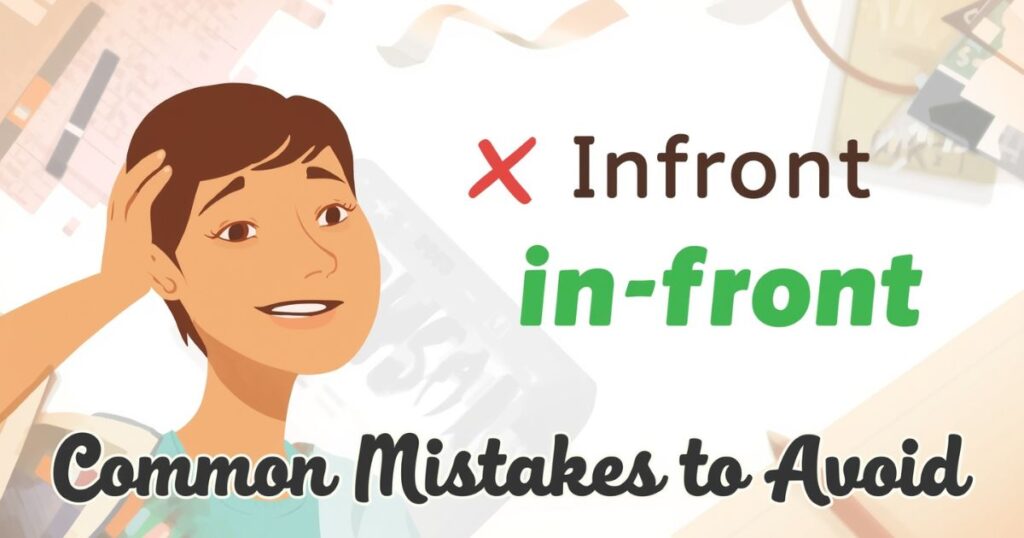
✗ INCORRECT: “in-front” (hyphenation isn’t standard either)
✓ CORRECT: “In front” (capitalized only at sentence beginning)
Apply this knowledge immediately across all writing contexts. Email correspondence, social media posts, text messages, formal reports, creative stories every format benefits from correct spelling. Make conscious effort initially until proper spacing becomes automatic through vocabulary development.
Common Mistakes People Should Avoid When Using the Incorrect Spelling “Infront”
Autocorrect and Technology Failures
Modern technology creates as many problems as it solves. Typing speed causes fingers to skip spaces accidentally. Autocorrect sometimes merges words incorrectly without our awareness. Mobile keyboards optimized for efficiency occasionally sacrifice spelling accuracy in pursuit of faster input.
Error patterns emerge when we trust technology blindly. You type quickly without proofreading, hit send, and only afterward notice “infront” slipped through. These mistakes multiply across platforms texts, emails, social posts until incorrect spelling becomes normalized in your personal writing habits.
Solutions exist thankfully. First, adjust your device settings. Add “in front” as two separate words to your phone’s dictionary. Train autocorrect to recognize the phrase correctly. Second, slow down slightly when typing commonly confused phrases. That extra half-second prevents embarrassing communication errors.
Third, implement mandatory proofreading for anything remotely important. Business emails, job applications, client communications all deserve careful review before sending. Read sentences aloud to catch mistakes your eyes miss when scanning silently. Your ears often detect errors your brain overlooks visually.
Medical and Scientific Contexts
Healthcare settings demand absolute precision in language. Medical writing uses “in front” frequently when describing patient positioning, anatomical relationships, and procedural instructions. A misplaced space might seem trivial, but clarity in written communication saves lives in clinical environments.
Anatomical terminology examples include:
- The tumor sits in front of the vital organ.
- Position the monitor in front of the patient carefully.
- The lesion appeared in front of the spinal column.
- Place the surgical tray in front of the operating table.
Scientific documentation requires similar rigor. Research papers, laboratory protocols, technical specifications all follow strict formal writing tips that tolerate zero mechanical errors. Peer reviewers scrutinize manuscripts for language accuracy alongside methodological soundness.
Healthcare professionals use spatial awareness vocabulary constantly when communicating about human anatomy. “Anterior” technically means toward the front, but “in front” appears regularly in clinical notes and patient instructions for clarity. Maintaining professional writing clarity protects patients from confusion or miscommunication.
Casual Writing Traps
Informal writing mistakes multiply when we assume relaxed contexts permit lower standards. Social media, text messages, personal emails these platforms feel low-stakes compared to professional documents. But incorrect spelling still reflects poorly regardless of audience size.
Your writing quality becomes your personal brand across all contexts. Friends notice recurring errors even if they don’t mention them. Potential employers check social media profiles during hiring processes. That tweet with “infront” might disqualify you from opportunities you never knew existed.
Texting shortcuts have appropriate limits. “Ur” for “your,” “thru” for “through,” “btw” for “by the way” these abbreviated forms communicate efficiently in casual contexts. But “in front” cannot be abbreviated or condensed. Proper phrase formatting requires both words spelled completely with space between.
Professional boundaries blur increasingly as work communication moves to messaging platforms. Slack, Teams, Discord these tools blend professional and casual tones. Maintaining correct usage across all platforms protects your reputation and demonstrates consistent attention to detail.
ESL and Language Learning Challenges
Non-native speakers face unique obstacles with phrases like “in front.” Their first languages often express this concept differently, creating cognitive interference when learning English grammar basics. Spanish speakers think “enfrente.” French speakers think “devant.” These mental patterns resist the two-word English construction.
Translation errors occur when students apply their native language’s logic to English structures. If your language combines these words naturally, separating them feels artificial initially. But language learning accuracy requires embracing English’s unique patterns rather than imposing external logic.
Cultural differences in language extend beyond vocabulary to grammatical structure. Some languages combine prepositional concepts that English keeps distinct. Others split ideas English merges. Learning these exceptions individually through memorization and repetition builds language proficiency systematically.
Effective strategies for ESL learners include:
- Creating flashcards with correct spellings and example sentences
- Writing practice paragraphs using “in front” repeatedly
- Reading English texts noting how native writers use the phrase
- Asking native speakers for feedback on your written work
- Focusing on mastery rather than speed during learning
Read This Article: Messege or Message? Avoid This Costly Mistake!
How to Avoid These Mistakes?
Proven Proofreading Techniques
Reading aloud remains the single most effective error-detection method. Your ears catch awkward phrasing and incorrect spelling your eyes miss. When reading silently, your brain autocorrects mistakes without conscious awareness. Vocalization forces careful attention to every word.
Backward reading provides another powerful technique. Start from your final sentence and work toward the beginning. This disrupts your brain’s tendency to see what it expects rather than what’s actually written. You’ll spot errors hiding in plain sight previously.
Time gap strategy leverages cognitive distance. Write something, then walk away for several hours or overnight. Return with fresh perspective unbiased by authorial intent. Mistakes become immediately obvious after this mental reset.
Digital tools supplement human judgment effectively. Grammarly, ProWritingAid, Hemingway Editor these platforms catch spelling errors and suggest improvements. But never rely exclusively on technology. Software misses contextual nuances requiring human understanding.
Print review reveals errors screens hide somehow. The physical medium changes how our brains process text. Print important documents, grab a colored pen, and mark corrections carefully. This tactile process engages different cognitive pathways than digital editing.
Memory Devices and Learning Tricks
Mnemonic devices cement correct spelling through memorable associations. Try this: “I Need space FRONT of words” where I-N represents “in.” The silly phrase sticks in memory better than abstract rules.
Visual reminders work wonderfully for visual learners. Picture a physical space actual empty area between the words “in” and “front.” Imagine that space as something tangible you can’t remove. This mental image reinforces proper word spacing automatically.
Association techniques link unfamiliar rules to familiar patterns. “In front” stays separated just like “on top,” “at hand,” and “in between.” Grouping similar structures creates mental frameworks supporting accurate recall.
Repetition practice builds muscle memory. Write “in front” correctly twenty times daily for a week. Your hand learns the motion space between words until it feels unnatural to write otherwise. This physical reinforcement complements intellectual understanding.
Flashcard methods enable systematic practice. Front side: “How do you spell ___ ___ of?” Back side: “in front.” Quiz yourself randomly throughout the day until instant recognition becomes automatic.
Optimizing Technology Settings
Autocorrect training turns technology from enemy to ally. Most devices learn from your typing patterns. Consistently typing “in front” correctly teaches autocorrect to suggest proper spacing automatically.
Text expansion shortcuts save time while ensuring accuracy. Program your device so typing “ifo” automatically expands to “in front” with correct spacing. These shortcuts accelerate writing without sacrificing correctness.
Grammar checkers should be enabled across all writing platforms. Word, Google Docs, email clients activate comprehensive checking everywhere you type. These tools catch errors during composition rather than requiring separate proofreading later.
Browser extensions provide continuous support. Install Grammarly or similar extensions that flag errors as you type in web forms, social media, and other online contexts. This real-time feedback prevents mistakes before they become visible.
Spellcheck settings need configuration for maximum effectiveness. Ensure your dictionary marks “infront” with red underlines signaling error. Some systems require manual addition of commonly confused words to their alert lists.
Conclusion
You now possess complete clarity on the infront vs in front question. “In front” must always appear as two separate words no exceptions, no alternatives, no compromises. This grammar rule applies universally across formal writing, casual communication, and every context between.
Understanding correct spelling elevates your writing professionalism immediately. These seemingly small details distinguish polished, credible communication from careless work that undermines your message. Whether you’re composing business emails, academic papers, or social media posts, consistent language accuracy builds your reputation as a careful, competent communicator.
Common spelling mistakes plague even experienced writers. The key lies not in never making errors but in developing systems that catch and correct them systematically. Combine proofreading techniques, memory devices, and technology tools to create multiple layers of protection against spelling errors.
Remember that language learning is a continuous journey. Even native speakers encounter confusing phrases requiring conscious effort to master. Be patient with yourself while maintaining high standards. Practice using “in front” correctly in daily writing until proper spacing becomes effortless instinct.
Take action immediately. Review your recent messages for this error. Adjust your device settings. Create helpful reminders. Most importantly, forgive past mistakes while committing to improved writing clarity moving forward. You’ve got this mastered now completely.
Frequently Asked Questions
Is “infront” ever correct in English?
Absolutely not. “Infront” doesn’t appear in any standard English dictionary not Merriam-Webster, not Cambridge, not Oxford. This non-standard spelling never gains acceptance regardless of how frequently people use it incorrectly. The correct spelling requires two words separated by space in every instance.
Historical linguistics shows “in front” has maintained this separation throughout English’s evolution. Unlike “into” or “inside,” which merged from two-word origins, “in front” resisted consolidation. No regional dialect, no informal context, no casual usage makes misspelling infront acceptable.
Why do people commonly spell it as “infront”?
Several factors contribute to this widespread confusion. First, similar words like “inside” and “into” established precedent for merging. Our brains naturally expect “infront” to follow the same pattern. Second, typing speed causes people to skip spaces accidentally when writing quickly. Third, autocorrect sometimes fails to catch the error, normalizing incorrect spelling.
Language learning differences also play a role. Many languages express this concept as a single word, creating cognitive interference for non-native English speakers. Spanish “enfrente,” French “devant,” and German “vor” all prime learners toward combined spelling.

Flairsy is the word expert behind Englishfixerr.com, helping readers find the perfect synonyms and simple word choices. With a love for clarity and creativity, Flairsy makes English easy and stylish. From tricky terms to everyday phrases, he turns confusion into confidence.