
You hit send on that crucial email to your boss. Your text flies across cyberspace. Then you notice it that dreaded typo staring back at you. Did you just write “messege” instead of “message”? That sinking feeling hits hard.
We’ve all been there. You’re rushing through a business report, crafting social media posts, or firing off a quick text. Your fingers dance across the keyboard, and boom spelling mistakes slip through. But here’s the truth: some errors cost more than others. The messege vs message confusion isn’t just embarrassing. It can tank your professional credibility faster than you’d think.
This guide will save you from future facepalms. You’ll learn the correct spelling of message, understand why this mistake happens, and discover foolproof techniques to eliminate this error forever. Whether you’re sending a text message, writing an email, or preparing a job application, spelling accuracy matters. Let’s dive in.
Messege VS Message: Correct Spelling for Clear Communication
Let’s cut straight to it: “message” is the only correct spelling. “Messege” doesn’t exist in English. It’s not a British variation. It’s not slang. It’s simply wrong.
The word “message” traces back to Latin “missus,” meaning “sent.” That etymology explains everything about its meaning information delivered from one person to another. The correct word usage follows a clear pattern: M-E-S-S-A-G-E.
So why does this confusion plague so many writers? Phonetic spelling trips people up. When we say “message” aloud, that middle vowel sound seems ambiguous. Your brain might hear something between “ah” and “eh.” This spelling confusion leads fingers astray, especially during rapid typing sessions on smartphones or laptops.
Research from writing platforms shows “messege” ranks among the top 50 common English misspellings online. Search engines process millions of this misspelling daily. That’s millions of people undermining their communication clarity without realizing it.
Here’s what makes this particular error so problematic: spell-check tools don’t always catch it in context. Autocorrect might “fix” it to “massage,” creating an entirely different and often hilarious meaning. Imagine telling your teacher you didn’t receive their “massage” about the meeting. Awkward, right?
What’s the Key Point?
The bottom line: Only “message” appears in dictionaries. Period.
Here’s your instant reference guide:
✓ Message — Correct spelling
✗ Messege — Incorrect spelling
This isn’t about being a perfectionist. It’s about effective communication. When you misspell basic words, readers question your attention to detail. They wonder about your language skills. In professional writing, that doubt spreads like wildfire.
Think of “message” as having “mess” + “age” combined. The word literally contains “mess” and using the wrong spelling creates exactly that in your written communication.
The Correct Spelling: Message
Let’s break down each letter: M-E-S-S-A-G-E. Seven letters total. Two S’s sitting together in the middle. One A. One G. One E at the end.
Pronunciation helps here: MES-ij (phonetically). That second syllable uses a soft “ij” sound, not “edge.” This phonetic confusion explains why people incorrectly add an extra “e” after the “g.”
The message definition in English serves double duty. As a noun, it means information transmitted between people. As a verb, it means to send such information. Both forms maintain identical spelling. “I message my friend” follows the same pattern as “I received a message.”
Related words follow predictable patterns too:
- Messenger (one who carries messages)
- Messaging (the act of sending messages)
- Messaged (past tense)
Notice how none of these variations insert an extra “e” before the “g.” Understanding this pattern strengthens your overall vocabulary improvement and prevents similar errors in related terms.
British English and American English agree completely here. Unlike “colour/color” or “theatre/theater,” message stays consistent across all English-speaking regions. That standardization makes mastering this spelling even more critical for digital communication on global platforms.
The meaning of message extends beyond simple text exchanges. Warning signs convey messages. Facial expressions communicate messages. Body language delivers messages. Marketing campaigns spread messages. Every form of delivering information falls under this umbrella term.
Examples of “Message” in Sentences
Let’s see this word in action across different contexts. These message usage examples demonstrate proper spelling in real-world situations:
Professional email context:
- “I received your message about the quarterly proposal.”
- “Please message me when you arrive for the meeting.”
- “Her voicemail message explained the policy changes clearly.”
Casual text context: 4. “Did you get my message last night?” 5. “He left a message about dinner reservations.” 6. “That birthday message made me smile.”
Digital communication context: 7. “The error message appeared on my screen twice.” 8. “She sends instant messages faster than anyone I know.” 9. “Social media messages can reach millions instantly.”
Formal writing context: 10. “The warning sign delivered a clear message.” 11. “Legal documents must convey messages without ambiguity.” 12. “His speech carried an inspiring message about perseverance.”
Each example shows “message” functioning smoothly in sentences. Notice how communication clarity improves when spelling aligns with standard English. Readers process information effortlessly when they don’t stumble over misspelled words.
The versatility of “message” as both noun and verb appears throughout these examples. This dual functionality makes it one of English’s most practical words for discussing written communication and spoken communication alike.
Common Misspellings and Their Impact
Beyond “messege,” several variations plague writers. Here’s what people type when they mean “message”:
| Misspelling | Why It Happens | Frequency |
|---|---|---|
| Messege | Extra “e” insertion | Very Common |
| Mesage | Missing second “s” | Common |
| Messge | Dropped vowel | Occasional |
| Messsage | Extra “s” added | Rare |
| Massege | Confused with “massage” | Common |
That last one massage vs message confusion deserves special attention. A massage involves therapeutic treatment, applying pressure to muscles for relaxation and physical health. A message transmits information. Mixing these creates unintentional comedy in professional settings.
Imagine writing to your supervisor: “I got your massage about the contract.” Your boss might wonder what kneading techniques have to do with business reports. This communication mistake transforms serious exchanges into puzzling conversations.
The professional consequences hit hard:
Job applications with spelling errors face rejection 60% more often, according to hiring managers surveyed. Recruiters spend mere seconds scanning resumes. Spotting “messege” triggers immediate doubts about your attention to detail and professional writing skills.
Client relationships suffer when proposals contain basic spelling mistakes. One marketing agency lost a six-figure contract because their pitch deck repeatedly misspelled “message” throughout. The client questioned whether a company careless with spelling accuracy could handle their brand carefully.
Search engine rankings take hits too. The importance of correct spelling in SEO can’t be overstated. When your website content contains frequent misspellings, search engines downgrade your authority. Your online visibility plummets. Content riddled with errors rarely climbs search results, regardless of keyword optimization elsewhere.
Social media posts with spelling errors receive 40% less engagement. Users scroll past content that looks unprofessional. Your digital communication errors directly impact reach and influence.
Read This Article: Acception vs. Exception: Avoid This Big Mistake!
Tips for Avoiding Spelling Mistakes
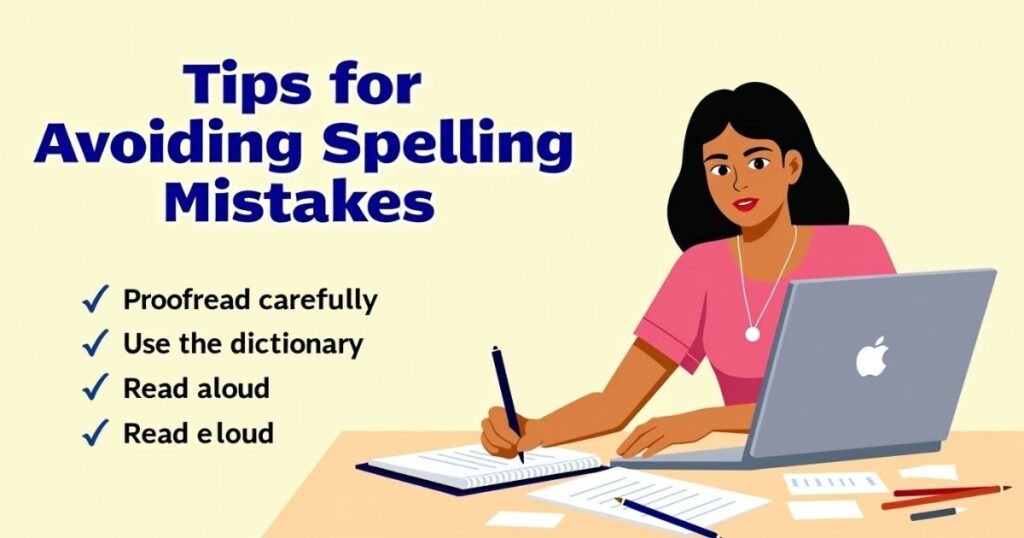
Ready to eliminate “messege” from your vocabulary forever? These proofreading techniques work:
1. Activate spell-check everywhere. Enable grammar and spelling tools across all devices. Your phone, laptop, tablet every platform should catch errors automatically.
2. Read everything backwards. This proofreading importance trick forces your brain to examine individual words rather than skimming for meaning. Start at the last word and work toward the first.
3. Slow down before sending. Rushing creates typo errors. Take five seconds to review texts and emails before hitting send. That pause prevents embarrassing mistakes.
4. Use professional tools. Grammarly, LanguageTool, and similar spell-check tools catch errors your standard software misses. These platforms offer real-time corrections as you type.
5. Create a personal error list. Track words you frequently misspell. Review this list weekly. Your brain will start recognizing these problem areas automatically.
6. Print important documents. Reading on paper reveals mistakes screens hide. Your eyes process printed text differently, catching errors you’d otherwise miss in written content.
7. Ask someone else to review. Fresh eyes spot what yours overlook. For crucial communications, request a quick proofread from a colleague or friend.
8. Practice writing the correct spelling. Write “message” fifty times by hand. This builds muscle memory that carries over to typing. Your fingers learn the pattern.
9. Enable email delay features. Gmail and other platforms offer send delays. Configure a 10-second window where you can cancel sent messages. This buffer catches last-second spotted errors.
10. Learn common patterns. Understanding why errors happen helps prevent them. Recognize your personal spelling confusion triggers and address them directly.
These written communication tips apply beyond just “message.” They improve your overall language accuracy across all writing contexts.
Importance of Correct Spelling
Why does this matter so much? Because effective communication demands precision. Every misspelling introduces potential misunderstanding into your message delivery.
First impressions stick. When someone reads your writing whether a text, email, or letter they form immediate judgments about your intelligence and professionalism. Studies show people rate writers with frequent spelling errors as less competent, less trustworthy, and less educated. Fair or not, that’s reality.
Career advancement depends heavily on communication skills. Managers notice who writes polished emails versus who produces sloppy content. Promotions favor people demonstrating strong professional communication standards. Your writing professionalism signals broader competence.
Trust building requires consistency. Clients and colleagues trust people who sweat the details. If you can’t spell basic words correctly, why should they trust you with complex projects? Document accuracy reflects broader reliability.
Research from business communications studies reveals startling statistics: 59% of professionals say they wouldn’t hire someone whose application contained spelling errors. 77% of hiring managers consider grammar and spelling accuracy critical when evaluating candidates.
The clarity in written content extends beyond avoiding mistakes. Correct spelling ensures readers focus on your ideas rather than stumbling over errors. Every misspelling creates a tiny interruption in comprehension. Those interruptions accumulate, degrading your message’s impact.
Academic success correlates strongly with spelling ability. Teachers across all grade levels report that students demonstrating strong language skills earn higher grades overall. That connection continues through university and into professional life.
How to Remember the Correct Spelling?
Let’s lock in the correct spelling permanently. These memory techniques make forgetting impossible:
Mnemonic device: “My Email Should Send A Good Example.” Each word’s first letter spells M-E-S-S-A-G-E. Ridiculous phrases stick better than dry facts. Create your own if this doesn’t resonate.
Visual chunking: Break “message” into two pieces: “mess” + “age.” You’re old enough (age) to clean up spelling messes. See how that connects?
Association technique: Link “message” to “messenger.” Both share that double-S pattern. Picturing a messenger (like in historical contexts) carrying scrolls reinforces the correct formation.
Physical writing practice: Write “message” in cursive twenty times daily for one week. Your hand learns the flow. That kinesthetic memory transfers to keyboard typing naturally.
Teach someone else: Explaining the correct spelling to another person even your pet solidifies your own understanding. Teaching forces you to articulate the pattern clearly.
Use it in sentences daily: Incorporate “message” into your conversations and writing deliberately. The more you use it correctly, the more automatic it becomes. Practice doesn’t just make perfect it makes permanent.
Create phone reminders: Set up autocorrect on your devices to flag “messege” aggressively. Train your phone to always correct this misspelling. After enough auto-corrections, your fingers learn.
Connect to related words: Remember that “messaging,” “messenger,” and “messaged” all follow the same pattern. None of these include an “e” before the “g.” This family resemblance helps.
These spelling rules and techniques work for other common spelling errors too. Apply these same strategies to whatever words trip you up regularly.
Quick Reference Guide
Is “messege” ever correct?
No. This spelling never appears in English dictionaries. It’s always wrong.
How do you spell message in British English?
Exactly the same: M-E-S-S-A-G-E. No variation exists.
What’s the plural of message?
Messages. Just add an “s” to the end.
Is message a noun or verb?
Both! “I received a message” (noun). “Please message me” (verb).
Where did the word message come from?
Latin “missus” (sent) through Old French “message.”
Final Thoughts
Mastering the correct spelling of message takes five minutes but benefits you forever. You now understand why “messege” doesn’t exist, how to avoid this error, and why spelling accuracy in communication matters for your professional reputation.
Every text message, email, and phone call you send reflects your language skills. Make each one count. The difference between “message” and “messege” seems tiny just one letter. But that single letter separates polished writing from sloppy communication.
Start today. Check your previous emails and texts for this error. Enable those grammar check tips we discussed. Practice writing the correct spelling until your fingers know it automatically. Share this guide with friends who might appreciate the clear communication guidelines.
Remember: effective writers aren’t born they’re made through consistent practice and attention to detail. You’ve got this. Now go send some perfectly spelled messages and watch your credibility soar.
Your communication matters. Make sure your spelling matches your message’s importance.

Flairsy is the word expert behind Englishfixerr.com, helping readers find the perfect synonyms and simple word choices. With a love for clarity and creativity, Flairsy makes English easy and stylish. From tricky terms to everyday phrases, he turns confusion into confidence.