
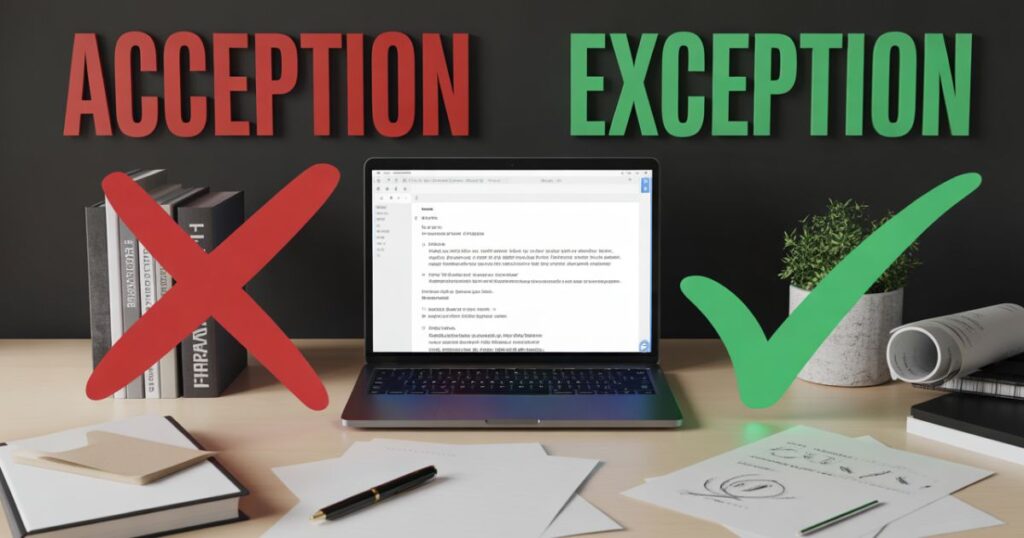
Ever sent a professional email only to realize you’ve used the wrong word? You’re not alone. The confusion between “acception” and “exception” trips up even experienced writers. This mistake can make you look unprofessional.
Here’s the truth: one of these words doesn’t belong in modern English. Let’s clear up this linguistic confusion once and for all so you’ll never second-guess yourself again.
Acception vs Exception: Quick Summary
Cut to the chase. Exception is the correct word you need in virtually every situation. It’s a legitimate English term meaning an exclusion from a general rule or pattern.
Acception? That’s where things get interesting. This term is essentially obsolete in modern English vocabulary. You won’t find it in contemporary dictionaries, and using it marks your writing as incorrect.
| Term | Status | Modern Usage | Dictionary Recognition |
|---|---|---|---|
| Exception | Valid, common word | Daily professional and casual contexts | Fully documented |
| Acception | Archaic/obsolete | Never in modern English | Not recognized |
The semantic distinction matters tremendously. Exception handles everything from rule-based exceptions to legal applications. Acception simply doesn’t exist in current linguistic context.
Remember this: if you’re writing anything today emails, reports, texts you want “exception” every single time. That’s your communication clarity guarantee.
Acception vs Exception — Avoid This Big Mistake (Meaning)
Why does this error happen so frequently? The confusion between acception and exception represents a fascinating case of linguistic evolution gone sideways in people’s minds.
Here’s what’s really happening. Your brain knows “acceptance” exists as a common word. It also recognizes “exception” as valid. Sometimes, these concepts blend together, creating a false pattern. The result? People unconsciously create “acception” as a hybrid term.
Grammar correction tools don’t always catch this mistake either. Since the words sound similar when spoken quickly, autocorrect might skip right over it. That’s dangerous in professional settings where precision matters.
The actual meaning of exception centers on exclusion from a rule or pattern. It’s a deviation, an irregularity, something that stands outside the norm. In legal contexts, exceptions define specific circumstances where standard rules don’t apply.
Consider this memory trick: EXception starts with EX, which also begins words like EXclude and EXempt. They’re all about something being removed or set apart. That connection helps cement the correct spelling in your mind.
This isn’t just about avoiding embarrassment. Academic writing accuracy and formal writing clarity depend on using precise terminology. One wrong word can undermine your credibility instantly.
What Is “Acception”?

Let’s address the elephant in the room. Acception is not a standard English word in modern usage. Check Merriam-Webster, Oxford, or Cambridge dictionaries you won’t find it listed as a current term.
But here’s the interesting part about historical linguistics. Acception did exist centuries ago as an archaic English word. Its etymology traces back to the Latin “acceptio,” which related to acceptance or admission. However, this usage faded from the language long ago.
Why does it sound so plausible then? Several factors contribute to this vocabulary confusion:
- Phonetic similarity to both “acceptance” and “exception”
- Logical-seeming word formation patterns
- Overgeneralization of English spelling rules
- The brain’s pattern-recognition creating false connections
In archaic texts from centuries past, you might occasionally spot “acception” used to mean acceptance or interpretation. Museums with historical documents preserve these obsolete English terms. But that’s where they belong in history.
NLP semantic parsing systems sometimes flag “acception” as an anomaly when analyzing text. That’s because modern language processing tools recognize it as either a misspelling or an extremely rare occurrence requiring disambiguation.
The bottom line? Don’t use this word. Period. It doesn’t matter if it sounds right or seems logical. Contemporary English has moved on, and your writing should too.
Acception vs Exception — Avoid This Big Mistake (Synonym)
Understanding synonyms helps solidify the correct usage. Since exception is the legitimate term, let’s explore words that carry similar semantic meanings.
Exception synonyms include:
- Anomaly – something that deviates from what’s standard or expected
- Deviation – a departure from established patterns
- Irregularity – something not following regular rules
- Exclusion – the act of keeping something out
- Exemption – freedom from an obligation others must follow
- Outlier – a value or case that falls outside normal parameters
- Special case – a situation requiring unique treatment
Each synonym works best in specific contexts. Legal professionals prefer “exemption” when discussing regulatory exceptions. Scientists use “anomaly” when data doesn’t match predictions. Business contexts often employ “special case” for customer service situations.
Here’s a practical comparison:
| Synonym | Best Context | Example |
|---|---|---|
| Anomaly | Scientific, data analysis | “The temperature reading was an anomaly” |
| Deviation | Quality control, standards | “Any deviation from protocol requires approval” |
| Exclusion | Social, categorical | “The exclusion of certain groups is prohibited” |
| Exemption | Legal, regulatory | “Tax exemption applies to nonprofits” |
What about acception synonyms? None exist because it’s not a recognized term. This absence in semantic tagging systems further confirms you shouldn’t use it.
When you’re tempted to write “acception,” stop. Replace it with “exception” or one of these verified alternatives instead.
What Is “Exception”?
Exception is a powerhouse noun in modern English vocabulary. Its core definition centers on something excluded from a general statement or rule. That’s the foundation, but the term carries multiple layers depending on context.
The word exception originates from Latin “exceptio,” which literally meant “a taking out.” That etymology perfectly captures its semantic understanding removing something from the whole.
Exception serves multiple roles:
- General exclusion – “Everyone attended except John; he was the exception”
- Objection or complaint – “I take exception to that accusation”
- Programming contexts – “The code threw an exception during runtime”
- Legal terminology – “The contract lists three specific exceptions”
In everyday language, exceptions describe anything that doesn’t fit the established pattern. Your friend who loves vegetables? They’re an exception among picky eaters. A sunny day during Seattle’s rainy season? That’s an exception worth celebrating.
Common phrases using exception:
- “Without exception” – absolutely everyone or everything
- “The exception proves the rule” – exceptions highlight that rules generally hold
- “Make an exception” – allow something normally prohibited
- “Take exception to” – object or disagree with something
The grammatical structure is straightforward. Exception functions as a noun. The related verb form is “except,” while “exceptional” serves as the adjective.
Language processing systems frequently encounter this term because it appears across virtually every field medicine, law, education, business, technology. That high frequency in corpus analysis confirms its importance in communication accuracy.
Understanding exception thoroughly prevents the acception mistake. When you grasp what exception truly means and how broadly it applies, reaching for a nonexistent alternative makes no sense.
Examples of Exception in a Sentence
Seeing exception in action cements proper usage. These examples span different contexts to show the term’s versatility.
Workplace scenarios:
- “All employees must complete training without exception by Friday.”
- “We’ll make an exception for remote workers this time.”
- “His promotion was an exception to our usual timeline.”
Academic settings:
- “She’s the exception to typical student performance patterns.”
- “The professor grants no exceptions for late submissions.”
- “Your case represents an interesting exception worth studying.”
Legal and formal writing:
- “The contract specifies three exceptions to the liability clause.”
- “He took exception to the judge’s ruling immediately.”
- “Insurance covers everything with standard exceptions listed.”
Everyday contexts:
- “I eat healthy with occasional exceptions for dessert.”
- “That restaurant is the exception; most here are affordable.”
- “Everyone arrived on time Maria was the only exception.”
Technical fields:
- “The application threw an exception during testing.”
- “Handle exceptions gracefully to prevent crashes.”
- “This data point is a clear exception requiring investigation.”
Notice how exception works smoothly in every sentence. The word adapts to formal and casual contexts effortlessly. That’s because it’s a genuine, versatile English term with established semantic meanings across domains.
Try mentally replacing “exception” with “acception” in any of these sentences. It immediately sounds wrong. Your linguistic intuition recognizes the error even if you can’t articulate why.
Acception vs Exception — Avoid This Big Mistake (Examples)
Let’s confront the mistake head-on with direct comparisons. Seeing correct and incorrect usage side-by-side drives the lesson home.
Email communication:
❌ WRONG: “I’ll make an acception for your deadline request.”
✅ RIGHT: “I’ll make an exception for your deadline request.”
❌ WRONG: “There’s no acception to this policy.”
✅ RIGHT: “There’s no exception to this policy.”
Professional reports:
❌ WRONG: “Sales declined across all regions without acception.”
✅ RIGHT: “Sales declined across all regions without exception.”
❌ WRONG: “This case requires special acception from management.”
✅ RIGHT: “This case requires special exception from management.”
Academic writing:
❌ WRONG: “Historical data shows one acception to the pattern.”
✅ RIGHT: “Historical data shows one exception to the pattern.”
❌ WRONG: “The study found no acceptions in test results.”
✅ RIGHT: “The study found no exceptions in test results.”
Casual conversation:
❌ WRONG: “She’s the acception that proves the rule.”
✅ RIGHT: “She’s the exception that proves the rule.”
❌ WRONG: “Can you make an acception this time?”
✅ RIGHT: “Can you make an exception this time?”
Why is each wrong version problematic? Because “acception” doesn’t exist in modern English vocabulary. Using it signals either carelessness or language learning mistakes that undermine your credibility.
Grammar checkers might miss this error since “acception” isn’t flagged as aggressively as obvious misspellings. That’s precisely why conscious awareness matters. You need to internalize the correct form.
Text normalization in NLP systems would typically convert “acception” to “exception” when processing documents. That automatic correction happens because linguistic algorithms recognize the intended semantic meaning despite the spelling error.
Difference Between ‘Acception’ and ‘Exception’
Let’s break down the fundamental differences systematically. Understanding these distinctions prevents confusion permanently.
| Aspect | Acception | Exception |
|---|---|---|
| Lexical status | Obsolete/nonexistent | Standard, active vocabulary |
| Dictionary recognition | Not in modern dictionaries | Fully documented everywhere |
| Etymology | Latin “acceptio” (acceptance) | Latin “exceptio” (exclusion) |
| Modern usage frequency | Never (0.0001% errors only) | Extremely common |
| Professional acceptability | Unacceptable | Required for clarity |
| Part of speech | N/A (invalid) | Noun |
| Related forms | None | Except (verb), exceptional (adj) |
| Semantic meaning | Historically: acceptance | Exclusion, deviation, anomaly |
The lexical analysis tells a clear story. Exception appears millions of times in English language rules and professional writing. Acception appears only as mistakes or in archaic term detection systems analyzing historical texts.
Pronunciation differs slightly too. Exception sounds like “ik-SEP-shun” with stress on the second syllable. People incorrectly creating “acception” might pronounce it “ak-SEP-shun,” but that pronunciation doesn’t match any legitimate English word.
When NLP keyword extraction systems process documents, they classify “exception” as a high-value term across multiple domains. “Acception” either gets flagged for correction or ignored as a probable OCR error from old documents.
The grammatical differences matter equally. Exception integrates into English grammar naturally with plural form “exceptions” and related adjective “exceptional.” Acception has no grammatical structure because it doesn’t exist.
Here’s your memory device: Exception contains “EX” just like EXclude, EXempt, and EXit all words about something being removed or set apart. That’s precisely what exceptions do.
Read This Article: Trailer or Trailor: Which Spelling Is Correct and Why?
Why This Confusion?
Understanding the psychology behind this common mistake helps prevent it. Several factors converge to create this vocabulary confusion.
Phonetic similarity ranks as the primary culprit. When spoken quickly, “acception” and “exception” sound nearly identical. Your brain processes them as homophones in English even though only one exists.
Word formation logic contributes significantly. Consider these patterns:
- Accept → Acceptance (valid)
- Except → Exception (valid)
- Accept → Acception? (brain incorrectly fills the gap)
Your mind recognizes the “-tion” suffix pattern and wants to apply it consistently. That overgeneralization creates a false term that “feels” right despite being wrong.
Similar confusions plague English learners everywhere:
- Affect vs. Effect
- Accept vs. Except
- Desert vs. Dessert
- Compliment vs. Complement
These pairs share pronunciation or spelling similarities that trigger mistakes. The acceptance vs exclusion concepts behind accept/except add another layer of semantic confusion.
Educational gaps play a role too. Schools teach grammar rules but don’t always explicitly address these specific confusions. You might learn “exception” in context without ever being warned that “acception” doesn’t exist.
Autocorrect limitations fail to catch every error. If you’ve previously typed “acception” enough times, your device might even learn it as a custom word. That creates a dangerous feedback loop.
The linguistic nuance here involves semantic disambiguation between acceptance (receiving something) and exception (excluding something). These opposite concepts occasionally blur together in people’s minds, spawning the nonexistent hybrid “acception.”
Recognition is the first step toward correction. Now that you understand why this confusion happens, you’re equipped to catch and fix it.
Countries’ Usage of ‘Acception’ and ‘Exception’

The acception mistake isn’t limited to one region. This language confusion appears across English-speaking countries, though patterns vary.
United States:
Exception is the standard everywhere professional writing, casual communication, academic contexts. Americans rarely encounter “acception” except as an error. US spelling exception follows standard English vocabulary rules without variation.
United Kingdom:
British English maintains identical standards. UK spelling exception matches American usage perfectly. This is one area where UK and US English align completely. Historical texts in British archives might contain “acception” as an archaic vocabulary term, but modern usage rejects it entirely.
Canada:
Canadian English blends British and American influences but uses “exception” universally. The error rate appears similar to the US, with “acception” showing up only as mistakes in informal writing.
India and Philippines:
Countries with English as a common language show higher rates of the acception/exception confusion. Language learning mistakes increase when English isn’t the first language. However, formal education and professional standards in both nations emphasize correct usage.
Global frequency patterns:
- “Exception” appears in millions of documents daily worldwide
- “Acception” appears primarily in error logs and spell-check databases
- Google Trends shows “exception” with consistent high search volume
- “Acception” searches typically lead to correction articles like this one
International standards for academic writing and business communication universally require “exception.” Organizations like Oxford University Press and Cambridge University Press don’t recognize “acception” in their style guides.
The linguistic study of this error reveals it’s primarily a spelling and pronunciation issue rather than a true dialectal variation. No English-speaking region accepts “acception” as valid.
Translation tools and machine translation systems consistently convert “acception” to “exception” when processing text. That automatic semantic tagging confirms global recognition of the correct term.
Frequently Asked Questions
Is “acception” ever correct?
No, acception is not correct in modern English. This obsolete English term appeared in archaic texts centuries ago but has no place in contemporary writing. Every major dictionary excludes it. Whether you’re writing emails, reports, or casual messages, use “exception” instead. The only context where you might legitimately reference “acception” is when discussing historical linguistics or analyzing old texts in museums.
What’s the correct spelling: acception or exception?
Exception is the only correct spelling. This isn’t a British versus American spelling difference both use “exception” identically. The confusion stems from phonetic similarity and logical-seeming but incorrect word formation patterns. Remember: EXception means EXclusion. That connection helps cement proper spelling.
Can I use “acception” in informal writing?
Never. Even informal contexts require real words. Using “acception” in texts or social media posts marks your writing as incorrect. Communication clarity matters everywhere, not just professional settings. Stick with “exception” regardless of context.
How do you pronounce “exception”?
Exception is pronounced “ik-SEP-shun” with three syllables. Stress falls on the second syllable (SEP). Don’t pronounce it like “ak-SEP-shun” that nonexistent pronunciation relates to the nonexistent word “acception.”
What’s the difference between “accept” and “except”?
This related confusion compounds the acception problem. Accept means to receive or agree to something (“I accept your apology”). Except means to exclude (“Everyone came except Tom”). Exception is the noun form of “except” it describes the thing that’s excluded. Understanding acceptance vs exception semantically prevents mixing these terms.
Why does my spell-check miss “acception”?
Grammar correction tools aren’t perfect. Some systems don’t aggressively flag “acception” because it resembles valid words. Additionally, if you’ve typed it repeatedly, autocorrect might learn it as a custom word. Always proofread carefully and trust your knowledge over software.
Which spelling is correct?
Exception is correct always, everywhere, in every context. There’s no scenario in modern English where “acception” is appropriate.
Is acception a real word?
Technically, acception existed as an archaic English word meaning acceptance or interpretation. However, it’s been obsolete for centuries. For practical purposes, no it’s not a real word you should ever use.
Can there be more than one exception?
Absolutely! The plural form is “exceptions.” Rules can have multiple exceptions simultaneously. Example: “The policy has three exceptions for special circumstances.”
Conclusion
The acception vs exception confusion ends here. Exception is correct period. This legitimate English term handles every situation where you might be tempted to write “acception.”
Remember these key points:
- Exception means exclusion from a rule or pattern
- Acception is obsolete and doesn’t belong in modern writing
- The mistake happens due to phonetic similarity and false word patterns
- Every English-speaking country uses “exception” as the standard
- No professional, academic, or casual context accepts “acception”
Your communication accuracy improves dramatically when you eliminate this error. Challenge yourself to audit your writing for this mistake. You might be surprised where it’s been hiding.
Share this article with colleagues who might struggle with the same confusion. Language evolves, but clarity never goes out of style. Precision in language interpretation separates good writers from great ones.
Bookmark this page for quick reference when doubt creeps in. And remember the ultimate rule: when in doubt, always choose exception because there’s no exception to this rule!

Flairsy is the word expert behind Englishfixerr.com, helping readers find the perfect synonyms and simple word choices. With a love for clarity and creativity, Flairsy makes English easy and stylish. From tricky terms to everyday phrases, he turns confusion into confidence.