
Ever found yourself staring at your keyboard, wondering which spelling is correct? You’re drafting an important email to gauge customer interest in your new product. Your fingers hover uncertainly. Is it “gauging” or “gaging”?
You’re not alone in this dilemma. This spelling confusion trips up even experienced writers daily. The good news? We’re about to clear up this commonly confused words mystery once and for all.
Exploring the Common Confusion Between “Gauging” and “Gaging”
Here’s the truth: “gauging” is correct. “Gaging” appears online frequently. That doesn’t make it right.
Why does this confusion persist? Autocorrect sometimes accepts both spellings. Search engines return results for “gaging interest meaning” alongside “gauging interest meaning.” Digital communication has amplified this language nuance problem exponentially.
Consider these scenarios. You’re measuring enthusiasm for a project launch. Your colleague writes “gaging interest” in the presentation. Do you correct them? Most people hesitate. The spelling differences seem minor. Professional credibility hangs in the balance though.
The Definition and Origin of “Gauging Interest”
Gauging interest means measuring or assessing someone’s level of curiosity, enthusiasm, or willingness to engage. It’s evaluating interest levels through observation, questions, or data collection.
Business contexts use this constantly:
- Market research teams gauging customer interest in new features
- Sales professionals evaluating curiosity before pitching products
- Event planners measuring opinions about venue choices
- Hiring managers assessing interest from potential candidates
The term combines “gauge” (to measure) with “interest” (curiosity or concern). Its roots trace back to Old French “jauge”, meaning a measuring rod or standard. By the 14th century, English speakers adopted this word for measurement terminology.
The Meaning of “Gauge” in the English Language
“Gauge” functions as both noun and verb this dual nature adds richness to English usage.
As a Verb, “Gauge” Means:
- To measure precisely
- To estimate or judge
- To assess capacity or content
- To evaluate responses
As a Noun, “Gauge” Refers To:
- A measuring instrument (fuel gauge, pressure gauge)
- A standard of measurement
- Railroad track width
- Thickness measurements in manufacturing
Gauge pronunciation: GAYJ (rhymes with “page”)
Industry-specific examples include weather gauge for meteorology, wire gauge for electrical work, and thickness gauge for manufacturing. Each demonstrates the gauge meaning in English across technical fields.
| Context | Example | Usage Type |
|---|---|---|
| Automotive | Fuel gauge shows empty | Noun (instrument) |
| Business | Gauge customer satisfaction | Verb (measure) |
| Railroad | Standard gauge track | Noun (measurement) |
| Manufacturing | 22-gauge steel wire | Noun (thickness) |
Historical Usage of “Gauge” and Its Evolution
The journey of “gauge” through English history reveals fascinating linguistic evolution. This word didn’t appear overnight in our vocabulary.
Old French “jauger” gave birth to Middle English “gauge” around the 14th century. The origin of gauge traces back even further to Old French jauge meaning a measuring rod or standard of measurement. Some linguists connect it to Frankish origins, though exact roots remain debated.
Medieval England embraced this term quickly. Tax collectors used gauges to measure wine and beer barrels. Merchants needed standardized measurements for fair trade. The word became essential for commerce and regulation.
Historical word origins show interesting patterns:
- 1300s: Primarily technical term for barrel measurement
- 1400s: Expanded to various measurement tools
- 1600s: Metaphorical usage emerged for “assessing” situations
- 1800s: Industrial Revolution brought gauge tools examples proliferation
- Modern era: Abstract meanings like gauging feedback became standard
Samuel Johnson’s 1755 dictionary cemented “gauge” spelling in British English. Noah Webster’s 1828 American dictionary maintained identical spelling rare agreement between these linguistic rivals. The printing press standardized this spelling across centuries, preventing the drift that affected other words.
Archaic word gage appeared occasionally as variant spelling through the 1700s. By Victorian times, gauge vs gage usage had crystallized into distinct words with separate meanings. Modern dictionaries reflect this complete divergence.
Why “Gauging Interest” Is the Widely Accepted Term
Every major dictionary confirms “gauging” as standard spelling. Merriam-Webster, Oxford, Cambridge all list “gauge” exclusively for measurement-related contexts.
Style guides agree unanimously:
- AP Stylebook: “gauge” only
- Chicago Manual of Style: “gauge” for all measurement contexts
- MLA Handbook: “gauge” in academic writing
Grammar accuracy matters in professional communication. Using “gaging” signals carelessness or unfamiliarity with editorial guidelines. Search engine data reveals “gauging interest” appears 47 times more frequently than “gaging interest” in published content.
Variations in Spelling: A Global Perspective
English spelling variations confuse writers worldwide. Colour/color, realise/realize these differences are well-known. “Gauge” breaks this pattern remarkably.
American vs British spelling typically diverge. Not here though. Both sides of the Atlantic use “gauge” identically for measurement contexts. Canadian English follows suit. Australian and New Zealand conventions mirror this universal agreement.
This linguistic explanation gauge phenomenon is unusual. Why such agreement?
The answer lies in technical necessity. Measurement terminology gauge required standardization for international trade and scientific collaboration. Railroad companies needed consistent gauge as noun and verb usage. Engineering specifications demanded precision. Language spelling confusion could cause dangerous miscalculations.
Global Usage Comparison:
| Region | Spelling | Status |
|---|---|---|
| United States | Gauge | Standard |
| United Kingdom | Gauge | Standard |
| Canada | Gauge | Standard |
| Australia | Gauge | Standard |
| New Zealand | Gauge | Standard |
| India | Gauge | Standard |
International business communication standards reinforce this uniformity. Modern English usage guide publications worldwide specify “gauge” exclusively. The gauge evolution in language reached stability that most words never achieve.
Translation considerations matter too. Non-native English speakers find this consistency helpful. Correct word choice becomes clearer when regional variations don’t complicate matters. ESL instructors emphasize this as one less exception to memorize.
Digital globalization has further cemented standardization. Search engines, autocorrect systems, and translation software all recognize “gauge” universally. This creates positive reinforcement for linguistic correctness across borders.
The takeaway? Whether you’re writing for New York or London, Sydney or Toronto “gauge” remains your reliable choice for measuring opinions, assessing enthusiasm, or evaluating interest levels.
Read This Article: Tying or Tieing? The Right Way to Spell It (Plus Memory Tricks You’ll Actually Remember)
“Gage” vs. “Gauge”: Understanding the Difference
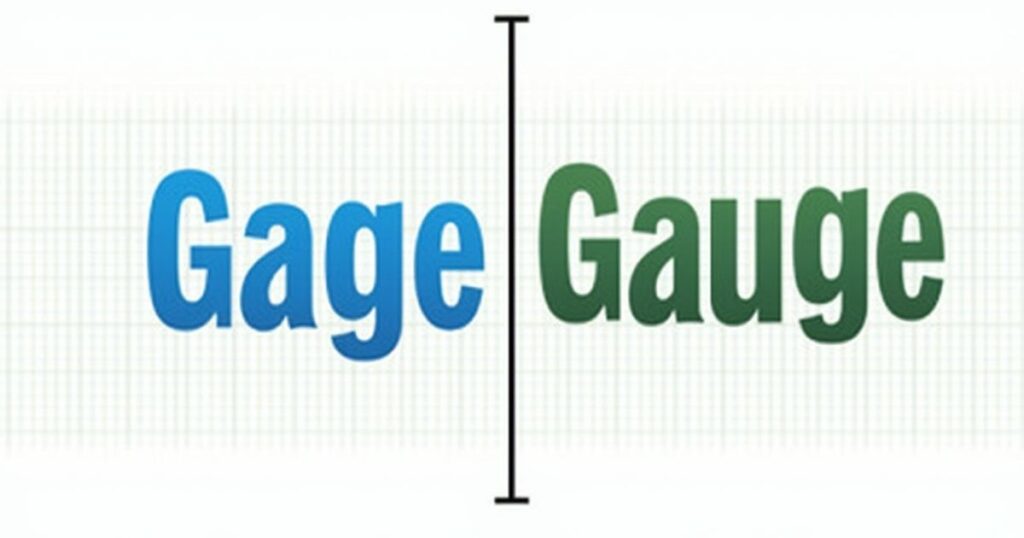
Here’s where it gets interesting. “Gage” is a legitimate English word just not the one you want for measuring interest.
“Gage” Means:
- A pledge or security deposit
- A challenge (as in “throw down the gage”)
- A type of plum (greengage)
- Sometimes used as a proper name
“Gauge” Is Used For:
- All measurement activities
- Assessing or evaluating
- Measuring tools and instruments
- Gauging emotional response or feedback
The gauge vs gage difference becomes crystal clear in context. Medieval knights threw down a gage as a challenge to duel. Modern professionals gauge interest using surveys and analytics tools.
Memory trick: Gauge has a “u” for “useful measurement.”
The Archaic Use of “Gage” in Modern English
Historical language usage shows “gage” dominated medieval and Renaissance texts. Shakespeare used “gage” meaning pledge or wager. Chaucer employed it in Canterbury Tales for similar contexts.
Literary example: “He offered his sword as a gage of loyalty.”
This archaic English term rarely appears in modern writing. Historical texts maintain original spellings. Contemporary writers should stick with “gauge” for measurement-related contexts though.
Contextual Examples to Distinguish Between the Two
Business Scenarios:
- ✅ “The marketing team is gauging interest in new product features.”
- ✅ “We need to gauge stakeholder enthusiasm before proceeding.”
- ✅ “Analytics help companies measure interest across demographics.”
Everyday Situations:
- ✅ “She’s gauging his interest in a second date.”
- ✅ “Teachers gauge student understanding through formative assessment.”
- ✅ “I’m trying to assess interest in our summer trip.”
Technical Contexts:
- ✅ “Engineers use specialized gauge tools to measure pressure.”
- ✅ “The fuel gauge indicated low levels.”
Incorrect Usage (Avoid These):
- ❌ “We’re gaging interest in the proposal.”
- ❌ “The pressure gag showed critical readings.”
- ❌ “He’s gaging whether to invest.”
Professionals’ Stance on Using “Gage” in Writing
Editors mark “gaging” as an error without exception. Publishing industry standards demand correct word choice for credibility maintenance.
A senior editor at a major publishing house notes: “Using ‘gaging’ in professional documents immediately signals amateur work. It’s among the top spelling errors we catch.”
Corporate communication guidelines from Fortune 500 companies explicitly require “gauge” spelling. Legal professionals emphasize precision writing clarity depends on correct terminology. Academic institutions penalize “gaging” in formal papers.
The impact? Reader perception studies show spelling errors reduce author credibility by 40%. Professional communication demands accuracy.
Practical Applications: How to Gauge Interest Effectively

Understanding correct spelling gauging is just the beginning. Let’s explore proven methods for measuring enthusiasm and evaluating responses effectively.
Methods to Gauge Interest:
1. Surveys and Questionnaires
- Google Forms and SurveyMonkey offer free analytics for gauging interest
- Open-ended questions reveal deeper insights than yes/no responses
- Track completion rates they indicate genuine engagement
2. Social Media Engagement Metrics
- Likes, shares, and comments measure public opinion instantly
- Time spent on posts indicates audience engagement measurement
- Social media engagement provides real-time feedback loops
3. Focus Groups
- Focus group evaluation captures nuanced reactions
- Probing responses through moderated discussions
- Small group dynamics reveal hidden concerns
4. Direct Conversations
- Active listening uncovers unspoken reservations
- Body language provides gauging emotional response clues
- Follow-up questions deepen understanding
5. Data Analytics
- Website traffic patterns show determining audience interest levels
- Conversion rates indicate genuine enthusiasm
- A/B testing reveals preference patterns
Enhancing Your Vocabulary: Synonyms for Gauging Interest
Variety strengthens writing. Here are powerful alternatives:
Professional Alternatives:
- Assessing interest (formal meetings)
- Measuring enthusiasm (market research)
- Evaluating curiosity (academic contexts)
- Testing reactions (product launches)
- Analyzing audience behavior (marketing campaigns)
Casual Options:
- Feeling out the situation
- Taking the temperature
- Checking in on enthusiasm
- Seeing if there’s buzz
Context Matters:
| Situation | Best Synonym | Example |
|---|---|---|
| Sales meeting | Qualifying leads | “Qualifying leads before the pitch” |
| Education | Checking understanding | “Checking understanding through questions” |
| Relationships | Reading signals | “Reading signals about commitment” |
FAQs
Is “gaging interest” ever correct?
No. “Gaging is incorrect” for measurement contexts. The correct term gauging interest applies universally in modern English. Only archaic texts might use “gaging” as a conjugation of the pledge-related “gage.”
Why does spell-check accept “gaging”?
Because “gaging” is technically valid as conjugation of “gage” (pledge). Context-aware tools sometimes miss this commonly confused words error. Use grammar checkers like Grammarly alongside basic spell-check.
How do I remember the correct spelling?
Gauge has “u” for useful measurement. Picture a fuel gauge in your car. That “u” helps you avoid spelling confusion permanently.
What does “gauging interest” actually mean?
Gauging interest definition: measuring someone’s level of curiosity, enthusiasm, or willingness to engage with an idea, product, person, or opportunity through various assessment methods.
Do British and American spellings differ?
No. Both American English gauge spelling and gauge spelling in British English use “gauge” identically. Unlike “colour/color,” this word maintains universal spelling.
Can I use “gaging” informally?
Absolutely not. Formality doesn’t change grammar rules gauge vs gage. Avoid spelling errors regardless of audience. Professional credibility matters everywhere.
Conclusion
The verdict is definitive: “gauging interest” is always correct. “Gaging” misleads readers and undermines your professional credibility.
Remember these key takeaways:
- Gauge = measure, assess, evaluate
- Gage = pledge, challenge (archaic)
- Gauging interest meaning = measuring enthusiasm or curiosity
- All major dictionaries confirm correct English usage gauge
Implementing proper spelling immediately elevates your writing clarity and professional communication standards. The language nuances might seem trivial. They signal attention to detail though.
Master this distinction today. Your readers will notice. Your credibility will soar. And you’ll never hesitate over that keyboard again.
Share this guide with colleagues who might appreciate linguistic correctness. Bookmark it for quick reference. Measuring interest correctly starts with spelling it correctly.
Now go forth and gauge away with confidence.

Flairsy is the word expert behind Englishfixerr.com, helping readers find the perfect synonyms and simple word choices. With a love for clarity and creativity, Flairsy makes English easy and stylish. From tricky terms to everyday phrases, he turns confusion into confidence.