
Ever scrolled through your messages and stumbled upon “TS”? Maybe someone texted it after you shared bad news. Perhaps you felt confused or even insulted. You’re not alone. Digital communication moves fast, and texting abbreviations pop up constantly. Understanding what TS means in text isn’t just about decoding two letters. It’s about navigating modern online etiquette, protecting relationships, and communicating with emotional intelligence.
This guide breaks down the TS meaning in text across platforms like Instagram, TikTok, and everyday messaging. You’ll discover when it’s appropriate, why it can sting, and most importantly 15 refined alternatives that sound better. Whether you’re Gen Z fluent in internet slang or someone trying to decode your teen’s messages, you’ll leave knowing exactly how to handle this trending text acronym 2025.
1. The Core Meaning of “TS” in Text
Primary Definition
Let’s get straight to it. TS typically stands for “Tough Sh*t.” Sometimes people also use it for “That’s Stupid,” though the first meaning dominates. When someone types TS, they’re usually expressing indifference to your problem. It’s their way of saying “deal with it” or “I don’t care about your complaint.”
The TS abbreviation meaning emerged from early 2000s internet forums where character limits mattered. People wanted speed. Full sentences felt excessive when two letters could convey dismissal instantly. Platforms like AIM and early texting on flip phones accelerated this trend. Fast forward to 2025, and TS slang persists across WhatsApp, Snapchat, Instagram DMs, and TikTok comments.
Variations and Secondary Meanings
Here’s where things get interesting. TS full form changes depending on context:
| TS Meaning | Context | Example |
|---|---|---|
| Tough Sh*t | Casual dismissal | “Didn’t get tickets? TS, better luck next time.” |
| That’s Stupid | Disagreement | “Your plan sounds risky. TS honestly.” |
| Taylor Swift | Fandom discussions | “New TS album drops Friday!” |
| TypeScript | Coding conversations | “I’m debugging this TS error.” |
| Transsexual | LGBTQ+ discussions | “TS rights matter deeply.” |
Digital communication demands you read surrounding messages carefully. A software developer mentioning TS likely references TypeScript, not dismissing you. Taylor Swift fans flood comment sections with TS praise. Understanding context in communication prevents awkward misinterpretations.
2. Is “TS” Always Offensive or Rude?
Analyzing the Tone Spectrum
Not necessarily but usually, yes. The meaning of TS in messages carries inherent dismissiveness. When someone responds “TS” to your disappointment, they’re showing lack of sympathy. That stings regardless of intent. However, close friends sometimes use it playfully, like inside jokes where both parties understand no harm’s meant.
Relationship dynamics determine everything. Your best friend saying “TS, you’ll survive!” after you burnt toast? Probably teasing. A colleague responding “TS” when you mention project delays? That’s unprofessional and potentially offensive. The same two letters shift meaning based on who’s typing and your history together.
When Context Flips the Script
Consider these scenarios:
- Close friends venting: “My date canceled.” “TS man, their loss!” (Playful support)
- Workplace setting: “I missed the deadline.” “TS.” (Completely inappropriate)
- Family dynamics: Your sibling uses TS after you complain about chores (Annoying but familiar territory)
Tone awareness separates friendly vs rude texting tone. If someone’s already upset and you hit them with TS, you’re pouring gasoline on frustration. Emotional states amplify perceived rudeness tenfold in text messaging.
3. When Is It Appropriate to Use “TS”?
Acceptable Scenarios (Rare)
Honestly? Almost never. But if we’re splitting hairs, here are the only situations where TS might slide:
- Extremely close friendships with established sarcastic banter
- Self-aware humor where everyone’s joking about minor inconveniences
- Venting sessions where mutual understanding exists (“First world problems, TS!”)
- Quoting someone else to discuss the phrase itself (like this article)
Even then, tread carefully. Texting etiquette evolves, and what seemed funny yesterday might land poorly today.
Red Flag Situations
Never use TS in these contexts:
- Workplace communication (Slack, Teams, emails, ever)
- First conversations with new acquaintances
- Sensitive topics involving genuine hardship
- Arguments where emotions already run high
- Professional networking on LinkedIn
- Customer service interactions
Your digital footprint follows you. Screenshots live forever. Employers scan social media during hiring. One thoughtless TS could haunt your reputation long-term.
4. Professional Alternatives to “TS”
Workplace-Appropriate Phrases
Professional communication demands diplomacy. Replace TS with phrases that acknowledge concerns while maintaining boundaries:
- “I understand your concern, though I see it differently.”
- “That perspective doesn’t align with our current objectives.”
- “Let’s explore alternative approaches together.”
- “I appreciate your input let me offer another angle.”
These alternatives practice emotional intelligence in texting by validating the other person before redirecting. The formula works: acknowledge + pivot + solution.
| Instead of TS | Say This | Why It Works |
|---|---|---|
| TS | “I hear your frustration.” | Shows empathy |
| TS | “Let’s revisit this with fresh eyes.” | Offers constructive path forward |
| TS | “That’s challenging—here’s what we can control.” | Focuses on solutions |
Email and Client-Facing Communications
When writing workplace emails, structure matters enormously. Try the sandwich method: positive observation + concern + positive closing. For example:
“I appreciate you raising this issue. While I see challenges with the current timeline, I’m confident we can adjust our approach. Let’s schedule a call to brainstorm solutions together.”
This replaces dismissal with collaboration. Your professional texting alternatives should always invite dialogue rather than shutting conversations down.
5. Polite Ways to Say “TS” Without Being Rude
Gentle Disagreement Phrases
Empathetic responses transform potentially harsh moments into connection opportunities. Try these polite alternatives to TS:
- “That sounds really frustrating for you.”
- “I can see why you’re disappointed.”
- “That’s definitely not ideal hang in there.”
- “I understand why that’s upsetting.”
- “What a bummer I’m sorry that happened.”
Notice the pattern? Each validates feelings before offering perspective. Emotional intelligence recognizes people need acknowledgment before solutions.
Setting Boundaries Kindly
Sometimes you genuinely can’t help. That’s okay. Respectful communication examples include:
- “I’m not able to help with that, unfortunately.”
- “That’s outside my comfort zone right now.”
- “I need to respectfully decline this time.”
You maintain boundaries without wielding TS like a weapon. Replacing rude phrases online starts with recognizing your power to choose kinder words.
6. Casual Alternatives: Keeping It Light
Friendly Texting Substitutes
Want to keep things casual without sounding cold? These phrases nail that sweet spot:
- “Not my vibe” (dismisses without judgment)
- “Hard pass” (clear but playful)
- “Meh, not feeling it” (honest and relaxed)
- “Gonna skip that one” (decisive but friendly)
- “That’s a no from me, dawg” (pop culture reference adds humor)
Gen Z texting culture favors phrases that convey personality. These alternatives feel authentic rather than robotic.
Emoji and GIF Responses
Sometimes visuals communicate better than words. The shrugging emoji 🤷 paired with “welp” conveys mild sympathy without overthinking. A well-chosen GIF maybe someone sipping tea or a character shrugging adds light-hearted tone to potentially awkward moments.
7. Sarcastic Alternatives: Playfully Dismissive
Humor-Based Responses
Sarcastic text replies require established rapport. Use these only with friends who “get” you:
- “Sure, Jan” (Mean Girls reference for obvious lies)
- “Tell me more” (dripping with irony)
- “Fascinating take” (obviously disagreeing)
- “Cry me a river” (classic dismissive phrase)
- “Life’s tough, wear a helmet” (humorous tough love)
Add tone indicators like /s if you’re remotely uncertain your sarcasm will land properly. Texting tone examples show how easily sarcasm backfires without vocal cues.
Risk Assessment Matters
Sarcastic alternatives walk a tightrope. What feels playful between you and your college roommate might devastate someone else. Consider their current emotional state, your relationship history, and whether they typically appreciate witty replies. When in doubt, choose warmth over cleverness.
Read This Post: WSP Mean in Texting? Decoding This Popular Acronym
8. Tone Matters: Why Context Is Everything
The Digital Communication Challenge
Text lacks everything that makes communication clear: facial expressions, vocal inflection, body language, timing. You’re essentially communicating blindfolded. Research shows 70% of communication is nonverbal. Strip that away and misinterpretation skyrockets.
The TS meaning in chat transforms based on invisible factors. Late-night texts read harsher than daytime messages. Stress amplifies perceived rudeness. Someone already having a terrible day interprets TS as genuine cruelty rather than casual dismissal.
Platform-Specific Conventions
Different platforms carry different expectations:
| Platform | Tone Expectation | TS Appropriateness |
|---|---|---|
| Instagram DM | Casual, visual | Risky unless very close |
| Professional, formal | Never acceptable | |
| Snapchat | Playful, temporary | Slightly more forgiving |
| Personal, conversational | Context-dependent | |
| Formal, documented | Absolutely never |
Understanding social media communication norms prevents foot-in-mouth moments across platforms.
9. Gender and Cultural Sensitivity
Gendered Communication Patterns
Research reveals women face harsher judgment for direct communication. A man saying TS might get labeled “efficient” while a woman using identical language gets called “aggressive” or “rude.” These double standards persist in workplace communication especially.
Gender sensitivity in texting means recognizing these biases exist and choosing language that doesn’t reinforce them. Regardless of your gender, opt for phrases that sound collaborative rather than dismissive.
Cultural Background Considerations
Different cultures approach directness radically differently. Northeast Americans often communicate bluntly compared to Southern states where politeness rules supreme. Immigrant communities navigate American texting language while balancing cultural communication styles from their backgrounds.
When chatting with someone from a different cultural context, lean toward more formal language initially. Let them set the tone before matching their casualness level.
10. Texting Etiquette: Replacing “TS” on Social Media or Apps
TS Meaning on Instagram
On Instagram, TS meaning in text Instagram contexts usually appears in:
- Story replies where someone dismisses your complaint
- DM conversations during disagreements
- Comment sections under controversial posts
Better Instagram alternatives include thoughtful replies like “That’s tough sending good vibes” or simply ❤️ reactions showing support without empty platitudes.
What Does TS Mean on TikTok
TS meaning on TikTok gets complicated because Taylor Swift fans dominate the acronym. But in comment sections on non-Swiftie content, TS occasionally surfaces as dismissive shorthand.
Trending text acronyms 2025 on TikTok favor creativity over harshness. Instead of TS, users might comment “not it” or “this ain’t the one” with skull emojis 💀 to convey similar energy more playfully.
11. How to Choose the Best Alternative: A Quick Guide
The Three-Question Method
Before responding, ask yourself:
- What’s my relationship with this person? (Close friend? Professional contact? Acquaintance?)
- What outcome do I want? (End conversation? Maintain connection? Set boundary?)
- How might this read without my tone? (Could this offend? Confuse? Hurt?)
This quick mental check prevents regrettable messages. Emotional intelligence texting guide principles remind us to pause before hitting send.
When in Doubt Rules
- Default to slightly more formal than necessary
- Ask clarifying questions instead of assuming
- Use complete sentences for complex topics
- Sleep on responses to emotionally charged messages
12. Common Misinterpretations of “TS”
Technical Confusion
Developers discussing TypeScript get confused when someone assumes TS means “tough sh*t.” Taylor Swift fans defending their icon wonder why anyone’s attacking. Transsexual individuals in LGBTQ+ spaces use TS as identity shorthand completely different context.
Multiple meanings of TS demand you check context clues: surrounding conversation topics, the person’s interests, platform conventions. When uncertain, simply ask “What does TS mean here?” rather than assuming.
Autocorrect Disasters
Predictive text creates hilarious (or mortifying) mistakes. Someone typing “yes” might accidentally send “TS” depending on their phone’s learning patterns. Always double-check messages before sending, especially important professional texts.
13. Why Replacing “TS” Is Often a Better Choice
Relationship Preservation
Small language choices accumulate. Use TS habitually and people start perceiving you as cold, dismissive, or lacking empathy. Replace it with thoughtful alternatives and you’re suddenly the friend who really listens.
Research on communication tone awareness shows relationships thrive when both parties feel heard. TS does the opposite it slams doors instead of opening windows.
Professional Reputation Management
Your digital footprint shapes career opportunities. Employers screen candidates’ social media. One thoughtless TS screenshot could tank an interview. Professional reputation requires consistency between private texts and public image.
LinkedIn posts demand polish, sure. But your Instagram DMs and WhatsApp groups? Those matter too. Colleagues screenshot disrespectful messages. Word spreads. Protect yourself by choosing refined communication everywhere.
14. Emotional Intelligence in Communication
Reading the Digital Room
Emotional intelligence means noticing subtle cues: response delays indicating stress, short replies signaling disengagement, excessive emojis covering hurt feelings. When you sense someone’s struggling, TS becomes particularly cruel.
Empathy in text requires imagination. Picture receiving your message when you’re already overwhelmed. Would it help or hurt? That mental exercise transforms communication quality instantly.
Growth Through Mindful Communication
Track your messaging patterns. Do you default to dismissiveness under stress? Notice triggers prompting TS impulses. Growth happens when you pause, breathe, and choose constructive responses instead.
15. TS Meaning in Text From a Girl
Avoiding Gender Stereotypes
Searching “TS meaning from a girl” reveals problematic assumptions about gendered communication patterns. Women don’t have special secret meanings for TS. Context matters infinitely more than gender.
If a girl texts you TS, consider: your relationship status, her typical communication style, surrounding conversation context. Same analysis you’d apply to anyone else.
Dating Context Considerations
In early dating stages, TS signals potential incompatibility. Someone dismissing your feelings this early? Red flag. Close attention to communication tone reveals character quickly.
Established relationship? Maybe she’s teasing playfully. But if TS becomes her go-to during disagreements, address it directly: “When you say TS, I feel dismissed. Can we find better ways to communicate?”
16. 15 Refined Sayings or Reply Examples Instead of “TS”
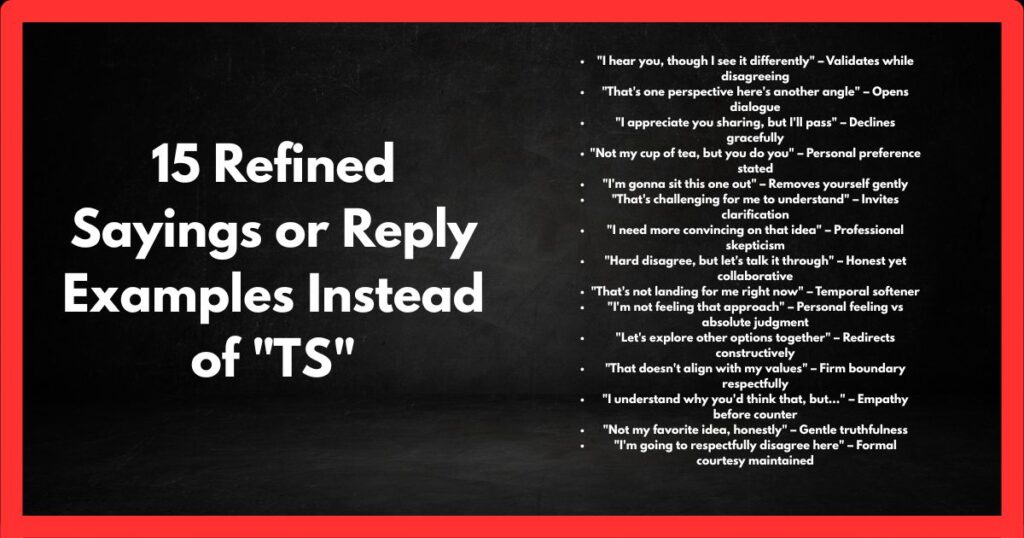
Ready for practical alternatives? Here are 15 polite ways to express indifference without sounding harsh:
- “I hear you, though I see it differently” – Validates while disagreeing
- “That’s one perspective here’s another angle” – Opens dialogue
- “I appreciate you sharing, but I’ll pass” – Declines gracefully
- “Not my cup of tea, but you do you” – Personal preference stated
- “I’m gonna sit this one out” – Removes yourself gently
- “That’s challenging for me to understand” – Invites clarification
- “I need more convincing on that idea” – Professional skepticism
- “Hard disagree, but let’s talk it through” – Honest yet collaborative
- “That’s not landing for me right now” – Temporal softener
- “I’m not feeling that approach” – Personal feeling vs absolute judgment
- “Let’s explore other options together” – Redirects constructively
- “That doesn’t align with my values” – Firm boundary respectfully
- “I understand why you’d think that, but…” – Empathy before counter
- “Not my favorite idea, honestly” – Gentle truthfulness
- “I’m going to respectfully disagree here” – Formal courtesy maintained
Each phrase accomplishes what TS attempts expressing disagreement or disinterest without emotional damage.
Conclusion: Say It Better Than “TS”
Digital communication in 2025 demands more than speed. It requires emotional intelligence, cultural awareness, and genuine care for how our words land. Understanding what TS means in text matters less than recognizing why better alternatives exist.
Every message shapes relationships. Choose dismissiveness and connections fray. Choose empathetic responses and relationships deepen. It’s genuinely that simple and that profound.
This week, challenge yourself: replace every TS impulse with something kinder. Notice how conversations shift. Watch relationships strengthen. Your words create your world. Make them count.
What’s your favorite alternative to TS? Share in the comments let’s build a collection of respectful communication examples together.

Flairsy is the word expert behind Englishfixerr.com, helping readers find the perfect synonyms and simple word choices. With a love for clarity and creativity, Flairsy makes English easy and stylish. From tricky terms to everyday phrases, he turns confusion into confidence.